


B2B teams are starting to test AI agents alongside traditional contact databases and, in some cases, replace parts of the static list-building workflow. Instead of exporting a fixed list and treating it as current, an agent can research, refresh and rank prospects when a query or signal triggers the process.
The shift is real, but it is not a replacement for judgement, strategy or the sales relationship itself. Here is what is changing, what is not, and how to think about it for your own pipeline.
Key takeaways
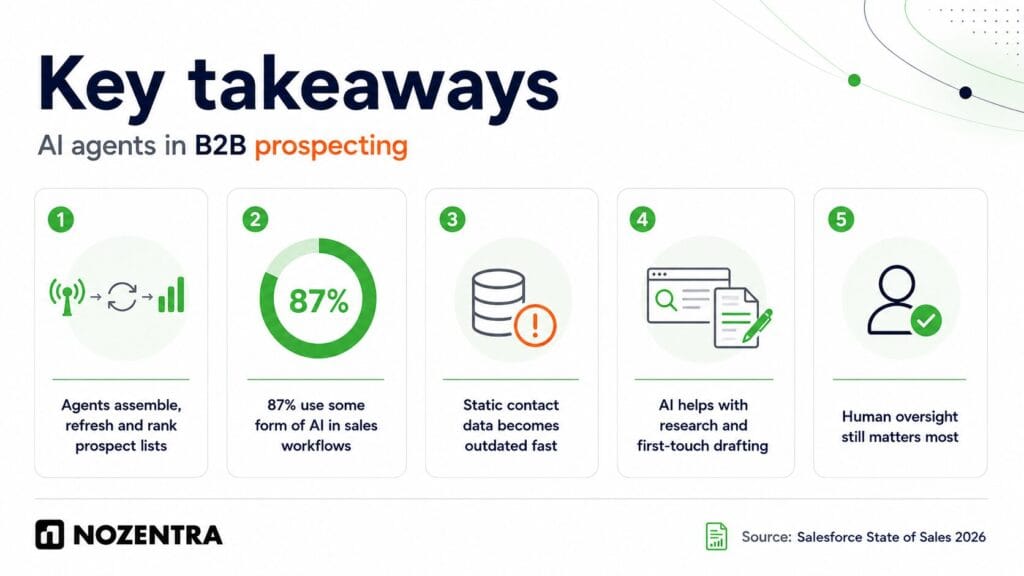
- AI agents can assemble, refresh and rank prospect lists when a workflow runs.
- Salesforce’s 2026 State of Sales report found that 87% of sales organisations use some form of AI for prospecting, forecasting, scoring or drafting.
- Static contact data still becomes outdated as people change jobs, responsibilities and companies.
- AI handles mechanical research and first-touch drafting well. It handles judgement, timing and relationship nuance less reliably.
- The practical model is to use agents to support experienced people rather than remove human oversight.
The shift from stored data to query-time assembly
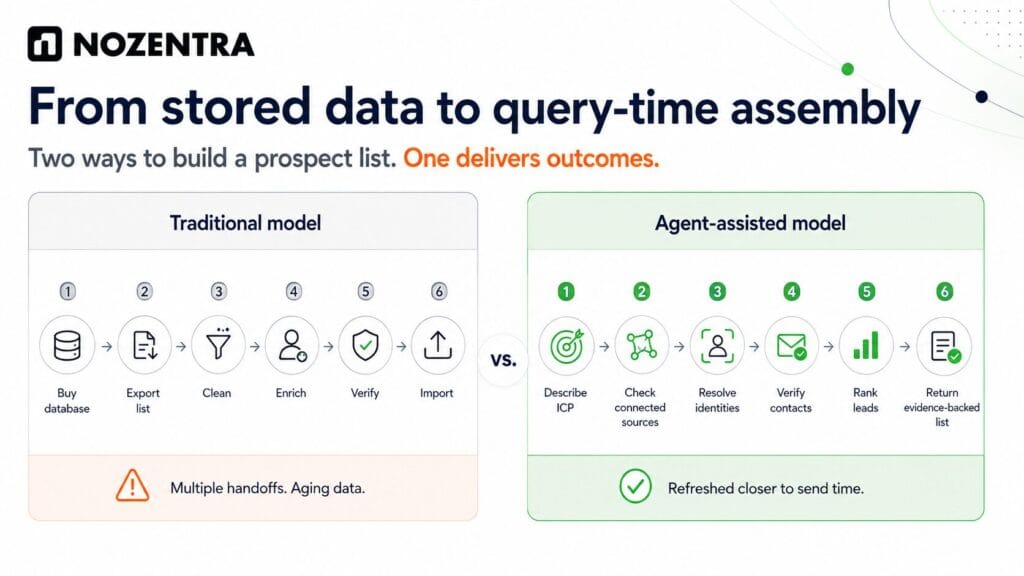
The traditional model
Buy a database, export a list, clean it, enrich it, verify emails and import it into your sequencer. Each step creates another handoff, while some of the underlying information may already be changing.
The agent-assisted model
Describe your ideal lead in plain language. For example, heads of revenue operations at US SaaS companies with 100 to 500 employees that recently moved to usage-based pricing.
An agent can break that description into conditions, check connected sources, resolve identities, verify available contact details and return a ranked list with evidence supporting each match.
That evidence may come from CRM history, previous emails, company websites, hiring pages and third-party data providers. Salesforce’s explanation of AI-assisted prospecting shows how agents can work across connected sales and customer data rather than relying only on live public sources.
The advantage is not that stored data disappears or that the workflow automatically becomes cheaper. It is that teams can refresh and evaluate prospect information closer to the moment it is needed.
The role can then shift from list-builder to judgement-maker, with teams deciding who to pursue and what to say rather than spending time repairing a spreadsheet.
Why the database model has been breaking down
There is no single annual decay rate that applies to every B2B database. Accuracy depends on the market, the type of information collected and how often the provider refreshes it.
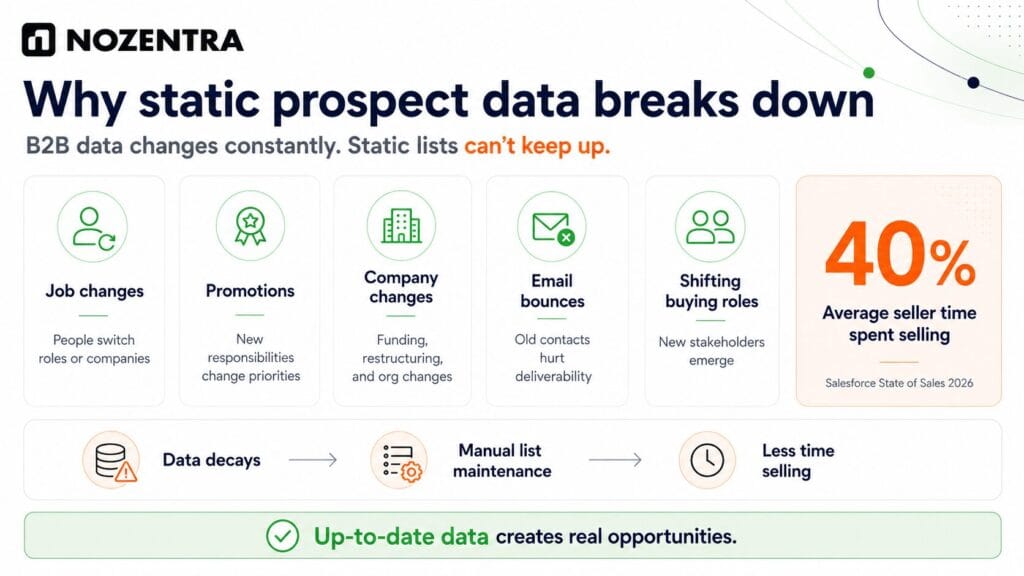
The underlying problem is straightforward. People change jobs, get promoted and move between companies. Businesses restructure, reduce headcount and shift buying responsibilities between departments.
A record can remain inside a database while becoming commercially useless. The contact may have left months ago, the email may bounce or the job title may no longer reflect the buying role. Dun & Bradstreet’s contact data management guidance explains why business contact data needs ongoing maintenance to remain useful.
The workflow built on top inherits that weakness: filter, export, clean, enrich, verify, import and sequence.
Salesforce’s 2026 research found that the average seller spends 40% of their time selling. The rest is spread across prospecting, administration, data entry, enablement and other work. This helps explain why teams are looking for ways to reduce repetitive research and list maintenance.
What the adoption numbers actually show
Salesforce’s 2026 State of Sales report, based on a double-anonymous survey of 4,050 sales professionals across 22 countries, found that 87% of sales organisations use some form of AI for prospecting, forecasting, lead scoring or email drafting.
The report also found that:
- 54% of sellers have used AI agents.
- Nearly nine in ten plan to use them by 2027.
- High-performing sellers are 1.7 times more likely to use prospecting agents than underperformers.
- Sellers expect agents to reduce prospect research time by 34%.
- Sellers expect agents to reduce email drafting time by 36%.
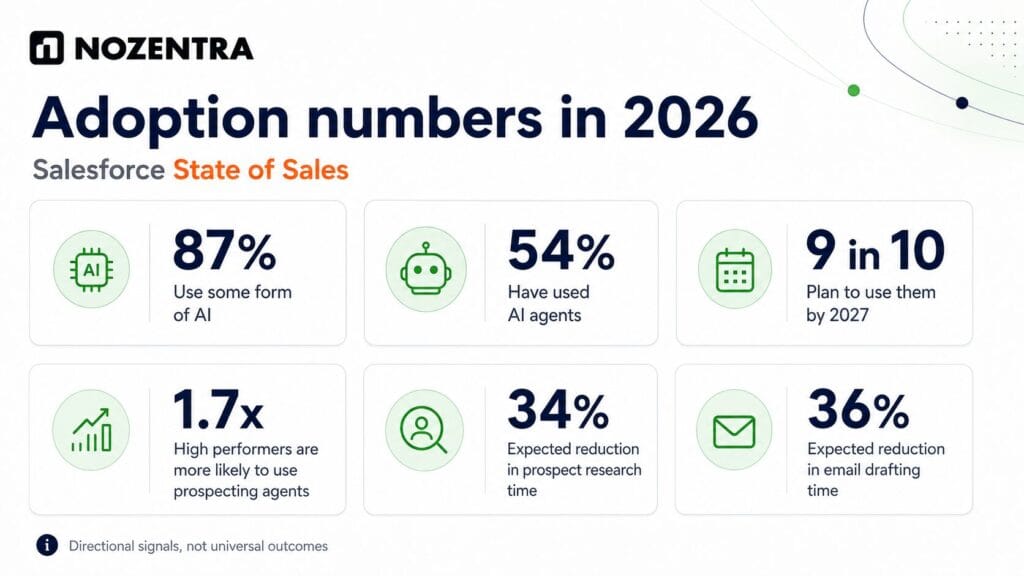
These figures need careful interpretation. The 87% figure includes several forms of AI use and does not mean that 87% of sales teams run autonomous prospecting agents.
The projected time savings are also seller expectations, not independently measured outcomes. The report shows strong momentum, but the percentages should be treated as directional rather than universal.
Where AI agents genuinely help, and where they do not
Where they help
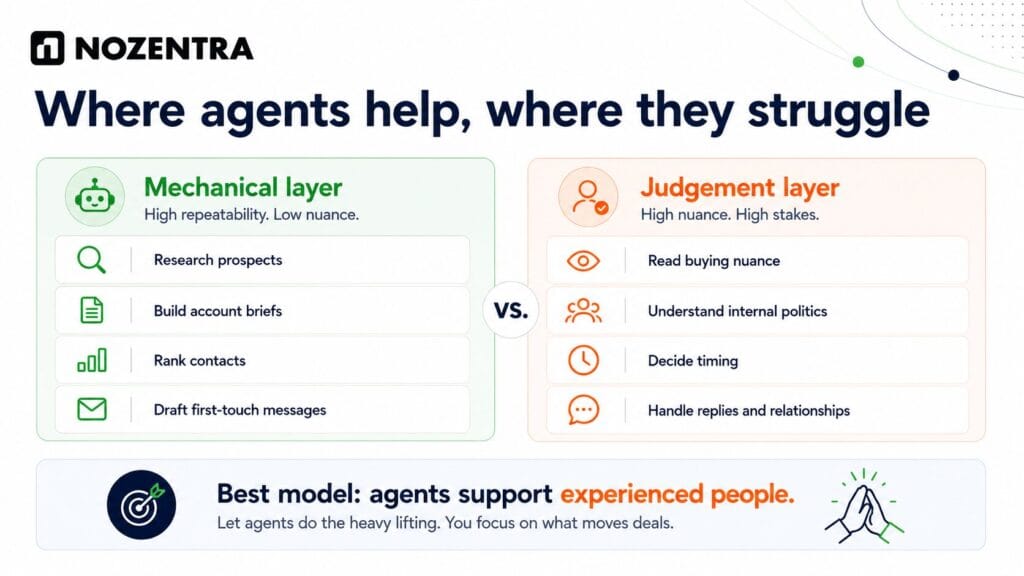
Agents are strong at the mechanical layer:
- Researching a prospect across connected sources
- Building an initial account brief
- Ranking contacts against an ideal customer profile
- Drafting a first-touch message
- Routing leads using defined signals
This fits naturally with behaviour-triggered email campaigns, where outreach responds to meaningful actions rather than following only a fixed sending schedule.
Where they struggle
Agents are weaker at the judgement layer, including understanding internal politics, reading the subtext in a reply and deciding when to push or wait.
Forrester’s analysis of agentic prospecting warns that buying signals can be weak, ambiguous or contradictory. Website activity, hiring changes and content consumption may indicate interest, but they do not always prove purchase intent.
Practitioner analysis from Human Agency on AI agents in B2B lead generation points to three common failure modes: poor data quality, weak governance and generic personalisation.
Human Agency provides AI lead-generation services, so its observations should be treated as practitioner experience rather than independent research.
Implementation: how to test this without overhauling your stack
Run a controlled parallel test instead of switching everything at once.
1. Choose difficult ICP segments
Take several active ideal customer profile definitions that currently require substantial research or manual cleaning.
2. Run both workflows
Process the same ICP definitions through your existing database workflow and an agent-assisted workflow.
3. Review the output
Check company fit, job titles, email validity, supporting evidence and message quality before allowing any outreach.
4. Measure quality and outcomes
Compare:
- Valid contact rate
- Bounce rate
- Incorrect ICP matches
- Positive reply rate
- Qualified meetings
- Research time per accepted contact
- Cost per qualified opportunity
- Percentage of agent output requiring correction
- Opt-outs and spam complaints
Nozentra’s guide to measuring B2B lead quality and ROI follows the same principle: judge lead generation by quality and commercial outcomes, not list size alone.
5. Keep human approval and compliance controls
Before an agent sends messages, confirm where the contact data came from, when the email was verified, whether the person has opted out and which actions require human approval.
The business remains responsible for privacy, direct marketing and deliverability, even when software handles the workflow.
6. Re-evaluate at renewal
Keep the existing database where broad market coverage and account mapping matter. Use the agent workflow where refreshed research and signal-based prioritisation add value.
At renewal, use the test results to decide whether to reduce seats, change providers, combine the two approaches or keep the current setup.
Nozentra’s view
We treat this the way we treat most AI-adjacent shifts: useful where it removes genuinely mechanical work, but risky where it is used to fake a relationship that is not there.
B2B buyers remember irrelevant automated outreach. An agent that helps a rep show up faster with better research is a real advantage.
An agent that sends outreach without proper data checks, sending controls or human review can damage a list, a brand and a domain’s reputation at the same time.
FAQs
Will AI agents replace SDRs (Sales Development Representatives) entirely?
The available evidence does not answer the long-term headcount question. Current use is focused on expanding research, prioritisation and drafting capacity. Complex qualification, relationship-building and closing still require human involvement.
Is it worth dropping a contact database subscription completely?
Not immediately for most teams. Test agent-assisted prospecting on difficult or signal-driven segments while keeping the database for broader market coverage. Make the final decision using accuracy, pipeline quality, cost and time saved.
What is the biggest risk in adopting AI agents for outreach?
The combination of poor data and weak governance. An agent can scale incorrect targeting, inaccurate personalisation and excessive sending much faster than a manual process.