


AI shopping agents are already placing real orders, though the scale and reliability of that shift is less settled than the marketing headlines suggest. Google’s Universal Commerce Protocol is rolling out through the AI Mode search experience and the Gemini app this summer for eligible US retailers, letting shoppers research and check out without leaving the AI conversation. OpenAI’s competing Agentic Commerce Protocol, launched with Shopify in September 2025, has seen far more modest merchant adoption than originally announced. Both point to the same underlying question for any store owner: can an AI agent actually find, understand, and buy your products, or does your store only work for a human clicking through pages in order?
Key Takeaways
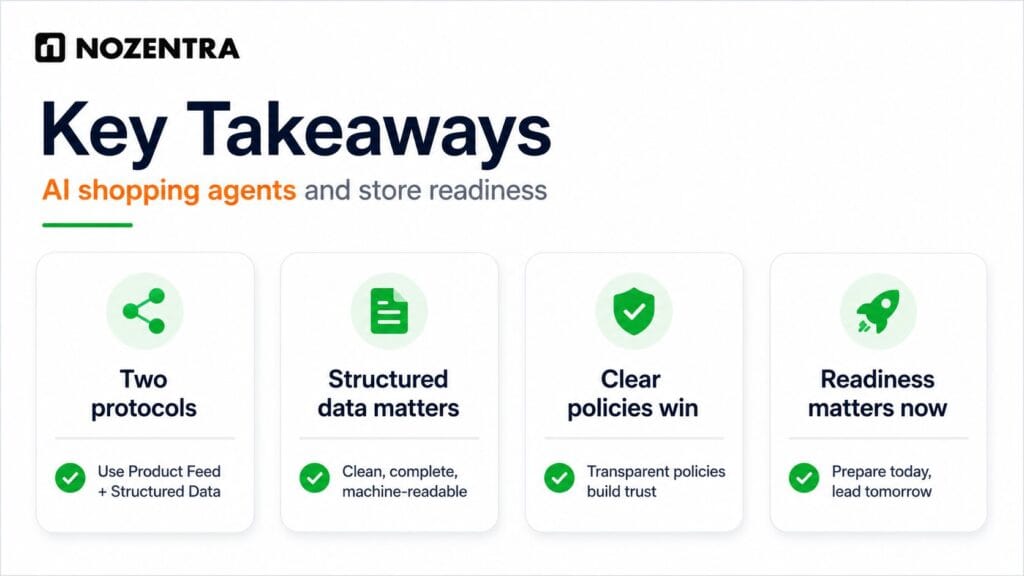
- Two competing standards are emerging: Google’s Universal Commerce Protocol and OpenAI’s Agentic Commerce Protocol, both still maturing.
- Structured, accurate product data now matters more to an AI agent than persuasive page copy.
- Checkout, shipping terms, and return policies need to be machine-readable and consistent, not just visible to a human.
- Early adoption has been slower and messier than the initial announcements suggested, so readiness work is worth doing without treating any single protocol as final.
Why the Shopping Journey Is Changing
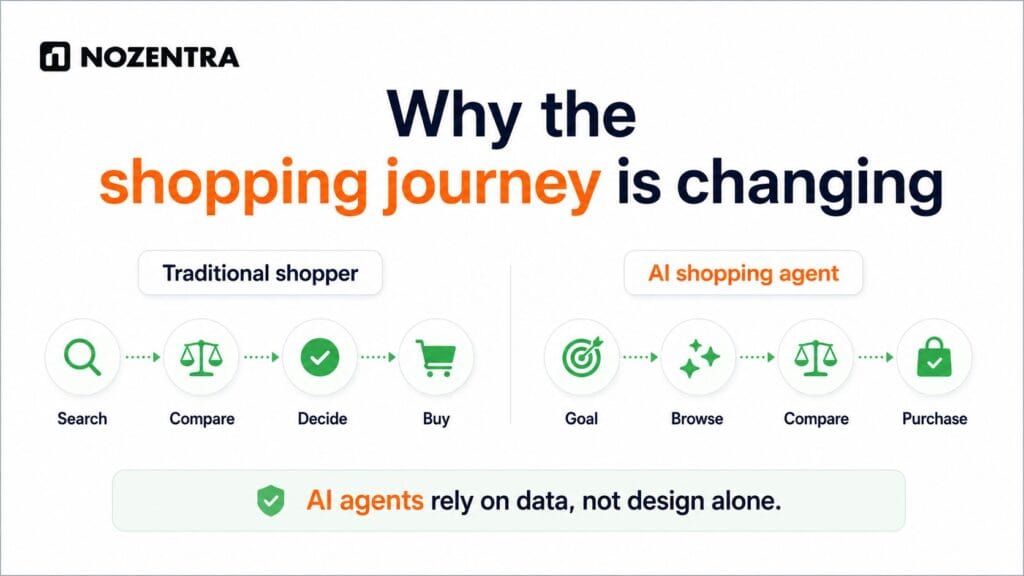
A traditional shopper searches, clicks, compares, and decides. An AI shopping agent compresses that into one exchange: it is given a goal and constraints, then goes out to browse, compare, and sometimes complete a purchase on the shopper’s behalf. When that happens, the agent does not read your homepage the way a person does. It evaluates a product feed, a set of structured attributes, and whatever schema markup your pages expose. If that data is thin, inconsistent, or missing, the agent has no reliable way to recommend your product over a competitor’s, no matter how good your site looks to a human visitor.
Two Protocols, One Underlying Requirement
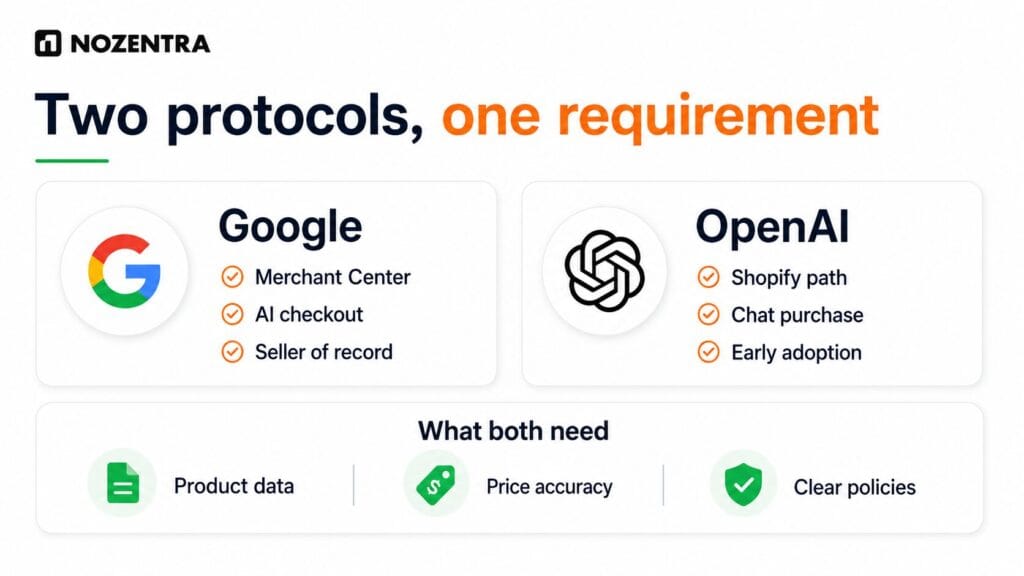
Google’s protocol is built around Merchant Center product feeds and lets eligible retailers activate checkout directly inside Google’s AI surfaces, with the retailer remaining the seller of record. OpenAI’s protocol works through Shopify integrations and lets a shopper complete a purchase inside a ChatGPT conversation. The two are not interchangeable, and neither has reached the scale its announcement implied. What both require, regardless of which one wins more adoption, is the same foundation: complete product data, consistent pricing and availability, and policies an agent can parse without ambiguity.
Why Humans Tolerate Ambiguity and AI Agents Do Not
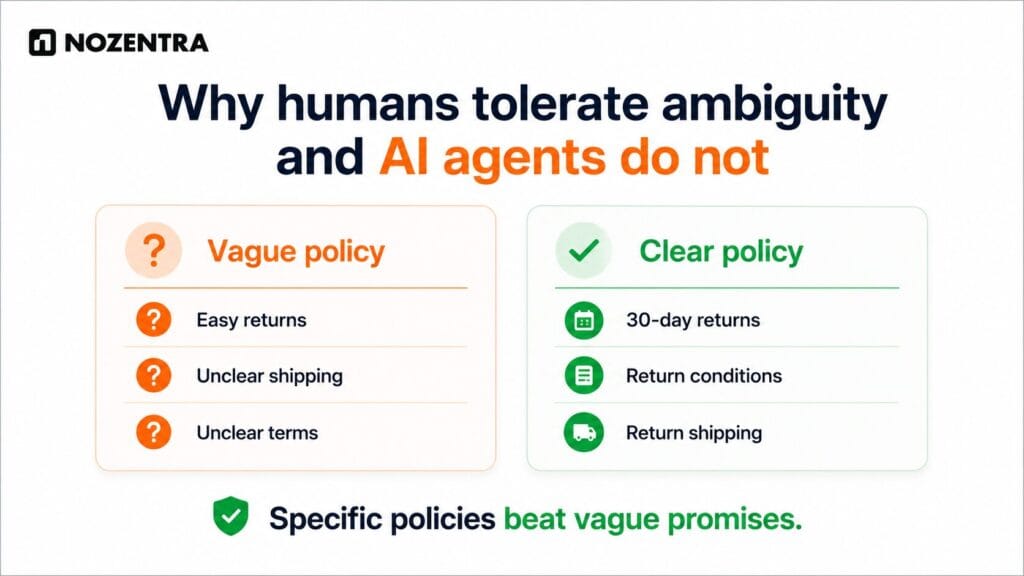
A human shopper reading a vague shipping estimate or an inconsistent return policy will usually keep browsing anyway, or contact support. An AI agent comparing dozens of offers in seconds treats that same ambiguity as a reason to skip your listing entirely, because it cannot resolve the uncertainty the way a person can. This means the messy middle of eCommerce, checkout terms, shipping windows, and tax handling, matters more for agent visibility than for human conversion in the short term.
Picture two competing stores selling a similar product. One lists a return window as “easy returns” somewhere in the footer. The other states a specific number of days, the condition items must be in, and who pays return shipping, on the product page itself and inside its feed data. An agent comparing both listings can only evaluate the second one with confidence. The first is not wrong to a human reader, but it is unreadable to a system that needs a definite answer before it will act.
A Practical AI Shopping Readiness Checklist
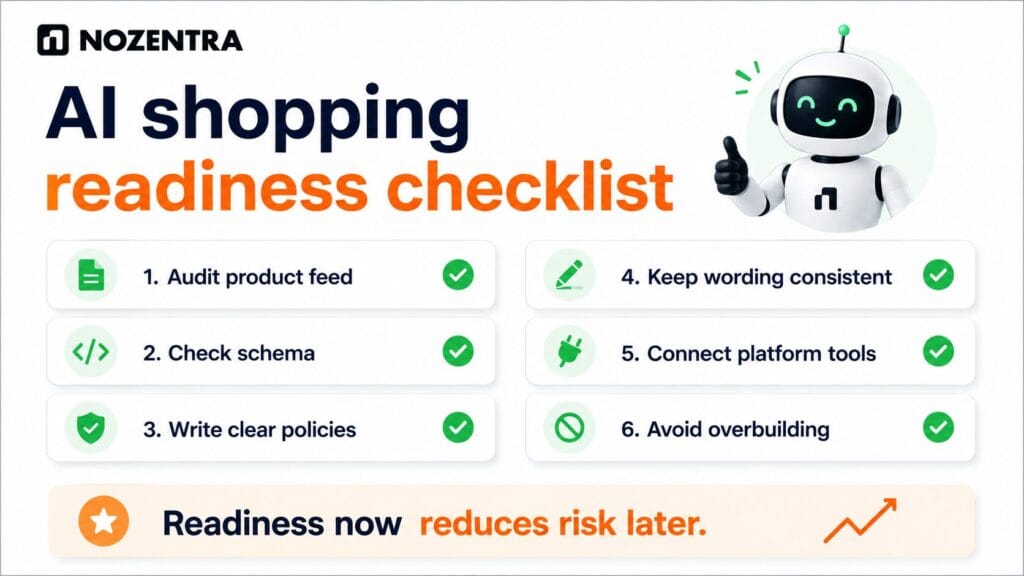
- Audit your product feed for completeness: accurate titles, categories, attributes, availability, and pricing kept current, not just on the website but in the feed itself.
- Add or verify Product and Offer schema markup on every product page, so structured data matches what a human sees, not an outdated or partial version of it.
- Write shipping, return, and warranty policies in plain, specific language, and keep them identical across every page that states them.
- Register with your platform’s agentic commerce programme if one is available, whether that is Shopify’s integration path or Google’s Merchant Center attributes for conversational commerce.
- Do not rebuild your entire checkout around a single protocol yet. Both standards are still evolving, and early over-investment in one risks being stranded if adoption shifts.
What This Does Not Require
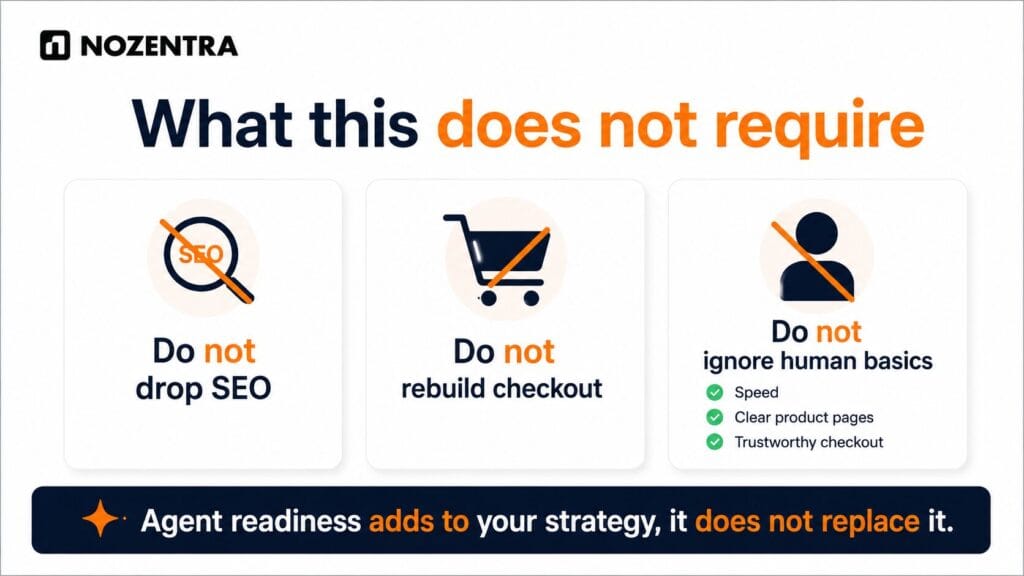
It does not require abandoning content-led SEO, and it does not require a checkout rebuild this quarter. The most common mistake right now is treating agentic commerce as a reason to deprioritise the fundamentals already covered in what are the important features of an eCommerce website: fast load times, clear product presentation, and trustworthy checkout still decide most human purchases, and most purchases are still made by humans. Agent readiness is additive data work, not a replacement strategy.
Nozentra’s Perspective
Nozentra sees AI shopping readiness as a technical eCommerce priority rather than a race to adopt every new protocol. The strongest approach is to improve product data, schema, policies, and checkout systems that support customers, search engines, shopping platforms, and AI agents alike.
This creates value now while preparing the store for how product discovery and purchasing may change.
Get Your Store Ready for Agentic Commerce
If auditing your product feed and schema markup feels like more than your team has time for this quarter, a Nozentra website development review can identify the specific gaps in your product data before they cost you visibility in either protocol.
Frequently Asked Questions
Do I Need to Support Both Google’s and OpenAI’s Protocols?
Not necessarily right away. Start with clean, complete product data and schema markup, which benefits both, then evaluate which platform integration matters most for your specific customer base.
Will AI Shopping Agents Replace My Website Traffic?
Not in the near term, based on current adoption figures. Treat this as a new, smaller channel to prepare for, not a wholesale replacement for search or paid traffic.
Conclusion
Agentic commerce is real but still forming, and the standards behind it are likely to keep changing through 2026. The lowest-risk move available now is the one that pays off regardless of which protocol wins: complete, accurate, machine-readable product data, and policies that mean the same thing to a person and a machine.