


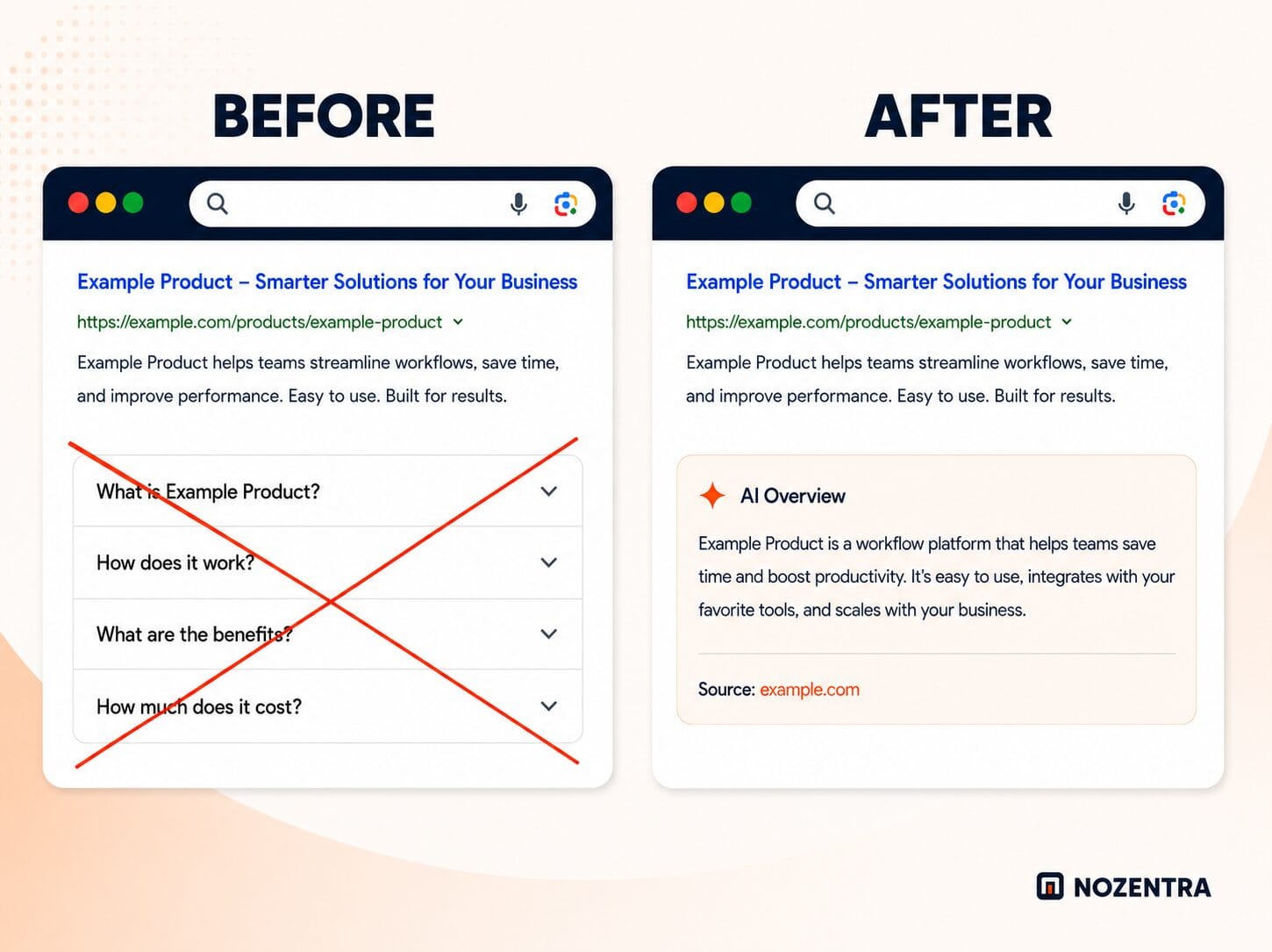
Google removed FAQ rich results from search on May 7, 2026. If your AEO plan depended on that expandable Q&A snippet to win clicks, it is time to update the plan. The good news is that the underlying signal, FAQPage schema, still matters as a way to help Google understand your page. What changed is the visual reward, not the value of structuring content around direct answers.
Key takeaways
FAQ rich results stopped appearing in Google Search on May 7, 2026, across all site types. This wasn’t a sudden move; it’s the final step in a process Google started narrowing back in 2023, when FAQ rich results were restricted to a small set of government and health sites. Google still uses FAQPage schema to understand page content, even though it no longer renders the expandable snippet. Search Console is rolling out a dedicated AI performance section, separate from traditional organic reporting. Google has confirmed that manipulating or buying citations for AI search counts as a spam violation. AEO strategy should now optimise for the answer itself, not for a rich-result shape that no longer exists.
What actually changed on May 7
The expandable question-and-answer rows that used to stretch a search listing down the page are gone. Search Console reporting tied to that feature and Rich Results Test support are being phased out through June 2026, with API support ending in August. This affects every site, including the government and health domains that were among the last allowed to keep the format after Google narrowed eligibility back in 2023.
Worth noting: Google didn’t publish a blog post or webmaster announcement for this change. There was no PR push, no explanation of the reasoning. The only public record is a documentation update, a deprecation notice quietly added to the top of the FAQ structured data page on May 7, 2026. For a feature that shaped SEO templates and content checklists for years, that’s a notably quiet exit.
This is a visual change, not a content-value change. Google’s documentation update confirms the schema itself still helps its systems understand what a page covers, it’s just no longer tied to a visible SERP feature. The practical reading: stop building FAQ blocks purely to chase a rich snippet, and start building them because they genuinely answer what a reader is asking.
A quick note on AI Overviews, since it’s the part of this story that gets oversimplified the most. Google’s own AI features guidance says there’s no special schema required to appear in AI Overviews or AI Mode. FAQPage markup isn’t a shortcut into AI answers, and there’s no confirmed cause-and-effect between adding it and getting cited. What it does is make a page’s existing question-and-answer structure cleaner for machines to parse, which is a real and useful thing, just not the same claim. We’ll treat that as settled for the rest of this piece rather than relitigating it section by section.
Why AEO Matters More Than Classic SEO (And What You’re Missing If You Ignore It)
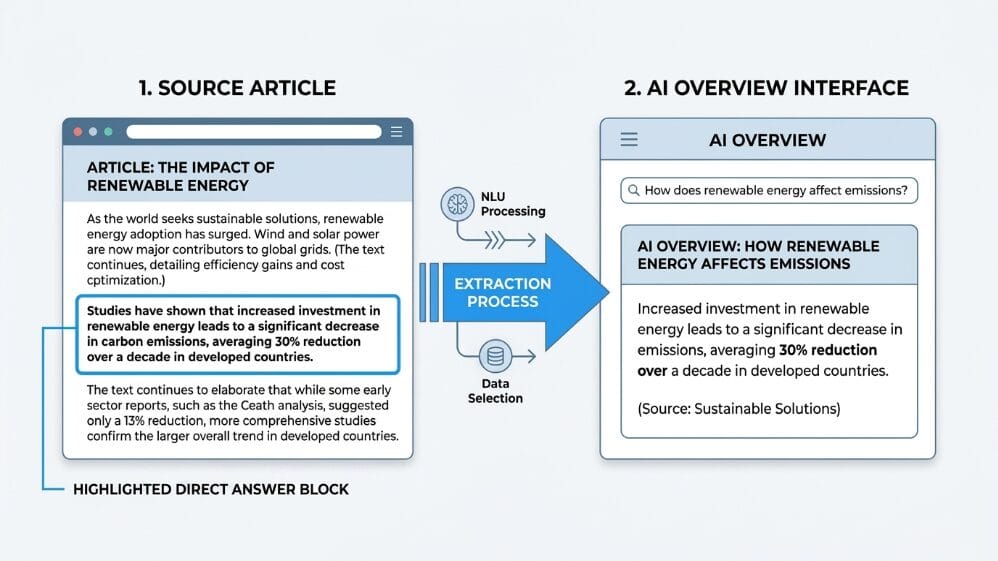
Answer Engine Optimisation is about preparing content so systems that generate direct answers, including AI Overviews and conversational tools, can find a precise response inside your page. The FAQPage schema was never the whole of AEO. It was one signal among several, including direct answers near relevant headings, question-based H2s, clear entities and accurate facts.
Losing the rich result removes a visible incentive but not the underlying mechanism. Pages structured for clear, extractable answers are still the pages most likely to get pulled into an AI-generated response, with or without the old snippet.
What Search Console’s new AI reporting means
Google is building a section in Search Console that reports how pages perform inside AI Overviews and AI Mode, separate from standard organic data. This matters because it gives site owners a way to see whether their content is actually being used in AI answers, rather than guessing from overall impression and click trends.
When this rolls out fully, the practical step is simple: check it the same way you check standard Search Console data, and treat it as a second performance lane rather than a replacement for organic reporting.
The new spam line: don’t try to buy or game citations
Google has confirmed that its search spam policies extend to AI search features, and it has explicitly warned against manipulating or paying for citations inside AI-generated answers. This closes off a tempting shortcut some sites were starting to test. The signal here is direct: AI visibility has to be earned through genuine relevance and structure, not engineered through schemes designed to trick the system.
For any business evaluating AEO vendors or in-house tactics, this is a useful filter. If a proposed tactic sounds like it is trying to influence which sources get cited rather than improving how clearly a page answers a question, it now carries real risk.
What to do instead of chasing the old snippet
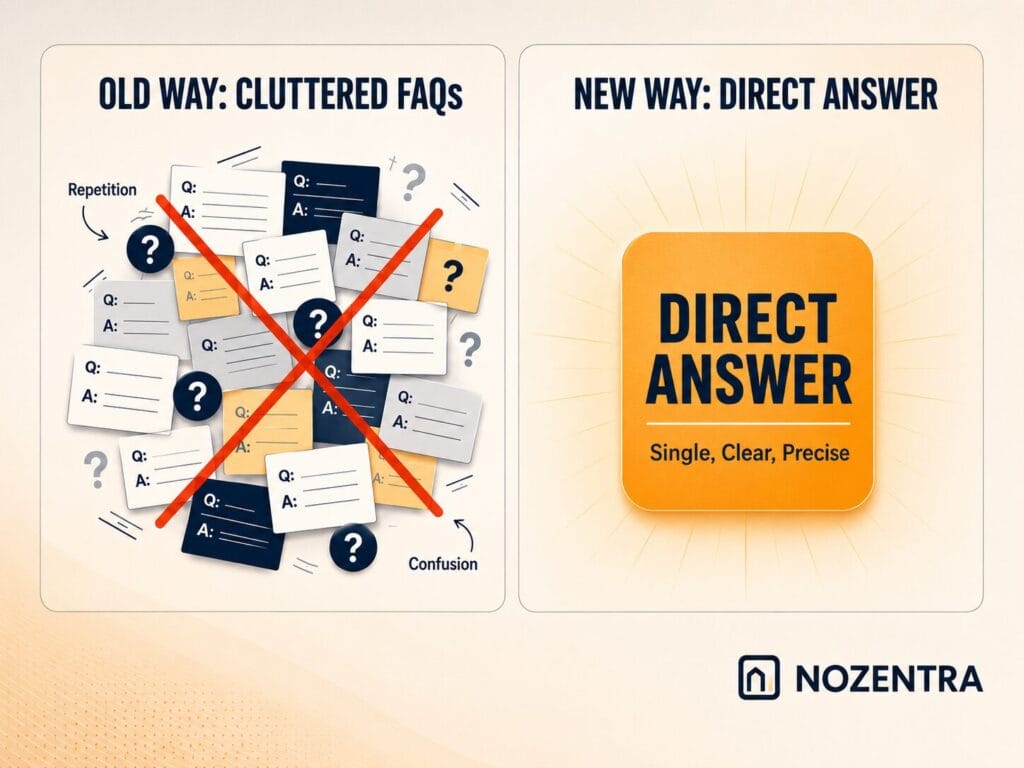
Keep using FAQPage schema where the questions are real and the answers are accurate. Stop using it as a decorative add-on with thin, repetitive Q&A pairs designed only to fill out the format.
Move the effort that used to go into snippet design into stronger on-page structure: a direct answer in the first 40 to 60 words, question-led H2 sections that mirror how people actually search, and short, scannable paragraphs that a retrieval system can lift cleanly.
Audit existing FAQ sections. If a page has ten FAQs and six are filler, cut them. Fewer, sharper answers extract better than a long list built for snippet real estate that no longer exists.
Implementation: a short audit checklist
Run this on your highest-impression informational pages first. Open each page and confirm it still has a FAQPage schema where it is genuinely relevant. Check whether the page opens with a direct, concise answer before any background context. Review question-based headings against the questions your audience actually searches, not generic variations. When Search Console’s AI performance section becomes available on your account, compare it against your top AEO-style pages to see which ones are appearing in AI answers. Remove or rewrite any FAQ content that exists only to fill a format rather than answer something real.
This is incremental work, not a rebuild. Most well-structured pages need adjustment, not replacement.
Nozentra’s view
We’ve watched AEO get reduced to a checklist item more times than we can count: add schema, add an FAQ block, done. The removal of FAQ rich results is a useful correction, and honestly, a welcome one. It separates the sites that were genuinely structuring content around real questions from the ones that were decorating pages for a visual reward that’s now gone for good.
Here’s the part most teams will miss. The sites that treated FAQ schema as a comprehension layer rather than a CTR trick lose nothing here. They were never relying on the snippet to do the work, so the removal barely registers in their numbers. The ones that built thin, repetitive FAQ blocks purely to chase SERP real estate now have a visible reason to fix what was always a quality problem, not a technical one.
Our take at Nozentra is that this update is less about FAQ schema and more about a pattern Google keeps repeating: rich result features get aggressively templated by SEO tooling, stop reflecting genuine page content, and eventually get retired. HowTo rich results went through the same arc in 2023. Expect the same thing to happen to any structured data type that becomes a shortcut instead of a description. The lesson isn’t “stop using schema.” It’s “stop using schema as a substitute for actually answering the question.”
FAQs
Does removing FAQ rich results mean FAQ schema is pointless now?
No. Google’s documentation confirms it still uses FAQPage schema to understand page content. The visual snippet is gone; the comprehension signal is not.
Will AI Overviews replace traditional organic clicks?
AI Overviews now appear in a meaningful share of US searches, which puts pressure on basic informational content. Pages with depth, clear structure and genuine expertise are better positioned, but no format guarantees a citation or a click.
Is it worth paying for “AI citation optimisation” services that promise placement?
Be cautious. Google has explicitly classed manipulating or buying AI citations as a spam violation. Any service promising guaranteed placement through manipulation tactics carries real risk to your site.