


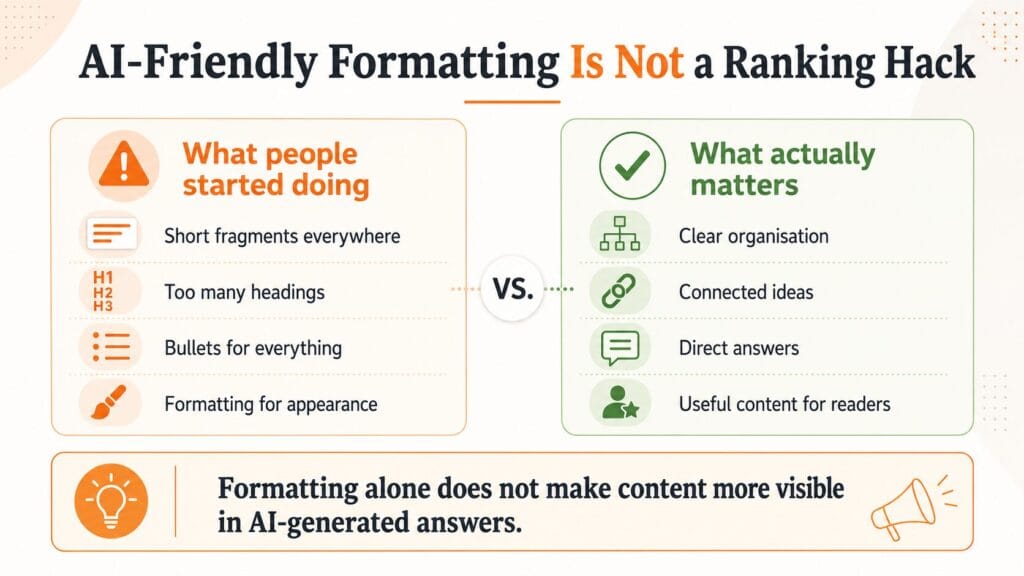
Loading a page with headers and bullet points does not make it more visible in AI-generated answers. Google’s official guidance for generative AI search states that there is no requirement to break content into tiny pieces for AI systems to understand it. What helps is content that is clearly organised because the ideas inside it are clear, not because it has been reshaped to look like a checklist.
Why did this need correcting
A piece of advice has spread quickly across AI SEO content: write everything in short fragments, stack headers every few lines, and bullet as much as possible, because AI systems supposedly parse this more easily. Google’s John Mueller and Martin Splitt cautioned against parallelising content with Markdown for AI SEO, directly challenging this assumption.
The correction matters because the advice was never based on confirmed platform behaviour. It spread because it sounded plausible and because AI search visibility is hard to test directly. Many sites adopted it anyway, often at the cost of readability for actual human visitors.
This issue now affects a significant search audience. Alphabet reported that Google AI Overviews had more than two billion monthly users across more than 200 countries and territories and 40 languages by July 2025.
What was actually being recommended, and why it falls short
The flawed version of this advice treats formatting as a signal in itself. The logic runs: AI systems read text in chunks, so chopping a page into many small chunks should help those systems extract information. In practice, this confuses surface structure with semantic clarity.
A page broken into twenty short bullet fragments is not automatically easier to understand than three well-written paragraphs. If the fragments lack context or sit disconnected from each other, a retrieval system has less to work with, not more. Genuine understanding depends on the ideas being clearly connected, not on how many line breaks separate them.
What actually helps AI systems to use your content
Based on current, confirmed search guidance, a few things consistently support both human and machine understanding of a page:
- A direct answer near the top of the relevant section, stated in plain language
- Clear, consistent entity names for brands, tools, people and concepts, so systems can connect the page to the correct subject
- Logical depth where a topic needs it, rather than forced brevity
- Accurate, current facts with visible sourcing
- Internal links with descriptive anchor text that explain where they lead
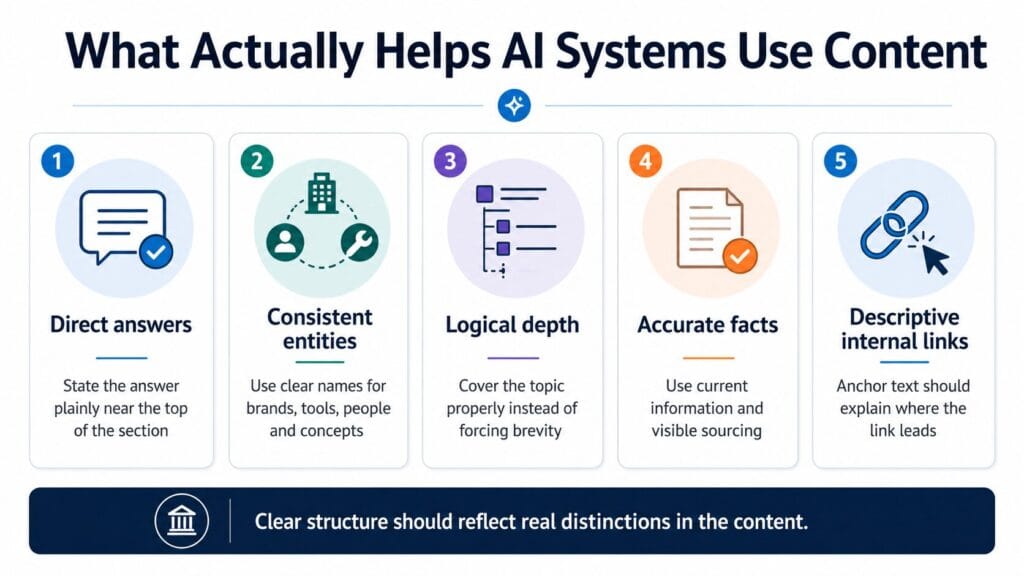
None of this requires breaking every paragraph into bullets. It requires writing clearly enough that the structure reflects real distinctions in the content, not artificial ones.
How to tell if your formatting is helping or hurting
A simple test: read a section aloud. If it sounds like a checklist because the ideas are genuinely discrete steps, the bullets are doing their job. If it sounds like a checklist because complete thoughts were chopped apart to look more scannable, the formatting is working against the content.
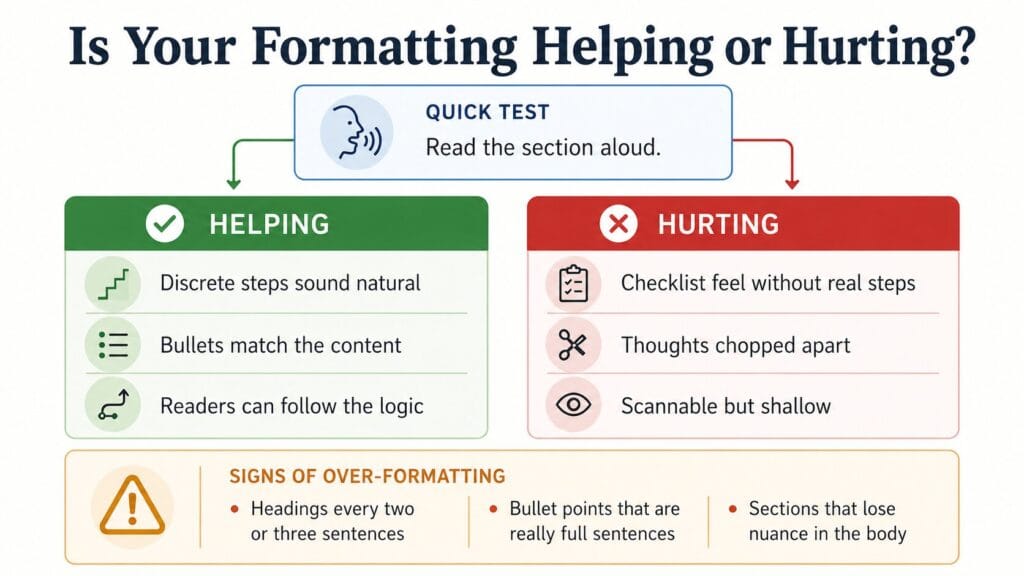
Other signs of over-formatting:
- Headings every two or three sentences with no real topic shift between them
- Bullet points that are actually full sentences with a fragment removed
- Sections that read fine as a table of contents but lose all nuance in the body
What to do instead
The fix is usually editorial, not technical. Start by reading the page as a person would, not as a checklist generator would. Where headings genuinely mark a new question or decision point, keep them. Where they were added purely for visual rhythm, merge the sections back together and let the paragraph carry the idea.
Nozentra’s own content review process treats this as a quality check before publication: does the structure exist because the content needs it, or because a formula said it should be there. Pages that pass this check tend to perform better for actual readers, which is the more reliable foundation for AI visibility anyway, since these systems are built to surface useful sources.
Where structure genuinely helps
This is not an argument against structure altogether. Tables are useful for genuine comparisons. Numbered steps are useful for genuine sequences. FAQs are useful when they answer real follow-up questions instead of repeating the body. The standard is whether the format matches the content, not whether it matches an AI SEO checklist.
Google’s generative AI guidance also recommends organising content with paragraphs, sections and clear headings when they help readers navigate and understand the information.
FAQs
Does Google penalise over-formatted content?
There is no confirmed penalty mechanism described in current guidance. The caution from Mueller and Splitt was about formatting not delivering the AI visibility benefit it is often claimed to provide, not about an active penalty.
Should I remove all headers and bullets from my content?
No. Remove the ones that exist purely for visual effect. Keep the ones that reflect a genuine shift in topic or a real sequence of steps.
What should I prioritise instead of formatting?
Clear, direct answers, accurate and current facts, consistent naming of entities, and content that fully covers the question being asked.
Conclusion
Formatting a page to look AI-friendly is not the same as making it genuinely useful to AI systems or to readers. The more reliable path is writing content that answers a real question clearly, with structure that reflects the logic of the topic rather than a formula borrowed from unconfirmed advice.
If you want a second opinion on whether your content’s structure is helping or working against it, Nozentra’s SEO services include a content-structure review as part of a standard audit.