


On July 9, 2026, Google added a “How this ad was made” section to My Ad Center, showing whether an ad was created or edited with AI. What actually needs a label, and where, is more specific than a blanket “disclose all AI ads” rule. The useful question isn’t whether to disclose. It’s whether your target region legally requires it, and whether Google labels the asset for you or expects you to do it yourself.
Key takeaways
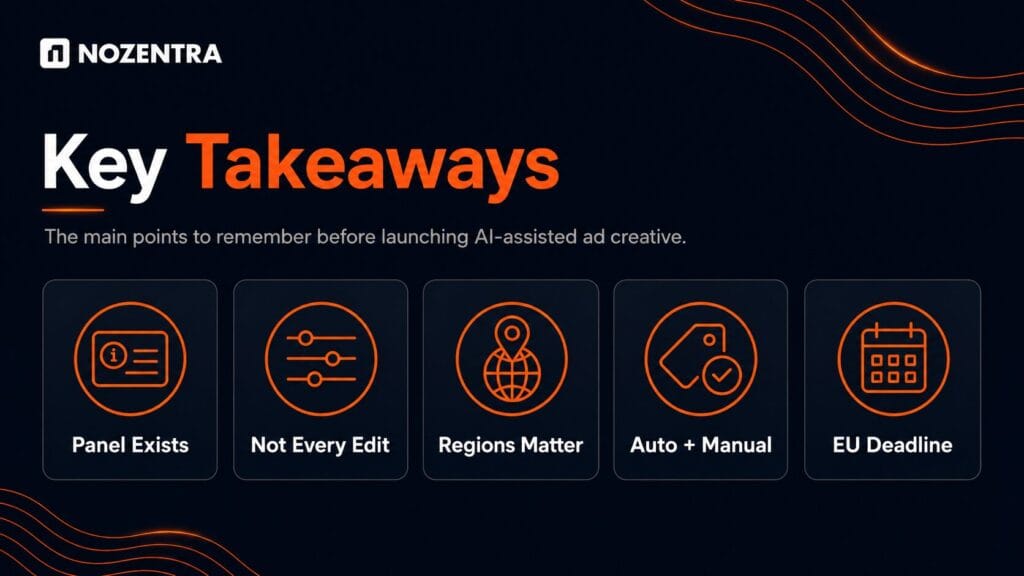
- Google’s My Ad Center now shows a “How this ad was made” panel, viewable via the three-dot menu or info icon on ads across Search, YouTube, and Discover.
- Not all AI-assisted content needs a label. Google’s election-ad policy excludes minor edits like cropping or color correction; its general guidance points the same way, though this isn’t confirmed as a blanket rule for commercial ads. Substantive generation, like an AI-created background or voiceover, is more likely to require disclosure, depending on the asset and region.
- Google names the EU, India, and New York as examples of regions with disclosure requirements, not a complete list. India and New York’s rules already applied before July 9. The EU’s, under AI Act Article 50, become enforceable August 2, 2026.
- Google auto-labels assets made with its own generative AI tools, which embed SynthID watermarks and C2PA credentials. It can also apply a label independently where legally required, or from signals shared by other platforms.
- For AI content built outside Google’s tools, advertisers get a “Review assets” prompt to self-declare. This isn’t the only route to a label; Google can apply one independently too.
Why this is arriving now
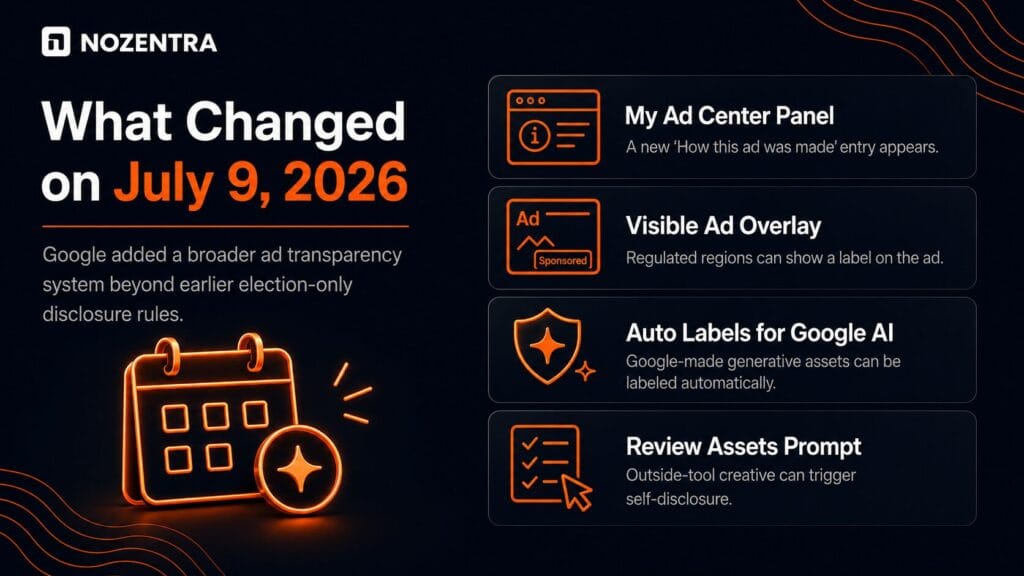
Google’s disclosure requirement for election ads with synthetic content has applied since 2023. What’s new is a general-purpose mechanism for ordinary ads. India and New York already had AI-disclosure rules before this panel launched; the EU’s obligations under Article 50 don’t take effect until August 2, 2026 (details below). Google frames the panel as a global feature and hasn’t said any particular law drove the timing, so treat that connection as our reading, not a confirmed Google statement.
Meta made a comparable move earlier, expanding its own AI-ad transparency policy in February 2025. The pattern is consistent: a platform feature arrives first, and a statutory deadline makes it effectively mandatory soon after, in regulated regions.
What counts as “AI-made,” and where a label is legally required
Google’s stated scope is substantive generation or editing, not any AI involvement. An AI-created background, a generated voiceover, or synthesized elements that change what the ad depicts are the kinds of changes most likely to require disclosure, though it depends on the asset and the applicable regional policy, not a fixed list. Google’s election-ad policy explicitly excludes standard edits like cropping, resizing, or defect removal. Its general guidance points the same way, but hasn’t published an equally explicit exemption list for commercial ads, so treat the election-ad scope as a guide, not a confirmed rule.
Regionally, Google names the EU, India, and New York as examples, not a complete global list. India and New York’s requirements were already in force before July 9. The EU’s, under Article 50, take effect August 2, 2026, covering specific categories rather than every AI-assisted ad. In these regions, a designated asset shows a visible overlay on the ad itself, not just a My Ad Center entry. Outside them, the panel entry is a transparency feature without a confirmed legal mandate today, though Google frames its list as illustrative, meaning more regions could be added later.
Automatic versus self-disclosure
Ads built with Google’s own generative tools, the asset features inside Performance Max and Asset Studio, tracing back to Google Marketing Live 2023, are labeled automatically. Those tools embed SynthID watermarks and C2PA credentials, technology Google says supports transparency, though it hasn’t detailed exactly how that feeds into the label itself.
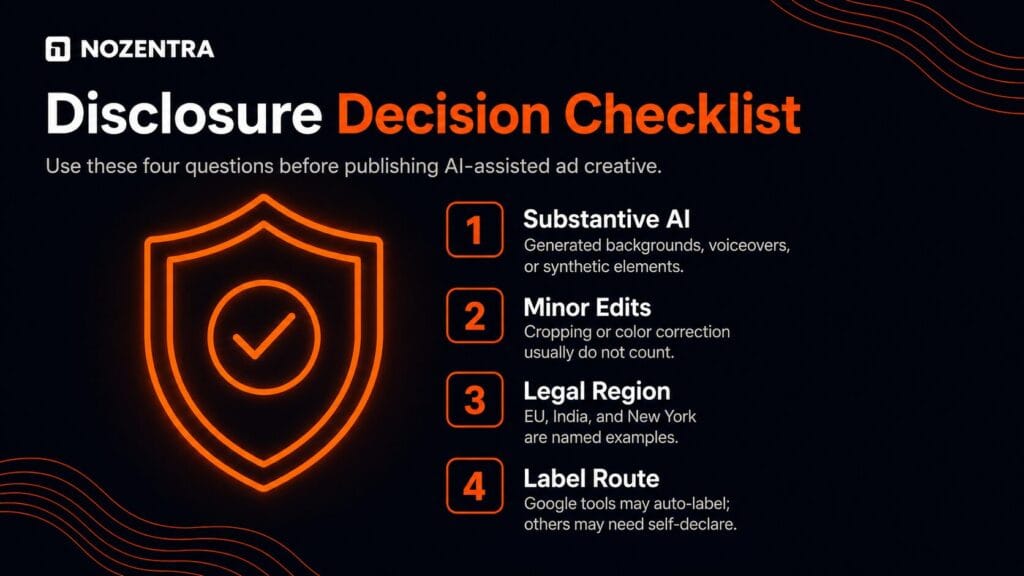
For creative built outside Google’s ecosystem, that provenance usually doesn’t exist, so advertisers get a “Review assets” prompt inside campaign creation, selecting “Label this asset as created or edited with AI” or “Don’t label this asset” per asset. Self-disclosure isn’t the only route, though. Google states it may apply a label itself, independent of the advertiser, where legally required or when it receives signals from other platforms.
A Nozentra observation
The practical failure point in accounts we’ve reviewed isn’t ignorance of the feature. It’s treating “AI disclosure” as one task instead of two questions: does this asset meet Google’s substantive-generation threshold, and does the target region legally require a visible label. Building both checks into a pre-launch asset review, alongside Google’s own “Review assets” prompt, catches most of the gap.
What to do next
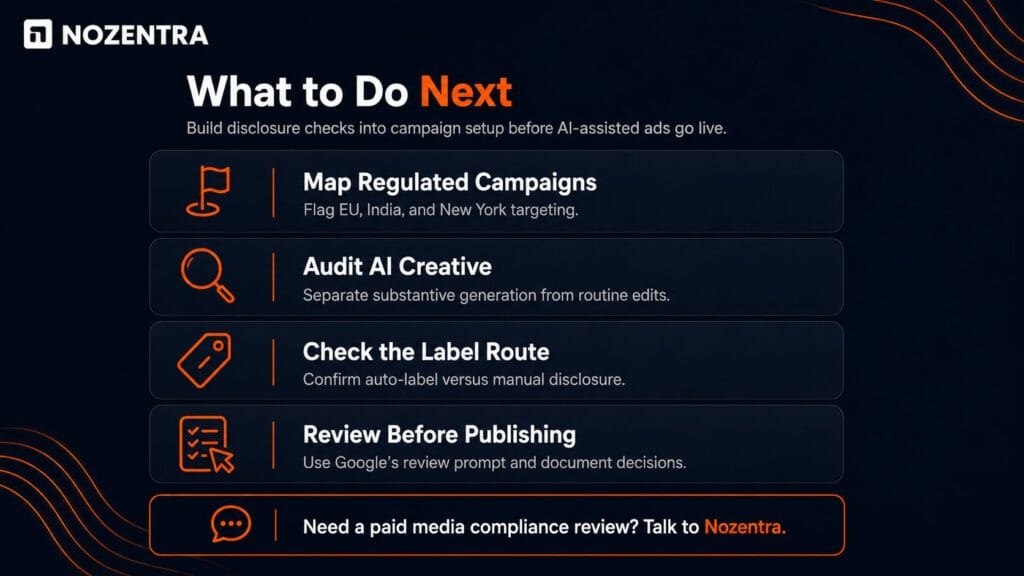
- List campaigns targeting the EU, India, or New York, Google’s named examples, not a confirmed complete list. India and New York’s rules already apply; the EU’s applies from August 2, 2026.
- Audit creative for substantive AI generation versus minor touch-ups. Election-ad policy draws that line clearly; commercial-ad guidance is less explicit, so confirm anything borderline.
- Confirm which assets are Google-native (auto-labeled) versus outside tools (need manual disclosure via “Review assets”).
- Complete manual disclosure during campaign or asset-group creation, where Google now surfaces it directly.
- For EU campaigns, track the August 2, 2026 deadline and confirm which specific ads fall inside Article 50’s scope.
If you’re unsure which campaigns fall inside a region with a legal requirement, that’s a reasonable scope for a paid media compliance review. Nozentra can check an existing Google Ads account against current regional rules alongside standard targeting and creative review.
FAQs
Do I have to label every ad that touched AI in any way?
Not usually. Google’s stated scope is substantive generation or editing, not any AI involvement. Election-ad policy excludes minor edits explicitly; commercial-ad guidance points the same way but is less explicit, so treat borderline cases as worth checking.
Does Google ever catch undisclosed AI content itself?
Sometimes. Google can apply a label itself where legally required or when it receives signals from other platforms, independent of the advertiser. Google-made content carries SynthID and C2PA credentials, though Google hasn’t detailed exactly how that feeds into labeling. For third-party content without that provenance, self-disclosure via “Review assets” is the main route today, but not the only one Google has described.
Conclusion
Google now shows people how an ad was made. The compliance task underneath is narrower than “label everything AI touched.” It comes down to two questions per campaign: does the creative involve substantive AI generation rather than routine editing, and does the campaign target a region with a legal requirement, currently the EU, India, or New York as Google’s named examples, not a confirmed complete list. For EU campaigns, that requirement doesn’t start until August 2, 2026, and even then covers specific categories under Article 50, not every AI-assisted ad.