


No, for Google’s own systems. Google’s documentation confirms a well-built HTML website already works for Google Search, AI Overviews, and AI Mode, and Search Advocate John Mueller has personally pushed back on building a separate version for AI crawlers. Google cannot confirm how every outside AI assistant, ChatGPT, Perplexity, and others, handles markdown or LLMs.txt files, so treat this as guidance about Google’s own systems, not a blanket rule for AI. A second, stripped-down version of your site adds ongoing work without a confirmed benefit.
Key Takeaways
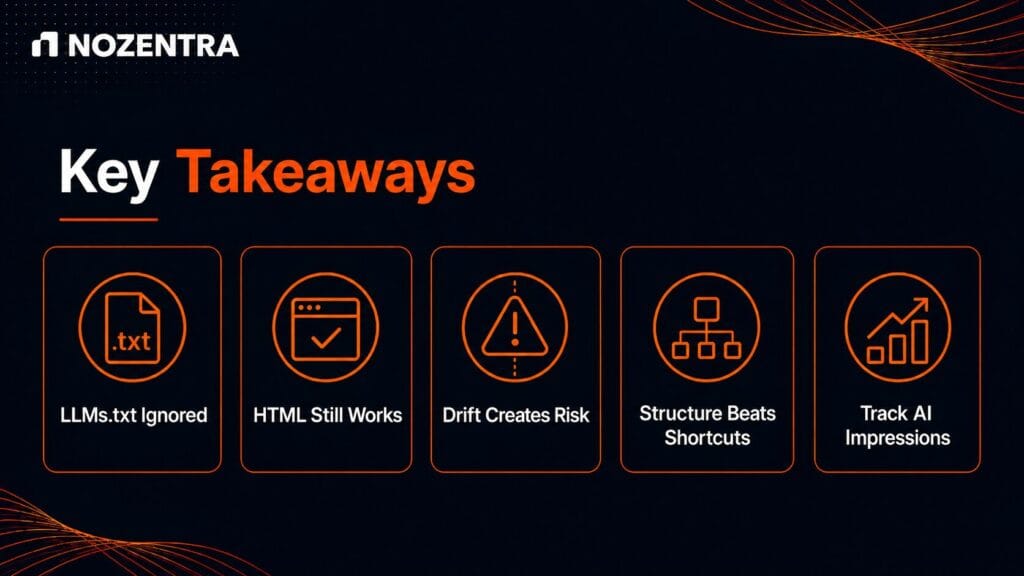
- Google’s help document confirms that LLMs.txt files do not help or hurt Search rankings, and that markdown or AI-only files are not required to appear in Google Search or its AI features. That is Google’s formal position.
- The stronger pushback against actually building a separate markdown version, including the maintenance burden and a possible cloaking risk if the two versions drift apart, came from Search Advocate John Mueller personally, not a formal Google policy announcement.
- Google Search Console’s Generative AI report is rolling out to more properties and currently shows impressions from AI Overviews and AI Mode. It does not yet show clicks, CTR, conversions, or referrals from outside AI assistants, and it may not be live on every property yet.
- The fixes that already support AEO, clean HTML, clear headings, direct answers, and accurate structured data, are the same fixes Google is reinforcing here.
Why this keeps coming up
AI crawlers now request pages at meaningful scale, and some site owners assumed a leaner, text-only version would be easier for those bots to process and might improve their odds of being cited. A few infrastructure providers even added tools to auto-generate a markdown mirror of every page.
Nozentra has fielded this exact question from several clients this year, usually framed as “should we build an AI-friendly version of the site.” The short answer has not changed, but this month Google addressed it directly for the first time.
What did Google actually say about LLMs.txt files?
Google’s help document on optimising for generative AI search was updated to add two clarifications. First, maintaining an LLMs.txt file will not help or hurt a site’s visibility or rankings, because Google Search ignores it. Second, no new machine-readable file, AI text file, or markdown version is required to appear in Google Search, including its AI features, because Google Search does not use them to begin with.
That does not make LLMs.txt files harmful. If another platform or internal tool of yours reads them, keeping one is harmless. It simply means writing one for Google’s benefit accomplishes nothing.
What did John Mueller say about markdown-only pages?
Responding to a discussion about sites serving AI bots a separate, stripped-down text version, Mueller argued that a properly structured website already works for AI agents, search engines, and people at once. A second, agent-only version becomes a page nobody but a bot checks, which drifts out of date and adds maintenance work. It is worth being precise here: this is Mueller’s own, more pointed view, shared personally rather than published as formal Google policy. Google’s documentation makes the narrower point that markdown and AI-only files are not required, without warning against them outright.
Bing’s Fabrice Canel raised a related but different concern: Bing crawls both versions of a page anyway to confirm they match, which doubles the crawl and maintenance load. If the two versions drift out of sync, that mismatch is what turns into a cloaking problem, not the act of having a markdown version in the first place.
Is this actually a cloaking risk?
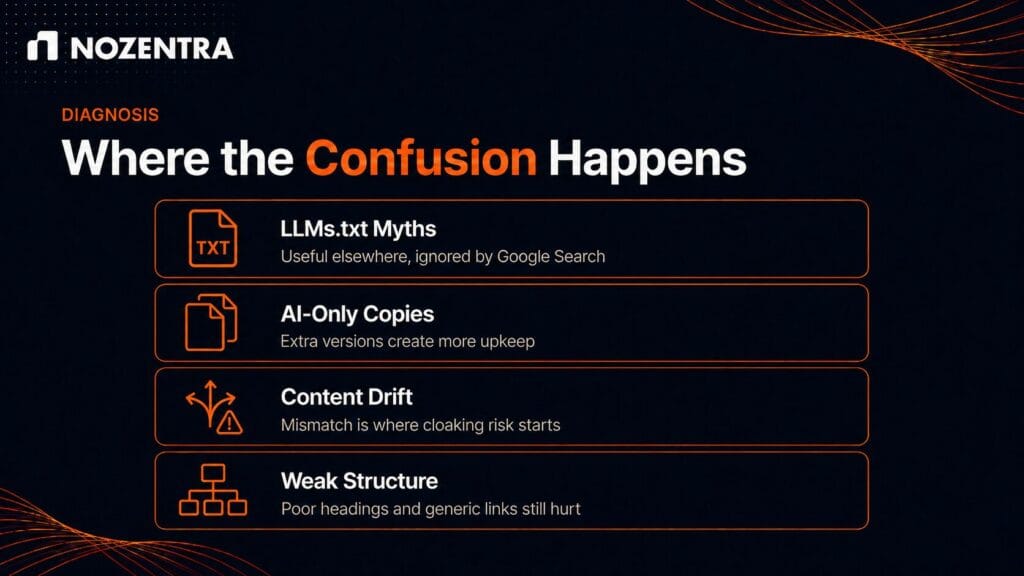
Cloaking means showing search engines or bots something materially different from what a human visitor sees, usually to manipulate rankings or results. An accurate markdown version that represents the same content as the HTML page is not automatically cloaking. The risk appears when the two versions drift apart, omit information, or get used to influence how a page is evaluated, the specific scenario Mueller and Canel were each pointing at, not the format itself.
So what should you build instead?
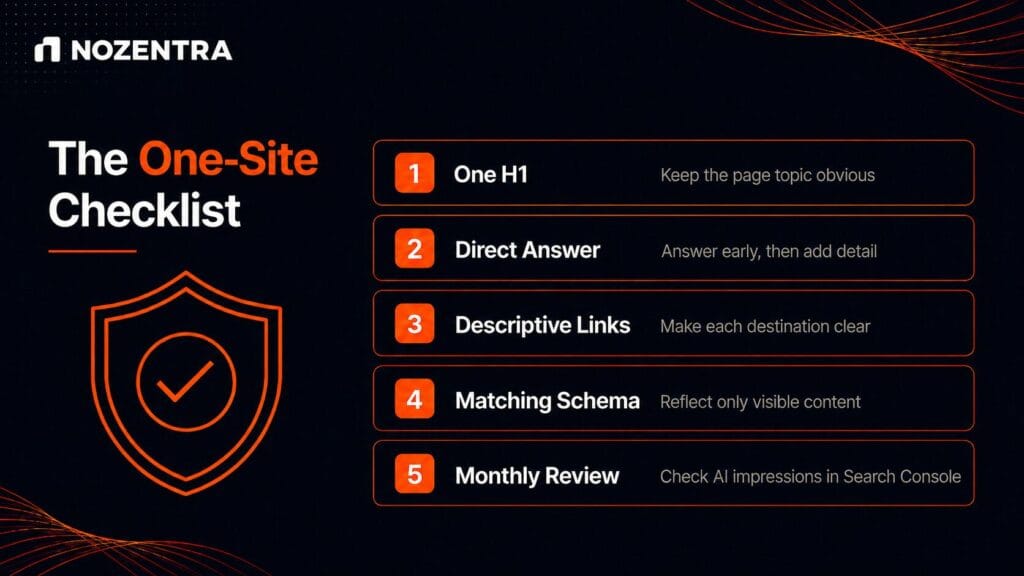
Nothing extra. The practical response is to make the one version of your site that people already see easier for every kind of visitor, human or automated, to parse correctly.
- One clear H1 and a logical H2/H3 hierarchy on every page.
- A direct, specific answer near the top of informational content, before the supporting detail.
- Descriptive internal links, so crawlers and readers both understand where a link leads.
- Schema, such as Article or Product, only where it matches the visible content. Google’s AI guidance requires no special structured data for AI Overviews or AI Mode, and FAQ schema stopped producing a rich result in Search as of May 2026, so skip it as an AI tactic.
- Where available, Google Search Console’s Generative AI report for AI Overviews and AI Mode impressions, treated as a partial, still-rolling-out signal rather than full referral or conversion data.
Where Nozentra sees this go wrong in audits
The pattern we see most often in audits is not a missing markdown feed. It is inconsistent heading structure, thin or duplicated content across near-identical pages, and internal links using generic text like “click here” instead of describing the destination. Those issues hurt a page’s chances with a human reader, a search engine, and an AI system in the same way. Fix the one page. Do not build a second one.
Implementation checklist
- Audit top pages for heading structure, one H1, a direct answer near the top, and schema that matches the visible content; drop FAQ schema as an AI tactic.
- If you serve any alternate version to AI bots, keep it equivalent to what people see; a mismatch, not the format, is what creates cloaking risk.
- Check whether the Generative AI report is live for your property in Search Console, and review it monthly once it is.
- Stop building AI-only endpoints purely to influence Google rankings. Keep one only if it genuinely serves another purpose, like an internal tool or a partner integration.
A relevant next step
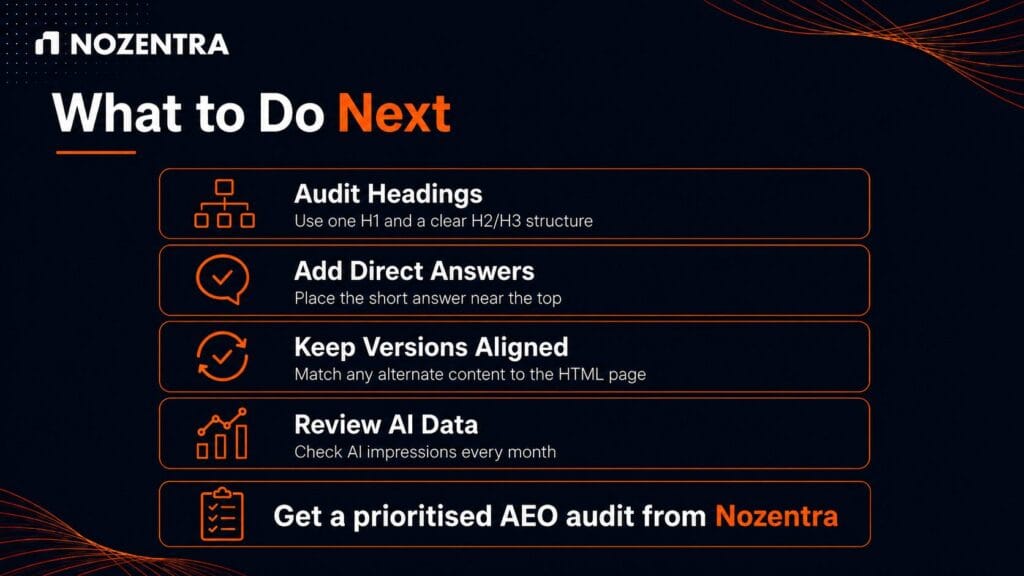
If you are not sure whether your current site structure is helping or working against your AI visibility, Nozentra offers a technical and AEO-focused audit that reviews heading structure, schema, internal linking, and Search Console AI data together, then hands you a prioritised fix list.
FAQs
Does an LLMs.txt file do anything at all for my site?
It can be useful if another platform or internal tool of yours reads it. It has no effect on Google Search visibility or rankings.
Does this apply to ChatGPT, Perplexity, and other AI assistants too?
Not by confirmation. Google’s statements cover Google Search, AI Overviews, and AI Mode only. Google cannot speak for how other AI assistants weigh markdown, LLMs.txt, or other formats.
Will a lightweight AI-only version ever make sense?
Not as a Google ranking tactic. A well-structured HTML page already works there, per Google and Mueller. A separate version can still make sense for a genuinely different purpose, such as feeding an internal tool, just not to influence Google rankings.
Is this the same as having a separate mobile site?
No. A responsive site serves the same content to every visitor and bot. A markdown feed only becomes a similar concern once it stops matching what the HTML page actually says.
Conclusion
Google’s documentation and its own search advocate now point the same direction for Google’s own systems: one well-built site is the AI-ready site, as far as Google can confirm. The work worth doing hasn’t changed, clean structure, direct answers, and accurate markup, just measured now with better tools than before.