How much does a website cost in 2026? For a small business site, published examples run from £2,000–£5,000 for a UK regional-agency brochure build, $6,500–$15,000 for a US basic professional design tier, AED 999–2,500 for two defined UAE provider packages, and PKR 40,000–120,000 for a Pakistani 5–10 page business site. These are different scopes from named sources, not four exchange-rate versions of one standard website. Hosting, content, subscriptions and support may be extra.
The useful number is the cost of a written scope over its first year. A low launch price can be sensible if your team will supply the copy and manage updates. A higher quote may include discovery, original design, content, integrations, testing and support. This guide separates those decisions so you can compare proposals fairly.
How much should a small business website cost?
A small business website should cost what its required pages, content, features and ownership model justify. For a straightforward site that explains a service and collects enquiries, the following published 2026 examples provide starting reference points. They are not Nozentra prices or measured national averages.
| Market | Published price example | Defined scope and source |
|---|---|---|
| UK | £2,000–£5,000 | Regional-agency brochure site of 5–10 pages, Red Eagle Tech, updated 21 May 2026 |
| US | $6,500–$15,000 | Basic professional web design tier for a small business, WebFX 2026 guide, checked 28 October 2026; confirm development and content in the quote |
| UAE | AED 999–2,500 | The Web Makers' five-page static Starter and up-to-six-page editable business package, updated 26 September 2026 |
| Pakistan | PKR 40,000–120,000 | 5–10 page business site estimate, ABiz Global Services, published 19 October 2026 |
The UK range comes from Red Eagle Tech's UK pricing guide. The US figure is WebFX's basic design tier, so ask whether development, copy and launch are included. The UAE figures are The Web Makers' own fixed packages: the cheaper one has no content management system, and domain, hosting and add-ons need checking separately. The Pakistan estimate is from ABiz Global Services' October 2026 guide, which does not publish a market survey method. Treat every figure as a planning example and request a current written quote.
The size of a business does not set the price on its own. A five-page site with original photography, detailed service copy and a booking integration can require more work than a larger site assembled from approved content and a reusable design. If you need a site that supports enquiries and a team that can update it, start with the websites and ecommerce service scope and specify those outcomes before asking for a price.
What affects the cost of building a website?
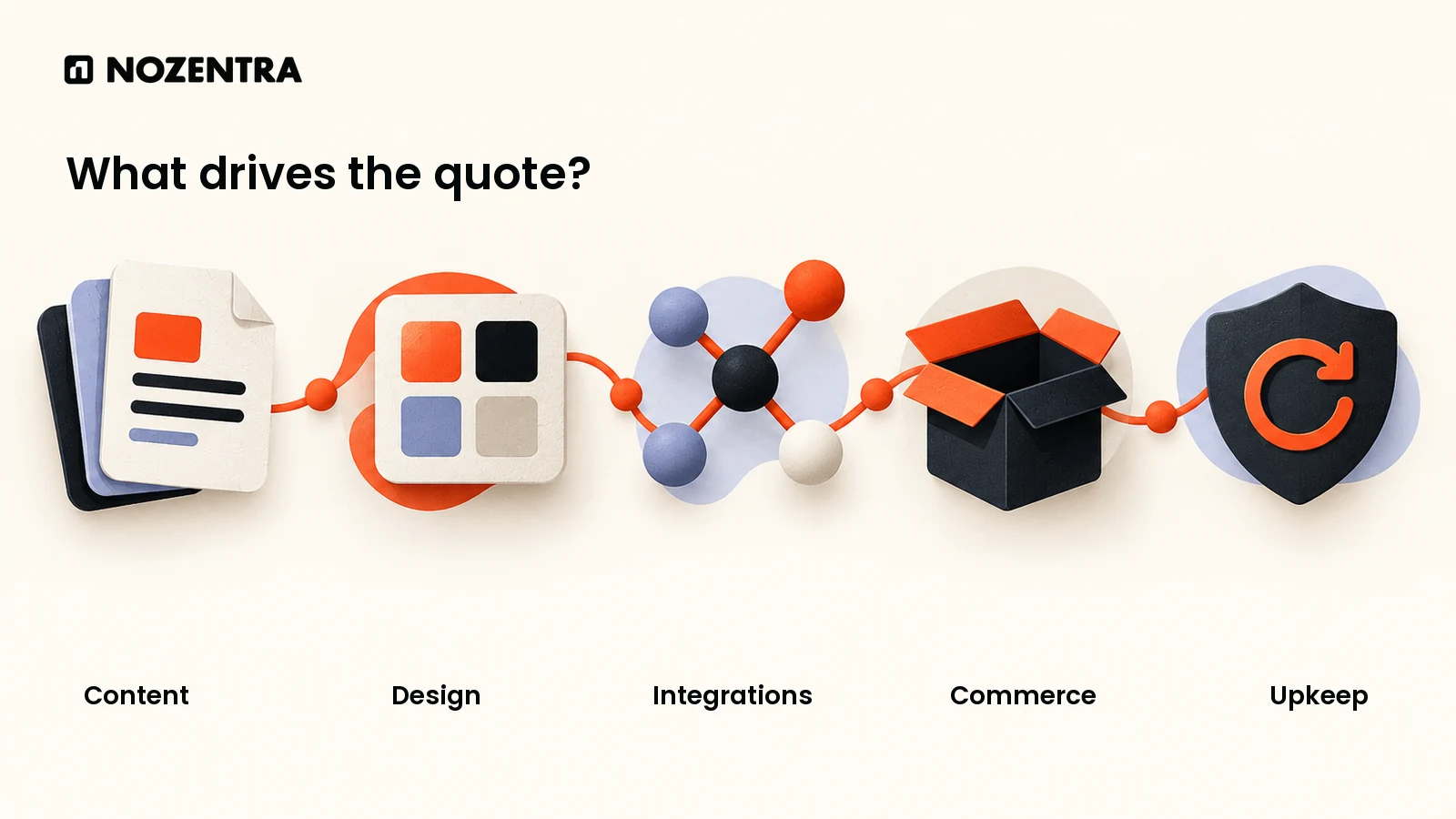
Scope, platform, integrations, content and upkeep are the main cost drivers. List each in the brief so a supplier can price the same work another supplier is pricing.
Pages and journeys. Count distinct page types, not just URLs. Ten service pages on one reusable layout differ from ten custom page designs. Define the visitor's path from search or campaign to enquiry or purchase.
Design and accessibility. A configured template takes less design time than a custom system of layouts and components. Ask how mobile behaviour, keyboard use, forms and content readability will be checked.
Content and migration. Decide who writes, approves, photographs, uploads and redirects content. Moving an old site can involve URL mapping and checking that important pages still work.
Platform and editing. A hosted builder can bundle infrastructure with a monthly subscription. A content management system or custom build may need separate hosting and technical care. Choose based on who will edit the site and what it must do, rather than the cheapest first month.
Connections and commerce. Booking, CRM, stock, payment, shipping, email and reporting systems each add configuration and testing. A simple contact form is a different project from synchronising orders with an inventory system.
Support after launch. Clarify whether the quote includes training, backups, security updates, small content changes and a response time. A cheaper build with no agreed owner for these tasks can be harder to budget.
These drivers are visible in The Web Makers' package exclusions and OuterBox's ecommerce scope breakdown. Neither source can tell you the cost of your own project without its requirements. Our guide to building a website that can grow helps decide which capabilities belong in the first release.
Is it cheaper to use Wix or Squarespace than to hire a web agency?
Usually, yes, if you compare the initial cash payment for a simple site. Wix and Squarespace sell ongoing builder subscriptions, while an agency charges for people to plan, write, design, build and check a defined result. The subscription does not do the owner's content work for them.
Choose a builder when your pages are few, a suitable template covers the job, your team can write and maintain the content, and a standard form or store meets the need. Choose professional help when the site must explain a complex offer, migrate important pages, connect systems, support several audiences or meet a demanding publishing workflow. An agency can still build on a hosted platform; these are decisions about who does the work and which platform runs it, not two mutually exclusive technologies.
Compare a builder and an agency over the same period. Include setup, subscriptions, paid apps, domain renewal, email, content creation, maintenance and the hours your staff will spend. Note who owns the domain, content and design files, who can make changes, and what happens if you move providers. GoDaddy's UK example separates builder and designer first-year and later-year costs, showing why a one-time fee and a subscription should not share one headline number.
For a platform-by-platform discussion, read WordPress vs Webflow vs Shopify. Its current plan details belong there; your website budget needs the full work and operating costs around the chosen platform.
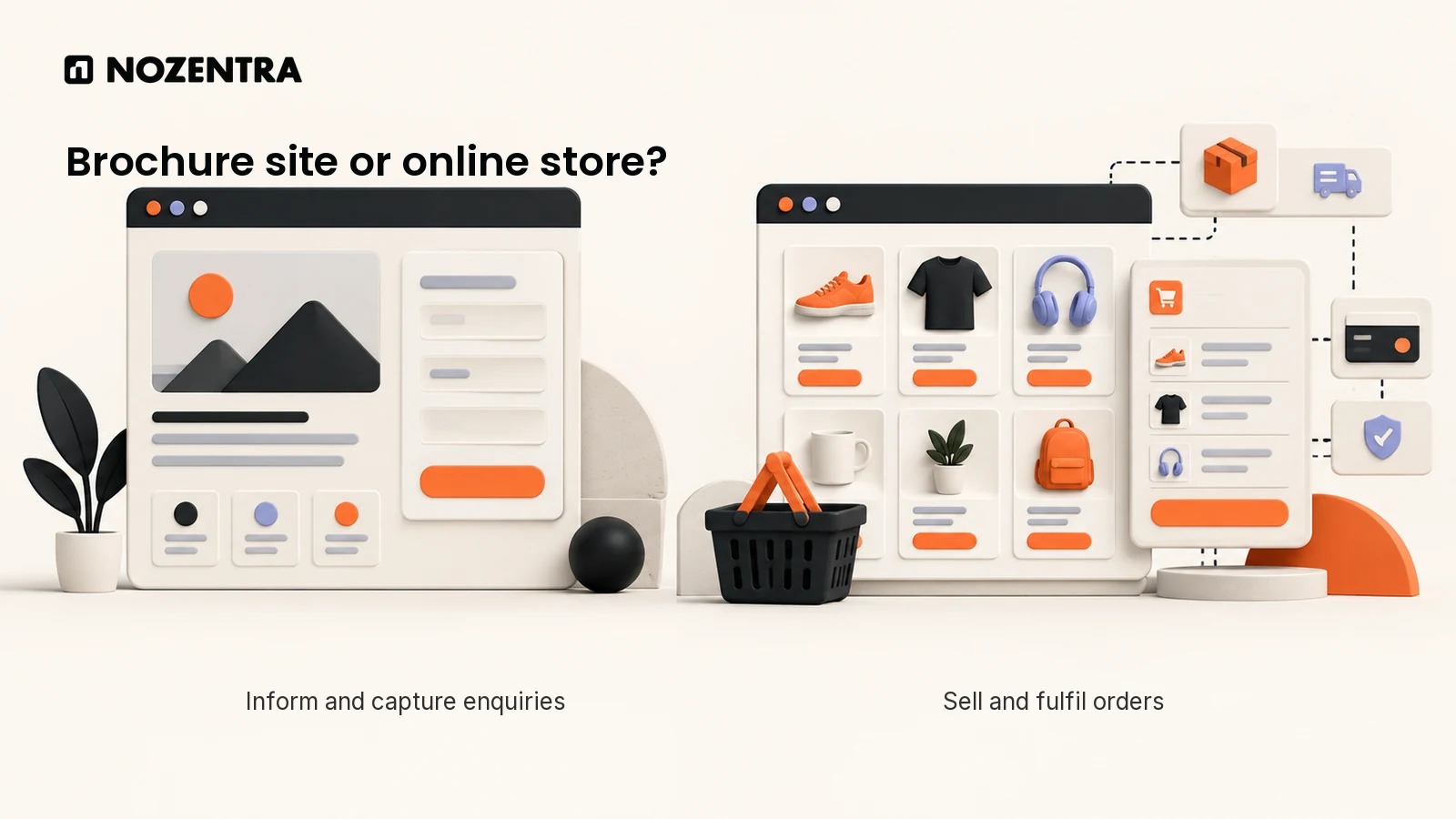
How much does an ecommerce website cost compared with a brochure site?
An online store generally costs more to implement and run because it needs product data, checkout, payment and fulfilment flows that a brochure site does not. The exact difference depends on whether you need a starter hosted store or a custom operation connected to other systems.
The same named guides give useful within-market, within-source comparisons:
| Source and market | Brochure or basic business site | Online store example |
|---|---|---|
| Red Eagle Tech, UK, May 2026 | £2,000–£5,000 for 5–10 pages | £2,500–£5,000 for a small store under 50 products; £5,000–£15,000 for 50–500 products |
| The Web Makers, UAE, September 2026 | AED 999 static Starter or AED 2,500 editable business package | From AED 3,999 for a basic WooCommerce or Shopify store |
| ABiz Global Services, Pakistan, October 2026 | PKR 40,000–120,000 for 5–10 business pages | PKR 90,000–300,000 for an ecommerce site |
These are the sources linked above. For the US, WebFX's 2026 design guide lists ecommerce functionality at $5,000–$25,000 as a scope component, while OuterBox's May 2026 guide places many professionally designed custom stores at $25,000–$150,000 or more. Those numbers describe different projects and should not be treated as competing quotes for the same store.
Before choosing a number, write down how many products and variants must be prepared, which payment methods and markets you need, who maintains prices and stock, which shipping and tax rules apply, and whether a CRM, ERP or fulfilment service must connect. Product photography, descriptions, data cleanup and redirects belong in the scope. A small store can start with standard features; add custom functions only when there is a clear operating need.
What ongoing costs come after a website launches?
Expect recurring costs for the domain, hosting or builder subscription, paid software, maintenance and the staff time needed to keep content current. Stores also incur payment processing and may pay for shipping, inventory or marketing tools. Ask which are included in the build contract and which renew separately.
The amount varies by setup. Red Eagle Tech estimates roughly £50–£300 a month to run a UK small-business site, depending on hosting, updates and support. The Web Makers advertises an optional AED 299 monthly care plan for its UAE clients, with domain, hosting and add-ons to check separately. ABiz Global Services estimates PKR 10,000–30,000 a year for domain and hosting and PKR 5,000–20,000 a month for an optional maintenance plan in Pakistan. These are examples from individual publishers, not universal monthly fees.
For a usable first-year budget, add build fee + content and migration + 12 months of subscriptions and hosting + domain renewal + agreed support + a reserve for changes. Ask for the renewal price, not only an introductory offer. If the quote includes a maintenance plan, have it state which updates, backups, checks and small fixes are covered and what triggers a separate estimate. Our website maintenance service describes the kinds of checks and responsibilities that can be agreed for a live site.
How can you compare website quotes fairly?
Send the same short brief to each provider and ask for one itemised first-year price and one later-year estimate. A useful brief can fit on one page:
State the site goal, audiences, required pages and the action visitors should take.
List the content you already have and who will write, photograph, upload and approve the rest.
List forms, products, payment methods, languages, integrations and any migration work.
Specify mobile and accessibility checks, testing, analytics setup and launch responsibilities.
Ask who owns the domain, accounts, source files and content, and what training your team receives.
Request separate lines for build, third-party subscriptions, hosting, ongoing care and later changes.
Then compare what each quote includes and excludes, not simply the total. If one proposal is much lower, ask which deliverables it leaves to your team. If a full build is beyond the current budget, agree a useful first release and a later phase. That keeps the first invoice connected to a working business need without paying now for features you may never use.
Prices and vendor packages change. The sources above were reviewed on 28 October 2026; confirm current fees, taxes, currency and scope directly with each supplier before signing.