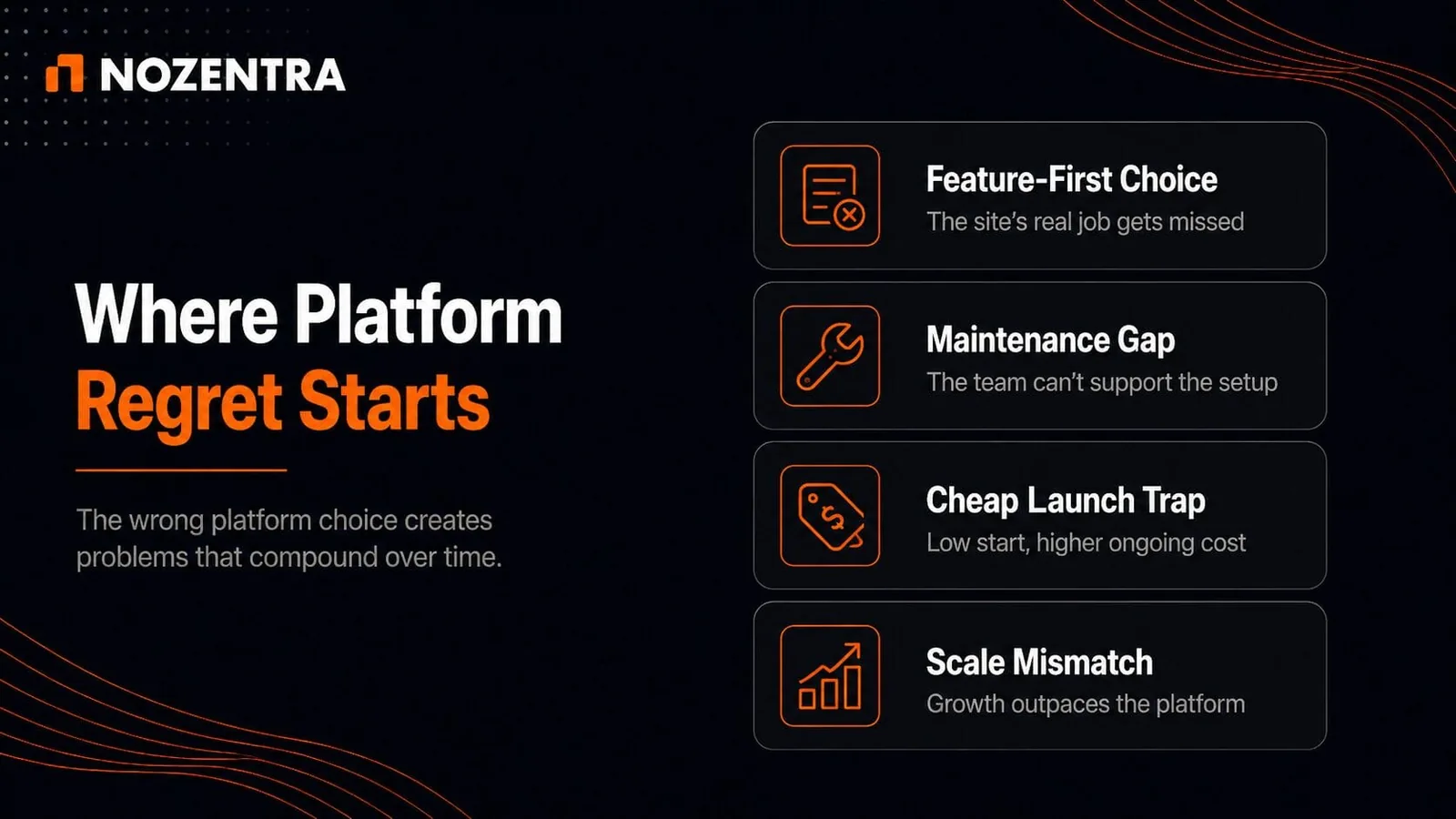
Most platform regret does not come from picking a bad tool. It comes from picking a good tool for the wrong job, then spending two years fighting it.
In our experience across 53 web builds, the decision rarely comes down to a feature comparison. It comes down to what the site is for, who will look after it, and what it really costs once the launch invoice is paid.
Key takeaways
Pick by the site's main job. Content and search growth points to WordPress, selling products to Shopify, design-led lead generation to Webflow.
WordPress runs 40.2% of all websites, Shopify 5.4% and Webflow 0.8% (W3Techs, 16 September 2026).
Webflow's Premium plan now includes 20,000 CMS items, but its ecommerce plans still top out at 15,000 items.
Shopify's real cost driver is apps, not the plan.
WordPress is the cheapest or most expensive option depending entirely on whether maintenance is somebody's job.
What is the site's actual job?
Write it in one sentence before you compare anything.
Publish content and win organic search over years: WordPress
Sell products as the core function: Shopify
Look sharp and convert leads through design: Webflow
That is most of the decision. The rest of this article is the evidence and the money.
How do the three compare side by side?
| Question | WordPress | Shopify | Webflow |
|---|---|---|---|
| Best for | Content and SEO growth | Selling products | Design-led lead generation |
| Setup speed | Slower, more moving parts | Often fastest to a first sale | Fast for design-heavy sites |
| Cost model | Free software, you pay hosting, plugins, upkeep | Monthly plan, payment fees, apps | Monthly plan, hosting included |
| Who maintains it | You or your agency | Low technical skill needed | Designers and marketers, fewer developer tickets |
| Technical SEO control | Deepest | Strong basics, more rigid structure | Solid, within plan limits |
| Catalogue ceiling | Set by your hosting (WooCommerce) | Built for large catalogues | 15,000 items on top ecommerce plan |
How popular is each platform?
Popularity is not a reason to choose a platform, but it does tell you how deep the market is for plugins, themes, hosting and people who can work on it.
- WordPress40.2%
- Shopify5.4%
- Wix4.2%
- Squarespace2.4%
- Joomla1.1%
- Webflow0.8%
Source: W3Techs, content management systems overview, 16 September 2026
Among sites that use a CMS W3Techs can identify, WordPress holds 58.8%.
When does WordPress make sense?
When content is the growth engine and you are willing to own the stack.
The software is free. Hosting, security, premium plugins and maintenance are yours to pay for.
You get the deepest control over hosting, structure and technical SEO of the three.
There is no platform cap on content or catalogue size. Your hosting sets the limit.
You own the upkeep: updates, backups, security and plugin conflicts. That is the whole trade.
It works when someone is accountable for it. For VIP Plumbing, we built a new WordPress site with the heading structure and technical SEO in place from day one, then ran local SEO on top. Organic traffic grew 500% and ranked keywords went from 95 to 156.
If nobody on your side owns maintenance, WordPress becomes the most expensive option on this list, and the bill arrives as rework.
When does Shopify make sense?
When the site's job is to sell, and you want the least friction between today and your first order. Inventory, checkout, payments, shipping and tax are built in.
| Shopify plan | Billed yearly | Billed monthly | Fee if you use a third-party gateway |
|---|---|---|---|
| Basic | $19/mo | $25/mo | 2% |
| Grow | $49/mo | $65/mo | 1% |
| Advanced | $299/mo | $399/mo | 0.6% |
| Plus | from $2,300/mo | from $2,300/mo | 0.2% |
The third-party fee disappears if you use Shopify Payments, which is the point of it. The bigger surprise is usually apps. Subscriptions, reviews, advanced filtering and loyalty tools can add up to more than the plan itself.
When does Webflow make sense?
When design control matters more than catalogue size, and your marketing team wants to publish pages without waiting on a developer.
Webflow changed its site plans on 13 May 2026, merging the old CMS and Business plans into one Premium plan:
| Webflow site plan | Price | What changed |
|---|---|---|
| Starter | Free | Webflow.io domain, limited CMS |
| Basic | $15/mo billed yearly | 300 static pages, no CMS |
| Premium | $25/mo yearly or $39/mo monthly | CMS items up from 2,000 to 20,000, collections up from 20 to 40 |
| Team | $2,500/mo, annual contract | Webflow Localize, publishing workflows, AEO agents |
Two limits are easy to confuse. CMS items (blog posts, case studies, other content) now go up to 20,000 on Premium. Ecommerce items are separate: Webflow says nothing changed for ecommerce plans, which still allow 500, 5,000 or 15,000 items. That is plenty for many small and mid-size stores. For large catalogues, Shopify is the smoother fit.
Which platform is best for SEO?
All three can rank. The platform is rarely the difference. Two things are:
How much technical control you get: URL structure, page speed, structured data, redirects.
How much of that control your team will actually use.
WordPress gives the most control and the largest plugin ecosystem. Shopify has strong fundamentals but fixed URL patterns such as /products/ and /collections/. Webflow is solid within its plan limits.
Unused control is worth nothing. A well-run Shopify store beats a neglected WordPress site.
What does each option cost over three years?
This is the question that should settle it, and almost nobody runs the numbers. Plan cost only, billed yearly, using the prices above:
- Webflow Basic540
- Shopify Basic684
- Webflow Premium900
- Shopify Grow1,764
Source: Shopify and Webflow published pricing, September 2026, calculated by Nozentra
WordPress is missing from the chart on purpose. Its licence costs nothing, and the rest (hosting, premium plugins, security, maintenance) depends entirely on who does the work. We will not invent a number for it, because that variability is the trade-off.
Whichever you choose, add payment processing fees, app or plugin subscriptions, and the time of whoever makes changes.
What should you decide before you commit?
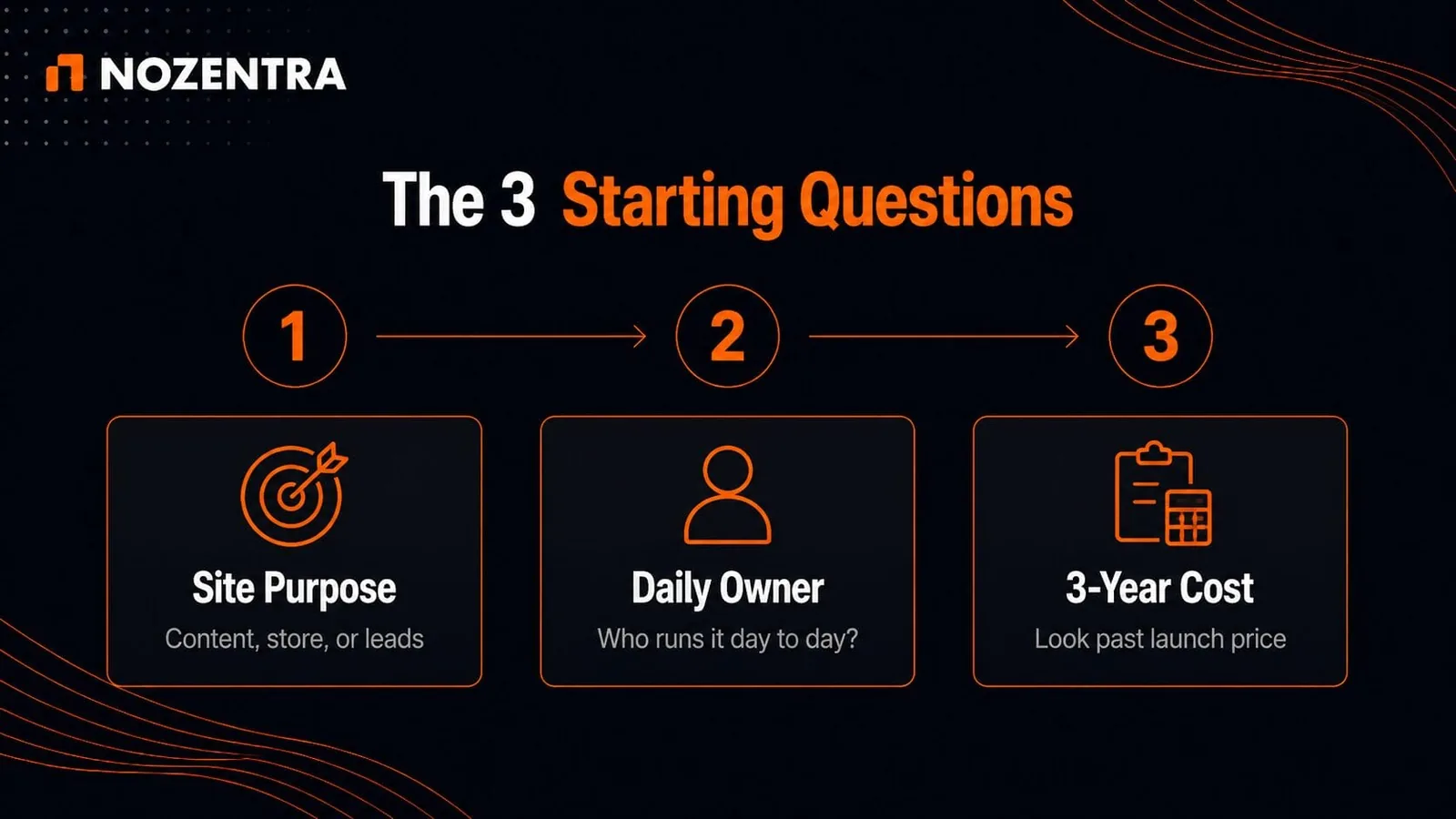
Answer three questions in writing:
What is the site's single main job? One sentence, not a list.
Who maintains it day to day? A developer, a non-technical marketer or an agency.
What is the realistic three-year budget, not just the first invoice?
If those answers do not point clearly at one platform, the problem is not the platform. The site's job has not been decided yet, which is the same issue behind websites that cannot scale.
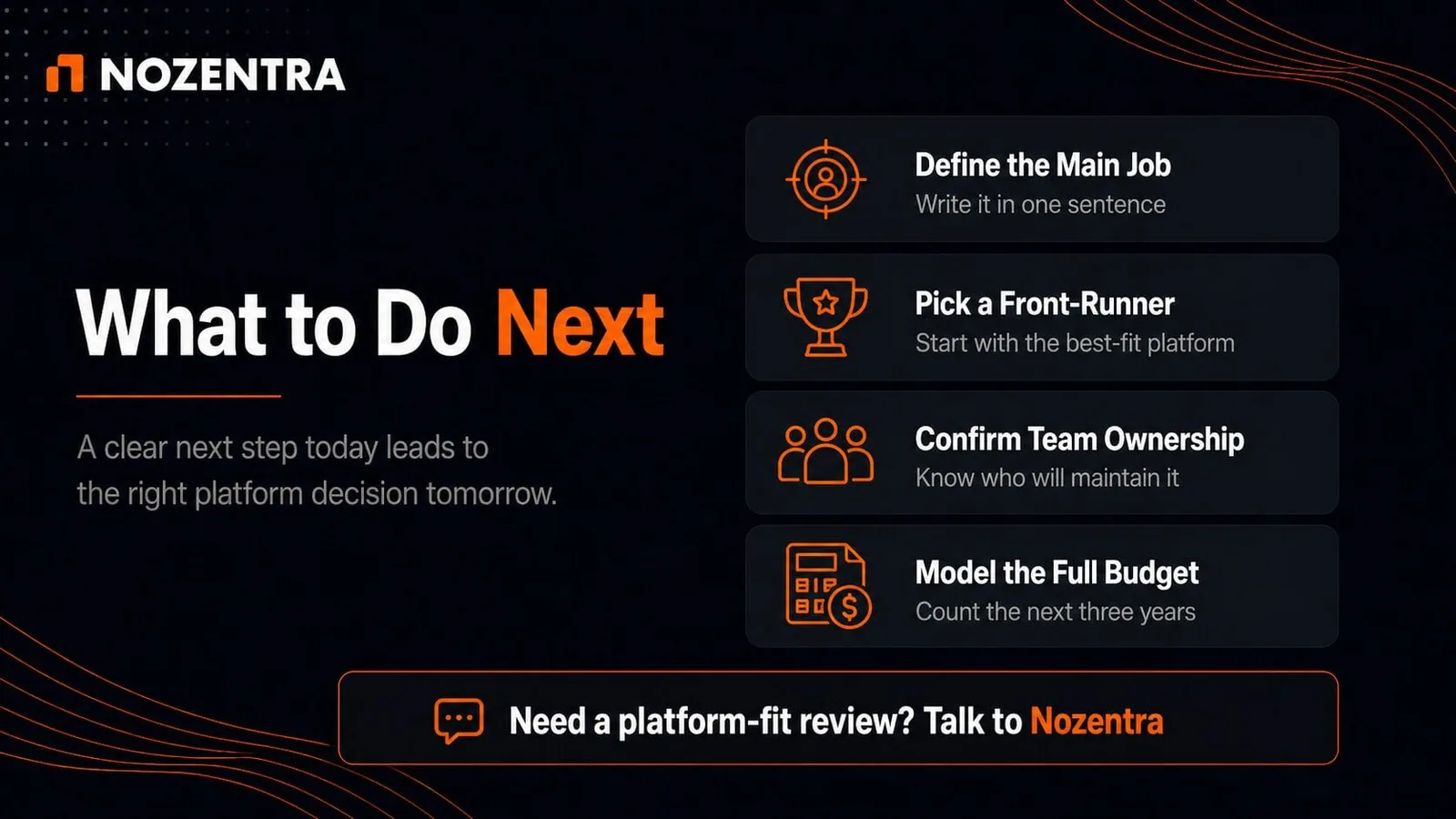
Weighing it up now? Tell us what the site needs to do and we will give you a straight answer, including "stay where you are" when that is right. See our website and ecommerce builds and website maintenance.
Frequently asked questions
Can WordPress handle ecommerce too?
Yes, through WooCommerce. It suits stores that also want deep content and SEO control, but it needs more setup and maintenance than Shopify's built-in store.
Is Webflow good enough for a full online store?
For many small and mid-size stores, yes. Webflow's largest ecommerce plan allows 15,000 items. Large or complex catalogues are usually a better fit for Shopify.
Does switching platforms later hurt SEO?
It can, if old URLs stop working. Map every old URL to its new home and add permanent redirects before launch. On Shopify you can import them as a CSV with two columns:
Redirect from,Redirect to
/shop/blue-widget/,/products/blue-widget
/category/widgets/,/collections/widgets
Handled carefully, a migration keeps the search value your old pages built up.