Content works when it is tied to a decision someone is actually trying to make. A keyword list can tell you what is being searched; it cannot tell you why a page should exist, who owns it, or what should happen after someone reads it. This is the approach Nozentra uses for content and demand work: start from the audience decision, give every article a defined role, and measure against a question set before the data arrives.
A topic is not yet a strategy
Content planning often begins with a list of phrases, competitor pages, or questions. Those inputs can be useful, but they do not explain why a piece should exist. A better starting point is the audience decision:
What is the person trying to understand, compare, avoid, or approve?
What evidence would genuinely help that decision?
What can Nozentra explain from a real capability, operating practice, or documented source?
This keeps publishing connected to service and proof. It also creates a clear reason to decline a topic. If a proposed article has no specific audience, no owned perspective, and no useful next decision, adding more words will not make it valuable. A thin page that ranks briefly and helps nobody still costs attention to maintain.
The test for declining a topic
Write the sentence a reader would say after finishing the article. If that sentence is "now I know what to do about X," the topic is worth planning. If it is "that was a definition of X," the topic probably belongs inside a stronger page rather than on its own URL.
Map the movement you expect
Each article should have a defined role. Roles are not interchangeable, and the role determines structure, internal links, and the useful call to action:
Definition pages establish a shared vocabulary so later comparisons make sense.
Comparison pages help a buyer weigh approaches, including the cases where your approach is the wrong one.
Implementation pages explain dependencies, sequencing, and what a team needs in place first.
Evidence pages show how an outcome was measured, with the limits of that measurement stated.
Nozentra can use AI to group research, identify recurring questions, test outlines, and support initial drafting. A human strategist remains responsible for the intent, factual basis, limitations, and final publication decision. The human owner also checks whether an article sounds like a capable agency explaining its work, rather than a machine filling a template. The boundary between assistance and authority is set out in using AI without giving up human ownership.
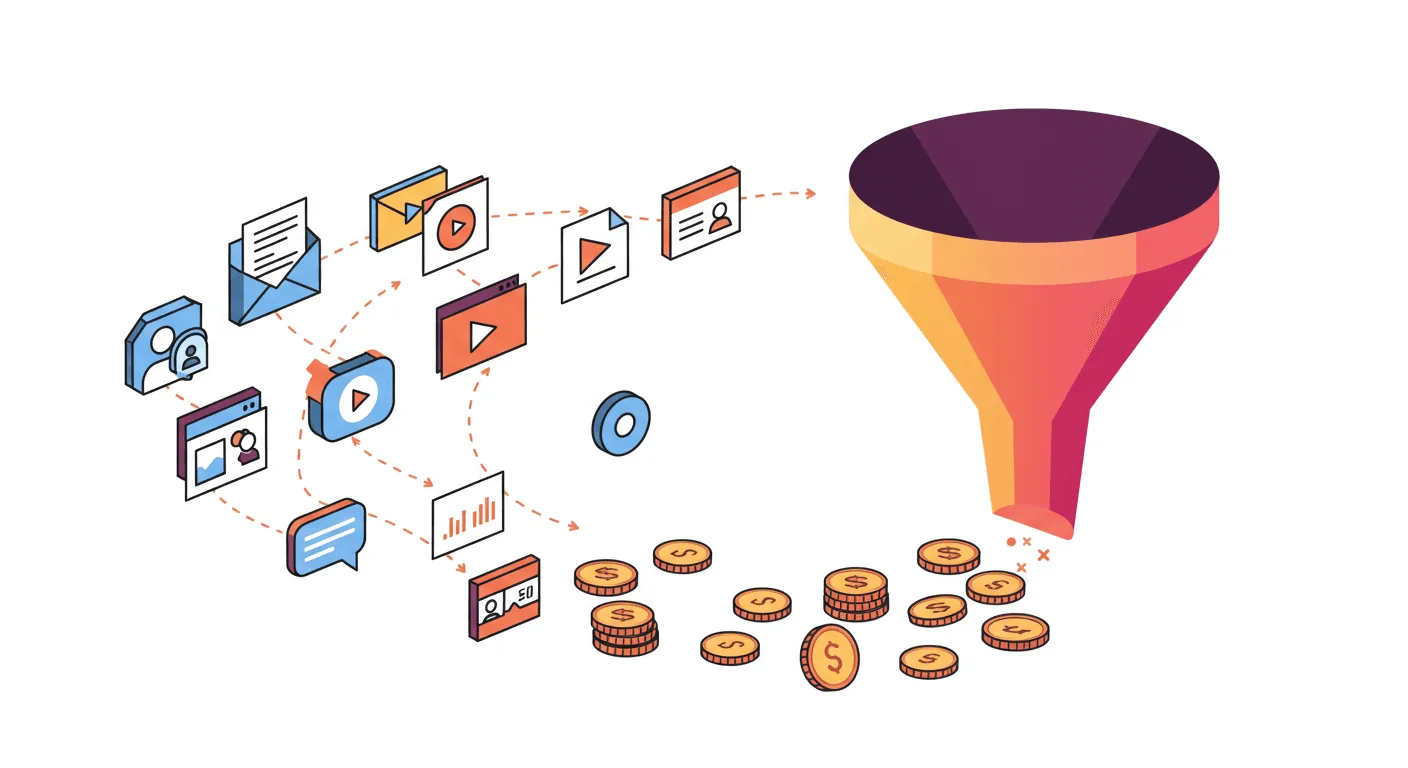
Make the next link a continuation, not a funnel
The next connection should be natural. A technical explanation may link to the relevant build service. A measurement guide may connect to CRO and analytics. A discoverability question may lead to AI search visibility. A reader with a combined constraint may need the one-team operating model.
Internal links also carry ranking value, so they should point deliberately. Link from supporting articles toward the page you want to rank, use anchor text that describes the destination, and avoid sending every reader down an identical path regardless of what they came to resolve.
Measure a useful signal
Traffic alone does not explain whether content helped. The measurement plan should name a question before data is collected:
Did qualified visitors reach a relevant service page?
Did the article answer a recurring sales question, reducing the time to a decision?
Did it improve discovery for an important subject, including inside AI answers?
Did it lead the team to revise an unclear offer?
The available evidence will vary. Search visibility, assisted journeys, enquiries, brand monitoring, and direct feedback can each contribute, but none should be presented as proof of causation without support. Reporting should separate observation from interpretation and name the missing context. A report that says "we cannot attribute this yet" is more useful than one that quietly implies a link that was never tested.
Maintain the collection as a system
Published content needs ownership after launch. Dates, links, examples, and service descriptions can become stale. Similar articles can compete with one another or leave a new visitor unsure which page is authoritative.
A regular review has three outcomes available:
Update: the page is still the right answer and needs current facts, examples, or links.
Consolidate: two pages are competing; merge them and redirect the weaker URL so its accumulated value is kept rather than discarded.
Withhold: the page no longer meets the standard and should come down with a redirect to the nearest useful answer.
Deleting a URL outright throws away every link and citation pointing at it. Redirecting keeps that value attached to the page that replaces it, which is why consolidation is usually the better move on an ageing collection. The same reasoning applies when a site is rebuilt, covered in planning a website that scales.
The workflow in short
Define the audience decision, gather owned evidence, draft with an accountable reviewer, connect the article to the correct next step, and schedule a measured review. This does not guarantee demand. It creates a disciplined way to learn what useful content contributes and where the wider build or growth system needs attention.
If content is running without a clear connection to a buyer decision, tell us what you are trying to move and we will say plainly whether more content is the right answer.