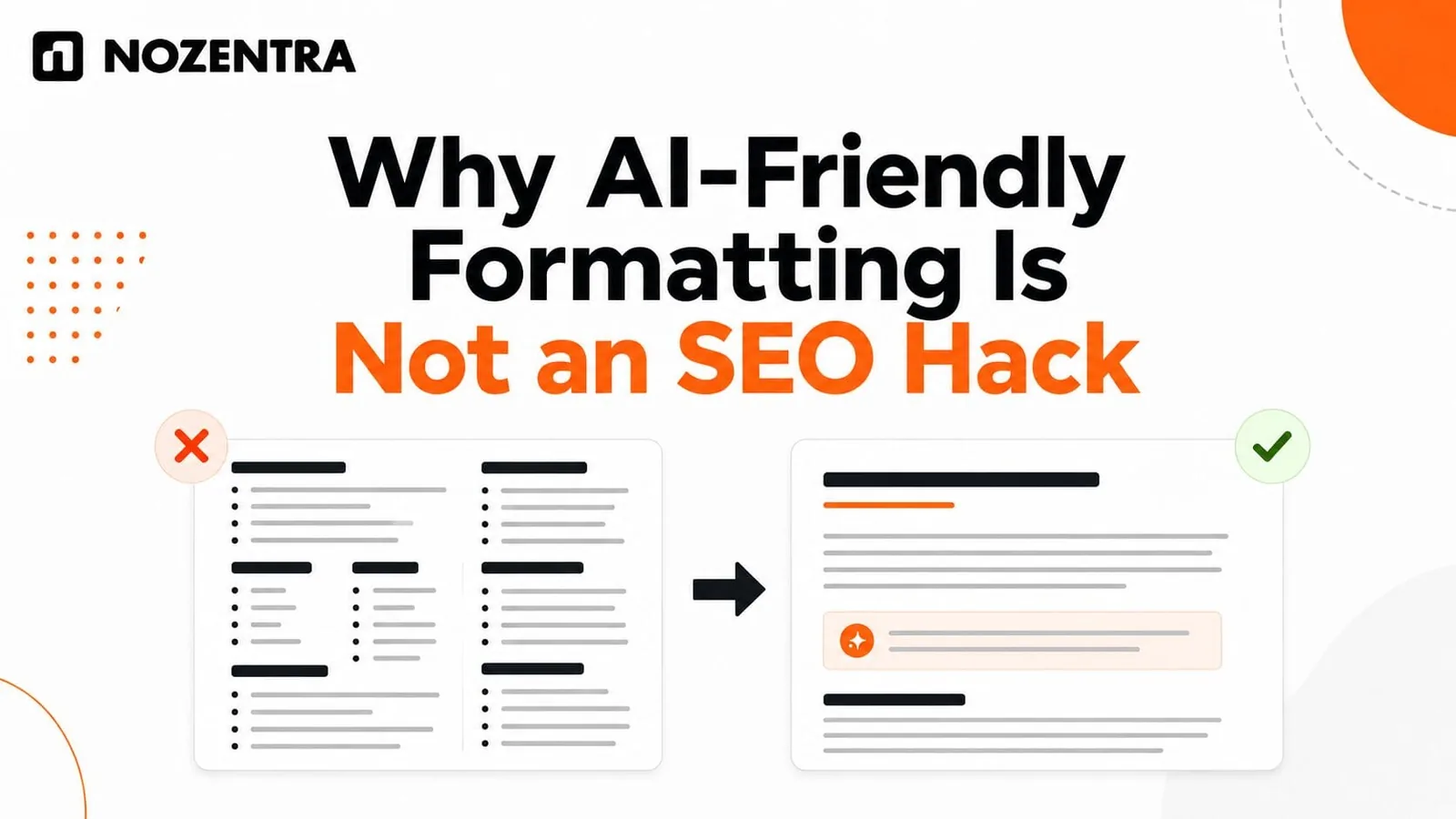
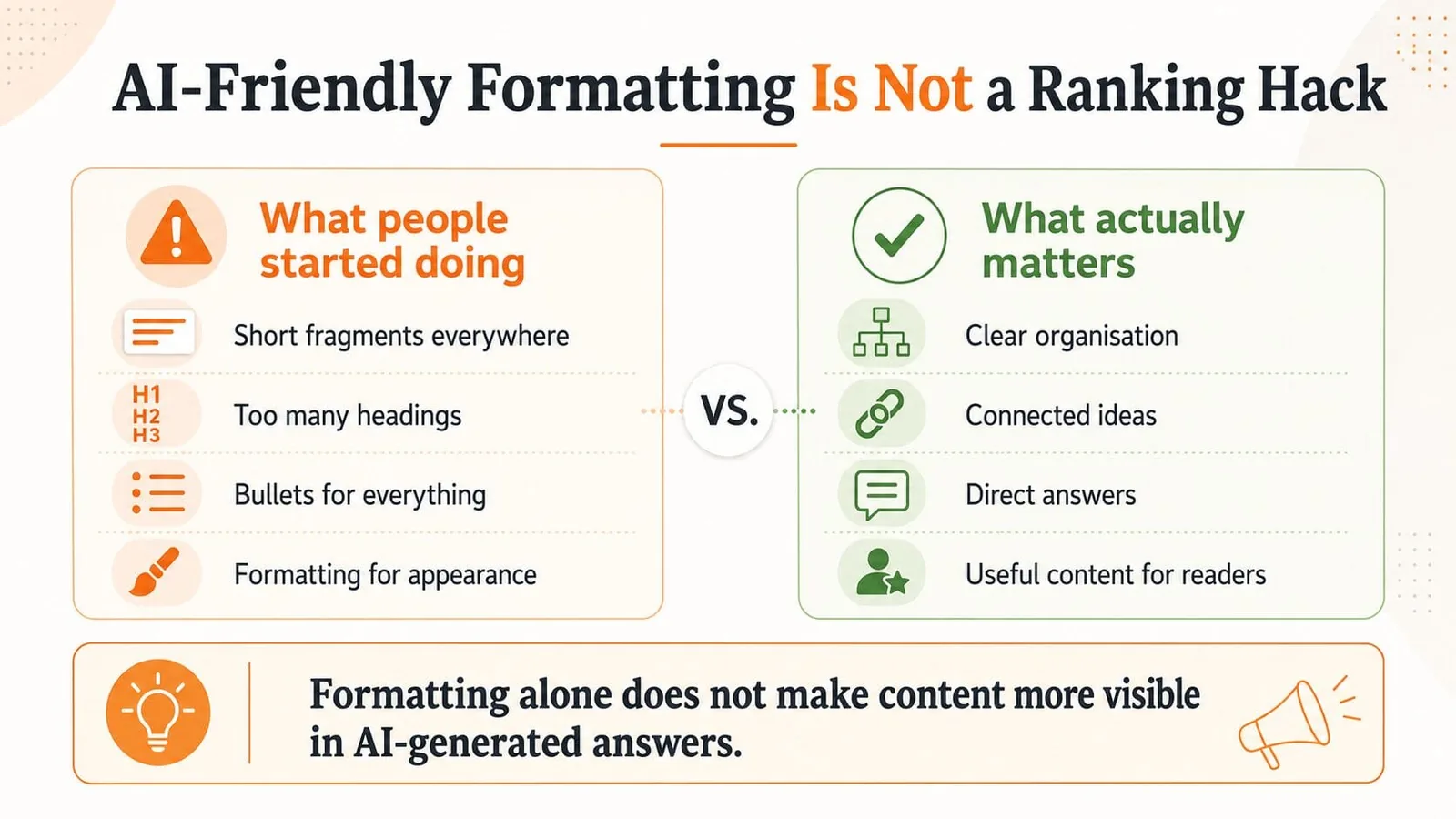
A popular piece of advice says AI systems prefer content broken into tiny pieces: short fragments, a heading every few lines, bullets everywhere.
Google says otherwise. Its guidance for AI search states that "There's no requirement to break your content into tiny pieces for AI to better understand it." Clear content helps because the ideas are clear, not because the page has been reshaped into a checklist.
Key takeaways
Google tells site owners to ignore "chunking" as an AI search tactic.
Danny Sullivan was blunter: "we don't want you to do that."
Structure should match the content. Tables for real comparisons, numbered steps for real sequences, paragraphs for connected ideas.
What helps is clarity: a direct answer, consistent names, accurate sourced facts and descriptive links.
The stakes are real. Google says AI Overviews has more than 2.5 billion monthly users.
Why does this matter so much now?
Because AI answers now reach a very large audience:
- AI Overviews, July 20252B
- AI Overviews, May 20262.5B
- AI Mode, May 20261B
Source: Alphabet Q2 2025 earnings call (July 2025); Google I/O 2026 keynote (May 2026)
At Google I/O in May 2026, Sundar Pichai said AI Overviews "now has over 2.5 billion monthly active users" and AI Mode had "surpassed 1 billion monthly active users." In July 2026, he added that Google is "sending billions of clicks to websites every week through AI features in Search."
With that much at stake, it is easy to see why formatting shortcuts spread. The problem is that they were never based on confirmed platform behaviour.
What does Google actually say about chunking?
Google's guide to AI features and your website lists it directly among things you can ignore:
For Google Search, you can ignore tactics like "chunking" content, creating unnecessary AI text files (like llms.txt), or pursuing inauthentic mentions.
It explains why: "Google systems are able to understand the nuance of multiple topics on a page and show the relevant piece to users." It also notes that shorter or longer pages can both work, depending on your audience and subject.
Danny Sullivan, Google's Search Liaison, addressed the trend on the Search Off the Record podcast in January 2026, as reported by Search Engine Roundtable:
We don't want people to have to be crafting anything for Search specifically.
Earlier in the same answer, about turning content into bite-sized chunks for LLMs, he said: "we don't want you to do that."
Why does over-formatting fall short?
It confuses surface structure with clarity. The logic goes: AI systems read text in chunks, so more, smaller chunks must help. In practice, a page broken into twenty disconnected fragments gives a system less context to work with, not more.
Compare the same point written two ways:
OVER-FORMATTED

## Returns
- 30 days
- Unworn
- Free

## Exceptions
- Sale items

CLEAR

## Can I return an item?

Yes. You can return unworn items within 30 days for free.
Sale items are final and cannot be returned.
The second version is shorter, easier for a person to read, and gives any system the relationships between the facts: what is allowed, under what condition, and the exception.
What actually helps AI systems use your content?
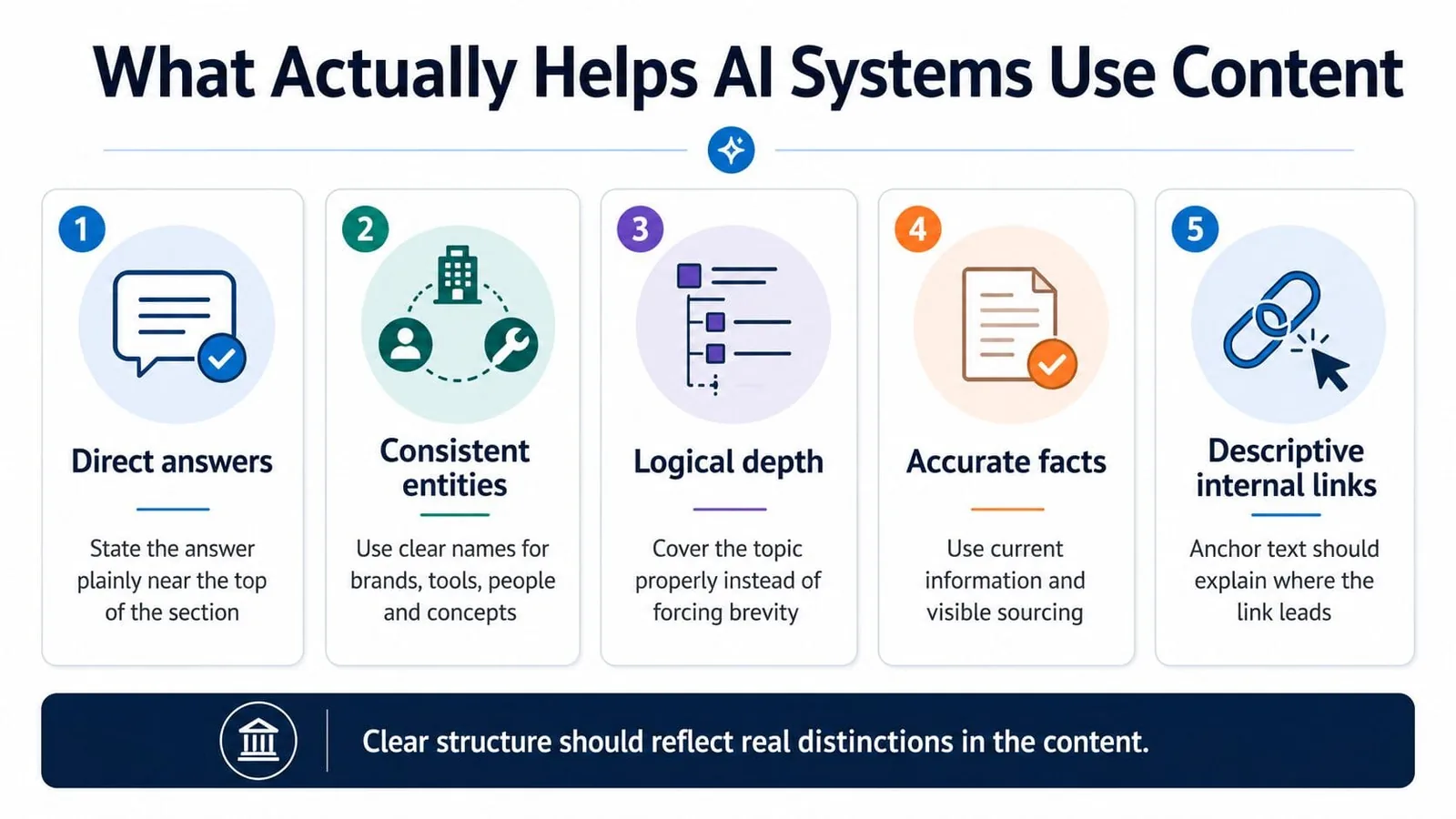
| What helps | What it looks like on the page |
|---|---|
| A direct answer | The answer in plain language near the top of the section |
| Consistent names | The same name for your brand, products and key concepts every time |
| Appropriate depth | As much detail as the topic needs, not forced brevity |
| Accurate, sourced facts | Current figures with a visible source |
| Descriptive links | Anchor text that says where the link goes, as Google's link guidance recommends |
| Organised sections | Paragraphs and headings that help a reader navigate |
That last point comes straight from Google: "People generally appreciate it when web pages are organized by paragraphs and sections, along with headings that provide a clear structure to navigate content." Structure is fine. Structure for its own sake is the problem.
On links, Google's guidance on crawlable links recommends anchor text that is descriptive and relevant to the page it points to.
How can you tell if your formatting helps or hurts?
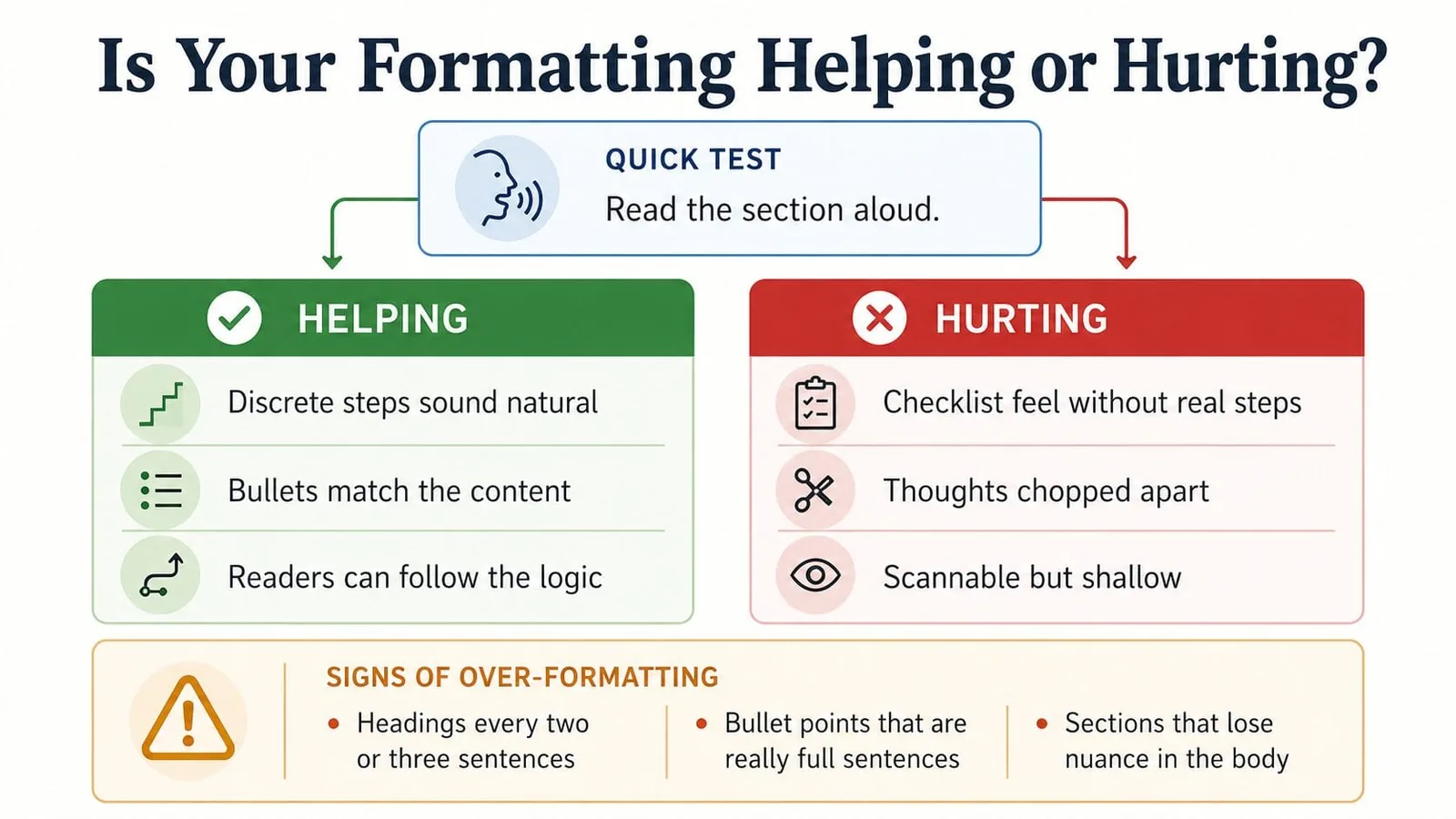
Read a section aloud. If it sounds like a checklist because the ideas really are separate steps, the bullets are doing their job. If it sounds like a checklist because complete thoughts were chopped apart, the formatting is working against you.
Signs of over-formatting:
A heading every two or three sentences with no real change of topic
Bullet points that are full sentences with a word removed
Sections that look fine as a table of contents but lose all nuance in the body
The same point repeated under several headings to look thorough
What should you do instead?
The fix is usually editorial, not technical:
Read the page as a visitor would, top to bottom.
Keep headings that mark a real question or decision. Merge sections that exist only for visual rhythm.
Turn fragment lists back into sentences where the items depend on each other.
Keep tables, steps and FAQs where they reflect a genuine comparison, sequence or follow-up question.
Check every fact is current and sourced.
We treat this as a quality check before anything is published: does the structure exist because the content needs it, or because a formula said so? Pages that pass tend to serve readers better, which is the more reliable route to AI visibility anyway.
For how AI systems choose what to cite, read how AI models and AI SEO work together. To check whether your pages appear in AI features at all, see how to track AI Overview visibility in Search Console. If you want a second opinion on your content structure, see our content and demand work or talk to us.
Frequently asked questions
Does Google penalise over-formatted content?
Google's guidance does not describe a penalty. It says chunking is not needed and can be ignored. The risk is wasted effort and pages that read worse for people.
Should I remove all headings and bullets?
No. Remove the ones that exist only for visual effect. Keep the ones that mark a real change of topic or a real sequence.
Are question-style headings a problem?
Not when they reflect questions your readers actually ask and sit above substantial answers. They become a problem when they are used to slice one idea into many thin sections.
What should I prioritise instead of formatting?
Clear, direct answers, accurate and current facts, consistent names and content that fully covers the question.
Sources
Google Search Central: AI features and your website (updated 10 July 2026)
Search Engine Roundtable: Google says don't turn your content into bite-sized chunks (9 January 2026)
Google: Google I/O 2026, Sundar Pichai's opening keynote (19 May 2026)
Google: Alphabet Q2 2025 earnings call, CEO's remarks (23 July 2025)
Google: Alphabet Q2 2026 earnings call, Sundar Pichai remarks (22 July 2026)