You cannot secure a fixed number-one rank in ChatGPT. To improve the chance that your business is mentioned accurately, make your pages accessible to search crawlers, explain clearly what you offer and who it helps, support important claims with evidence, and check the answers your prospective customers actually see. None of those steps guarantees a recommendation or citation.
The distinction matters. A mention names your business in an answer. A citation links to a source that supports an answer, which may be your site or someone else's. A referral is a visit from that answer to your site. Track each separately. OpenAI says ChatGPT web search can draw on targeted searches and that its citations can be incomplete or wrong, so a single favourable response is not a stable ranking position (OpenAI's search guidance).
This is a practical guide to ChatGPT SEO and broader AI search optimisation. It separates documented platform requirements from sensible experiments that still need to be measured for your business.
How do I get my business recommended by ChatGPT?
Start by making your business easy to discover and describe, then establish why it is a credible answer to a particular buyer question. ChatGPT chooses its own response, so no page edit, directory listing or agency can promise a recommendation.
Use this five-step sequence:
Write down the questions buyers ask. Include the problem, location, budget, industry and constraints that would change a good recommendation. “Which agency builds accessible ecommerce sites for UK retailers?” is more useful to test than “best agency”.
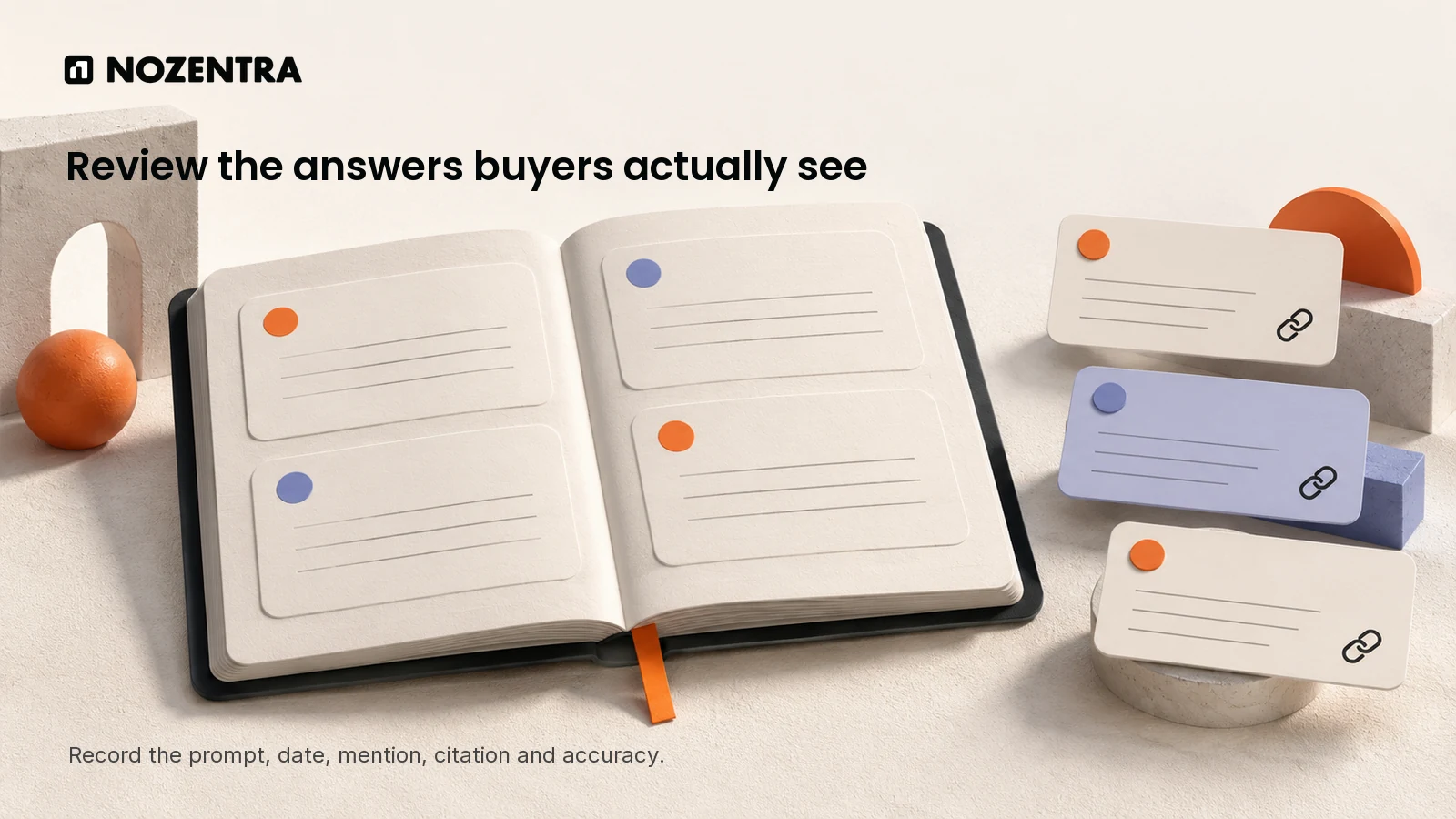
Record a baseline. Run those exact questions in ChatGPT with web search, Google AI Mode or AI Overviews where available, and Perplexity. Save the date, market, full prompt, answer, brand mentions and visible citations. Do not merge results from different platforms into one score.
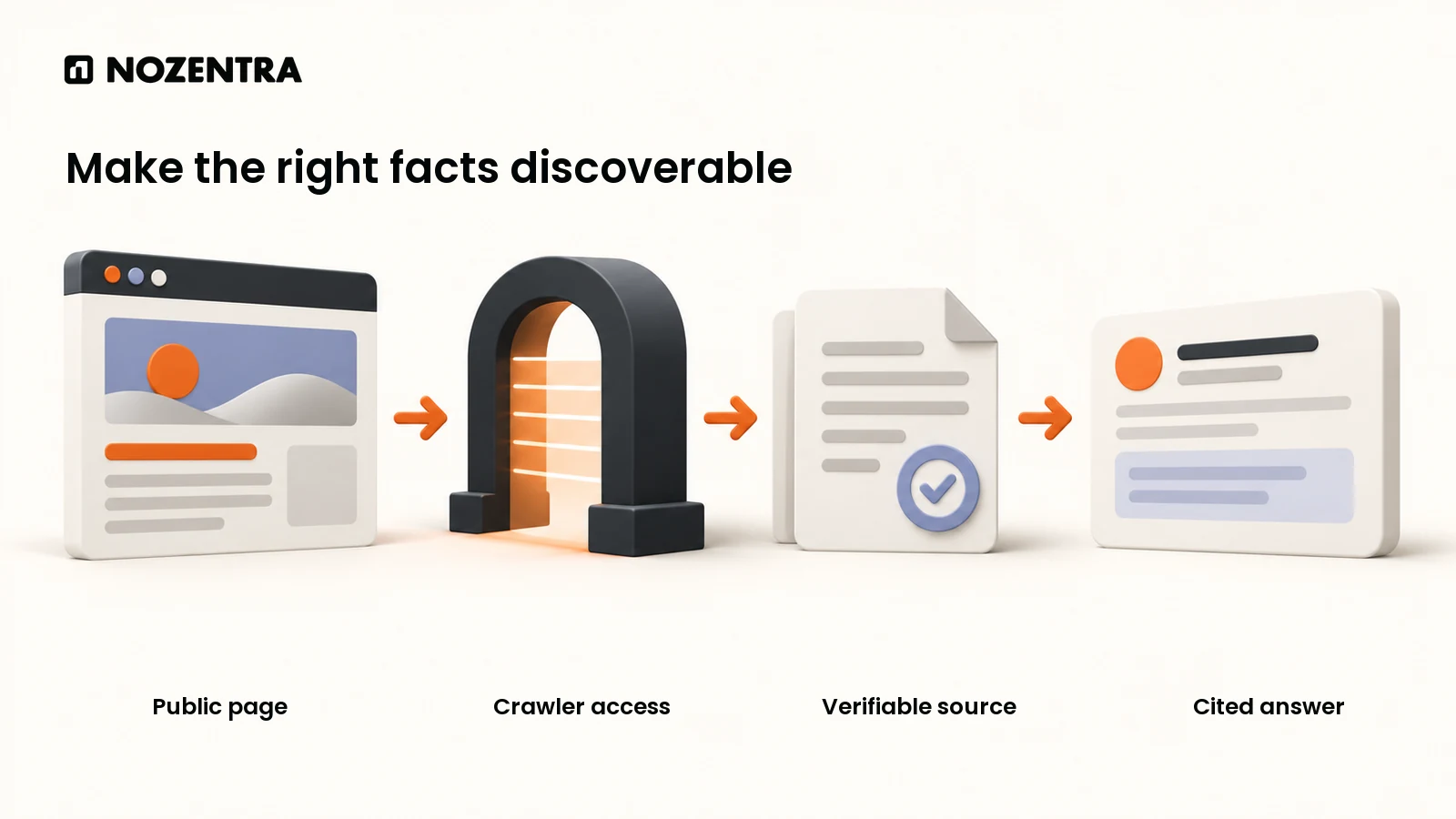
Check access and clarity. Confirm that the relevant pages load publicly, present their main facts as readable text, and have sensible internal links. A crawler should be able to reach a page that clearly states your service, audience, location, scope and evidence.
Strengthen the evidence. Publish useful explanations of real work, methodology, limitations and decision criteria. Correct outdated information on your own pages and on relevant independent profiles or publications you can legitimately update.
Repeat the same tests. Compare later answers with the saved baseline. Look for accurate mentions and relevant citations, then investigate the pages that actually appeared. Record changes without claiming that a single edit caused them.
The quality of the answer matters as much as inclusion. If an AI answer describes a service you no longer provide, correct the source material before celebrating the mention. For a wider explanation of how search engines and models interact, read our AI models and AI SEO explainer.
How does ChatGPT decide which websites to cite?
OpenAI has not published a complete ranking formula for ChatGPT citations. Its public guidance says ChatGPT may search the web, may rewrite a question into targeted searches sent to search partners, and may show source links. It also warns that results and citations can be incomplete, outdated or incorrect (OpenAI Help Center). Relevance to the question and access to a useful page are practical prerequisites; neither establishes that the page will be cited.
There is one technical check you can make with confidence. OpenAI identifies OAI-SearchBot as the crawler for ChatGPT search. A site that opts out will not appear in ChatGPT search answers, apart from possible navigational links. OpenAI distinguishes that bot from GPTBot, which concerns content that may be used to train foundation models. Allowing search access does not require allowing training access (OpenAI crawler documentation).
Ask your website team to check robots.txt, page-level indexing controls, firewall rules and the page as a public visitor sees it. Then inspect the live answer's sources. A citation may point to an independent review, a directory or a publisher rather than your website. If that page is inaccurate, address the real page and its publisher. Do not assume that adding your brand name to more pages will improve an answer.
Is generative engine optimisation (GEO) different from SEO?
GEO focuses on whether a business or source is represented in generated answers, while SEO covers discoverability and usefulness in search results more broadly. The work overlaps heavily: crawlable pages, clear content, trustworthy evidence and relevant links help people and search systems understand a site. The term GEO does not describe a separate, proven set of ranking tricks.
For a business, the useful difference is in what you observe. Conventional SEO reports may show indexed pages, queries, clicks and search traffic. AI-answer review adds the exact prompt, whether your business was named, how it was described and which sources were linked. These observations can change between runs, so keep the raw answers and dates. Our guide to answer engine optimisation and user intent explains the broader shift; the actions here are the website and evidence checks you can perform now.
Treat a new acronym or vendor tactic as a hypothesis until the relevant platform documents it or your own repeatable review supports it. A format that makes a page easier for a person to use may be worthwhile. Claims that a particular phrase count, AI-only file, FAQ markup or “citation score” forces a model to recommend a business are unproven.
Can I optimise my website for Google AI Overviews and AI Mode?
Yes. Start with Google's ordinary Search requirements and people-first content. Google says pages need to be indexed and eligible for a snippet to appear as supporting links. It says there are no additional technical requirements or special AI-specific optimisations for AI Overviews or AI Mode (Google Search Central).
Check that Googlebot can crawl the page, that it is linked from other relevant pages, and that the answer to the user's question is present in readable text. Keep your business details current. If you use structured data, make sure it agrees with what visitors can see. Google notes that AI Overviews and AI Mode may run several related searches to assemble an answer, which is a reason to cover the important subquestions a buyer genuinely has, without padding a page with repeated keywords (Google's AI features documentation).
The best content choice depends on the question. A concise service page may answer who you serve and how to contact you. A comparison may help someone choose between approaches. A how-to article may explain the process and its limits. Link those pages where the relationship is useful. Our AI version of a website guide discusses how to keep website information coherent across experiences.
| Surface | What the platform confirms | What to check |
|---|---|---|
| ChatGPT search | OAI-SearchBot is used for search; answers may cite sources | Search-bot access, public page clarity, the exact answer and its visible sources |
| Google AI Overviews and AI Mode | Normal Search eligibility and SEO practices apply; no special AI markup is required | Indexing, snippet eligibility, internal links, useful text and visible structured facts |
| Perplexity | Answers are presented with web-source citations | The answer and source links for your buyer's actual question; verify any claim against the linked page |
Perplexity describes its product as a web-first answer engine with inline citations (Perplexity). For Perplexity SEO, start by inspecting those displayed sources for the buyer's actual question. A citation there does not predict what ChatGPT or Google will show.
Does schema markup help my site appear in AI answers?
Accurate schema markup can help search engines understand supported facts about a page, but there is no verified schema type that guarantees inclusion or a citation in an AI answer. Google explicitly says no special schema.org markup is needed for AI Overviews or AI Mode (Google Search Central).
Use structured data where it accurately describes visible content and matches a supported Search feature. Google's structured data introduction explains how it can support eligible rich results; it does not promise a place in an AI-generated answer. Check names, services, locations and other facts against the page itself. A misleading markup block is a poor substitute for a clear service description.
For ChatGPT, OpenAI's public search and crawler guidance does not identify schema markup as a citation requirement. If a vendor says a markup change alone will make ChatGPT recommend you, ask for the platform source and a measurement plan before accepting the claim.
What is the best way to measure AI search visibility?
Use a small, repeatable question log that separates visibility from accuracy and visits. Begin with ten to twenty questions taken from real sales enquiries, support requests or customer interviews, if you have them. If you do not, start with a smaller documented set and label it as an editorial hypothesis. Use the same wording and market settings on each review date, while accepting that answers can still vary.
For each question, record:
The platform, date, location or language setting, exact prompt, and whether a web-search feature was active.
Whether the business was mentioned, whether its own site was cited, and which other URLs were cited.
Whether the service, location, price and limitations were described correctly.
Whether a visitor actually arrived from an AI answer, where your analytics can identify that referral.
Do not label every brand mention a citation. Do not infer that a missing link means your site was never considered. OpenAI's guidance says citations can be incomplete or incorrect, so open the source and check what it really supports. Google's Search Console includes AI features within overall Search traffic reporting, rather than offering a guaranteed citation count for every answer (Google's measurement guidance).
If this work needs an owner, define a modest cycle: review the prompt log, fix one important access or accuracy issue, improve one useful page, and inspect the next set of answers. Nozentra's AI Search Visibility service is built around a dated baseline, an entity and content plan, and review. It does not promise a fixed AI ranking or a guaranteed mention.
The goal is to make your business a clear, verifiable choice when it genuinely fits the question, and to notice when an answer gets the facts wrong. That is a better basis for action than chasing an imagined ChatGPT position.