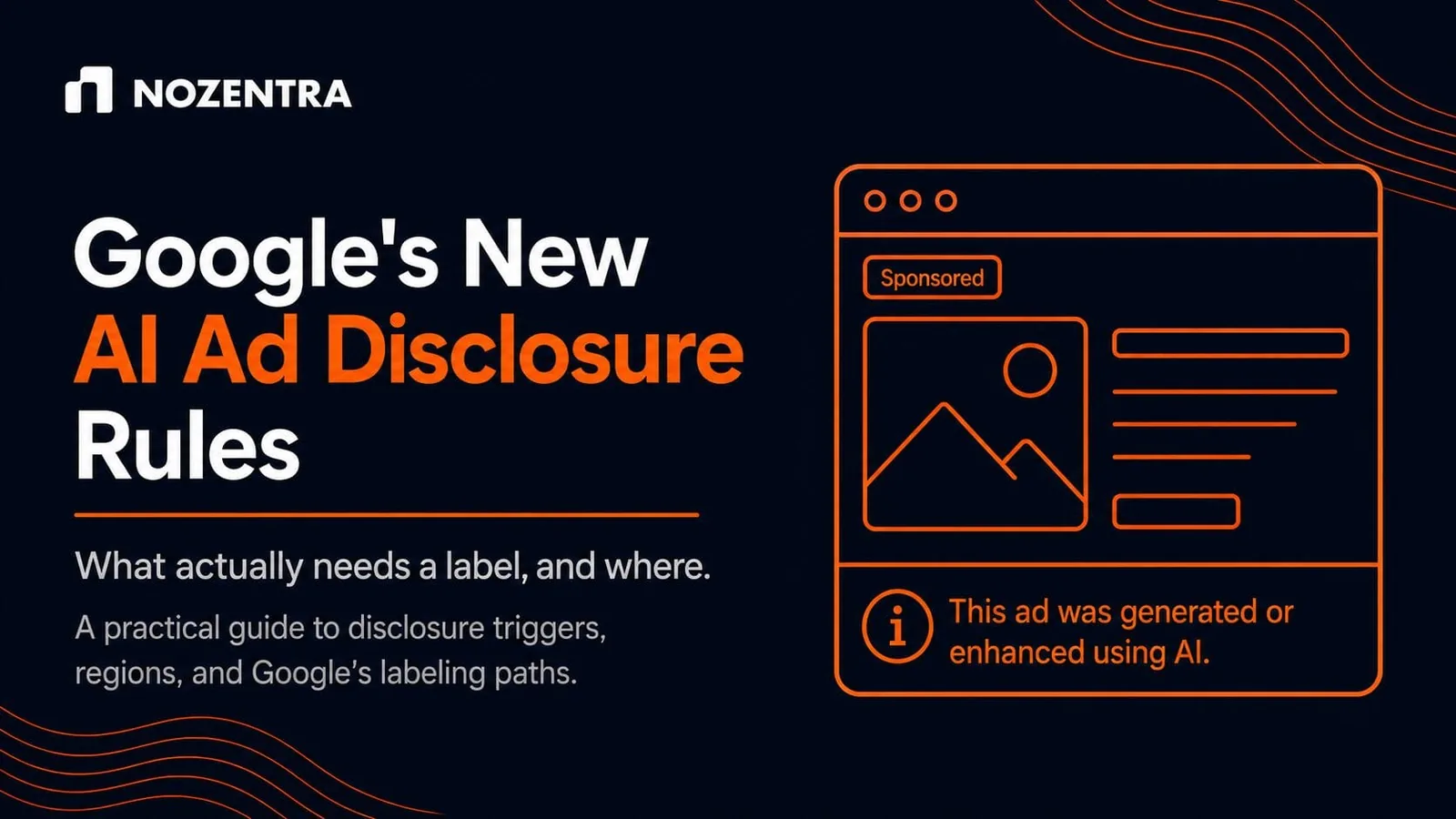
On 9 July 2026, Google added a "How this ad was made" panel to My Ad Center. It shows whether an ad was created or edited with generative AI.
That does not mean every ad that touched AI needs a label. The real questions are narrower: did AI substantively change the creative, and does the ad run somewhere the law requires disclosure?
Key takeaways
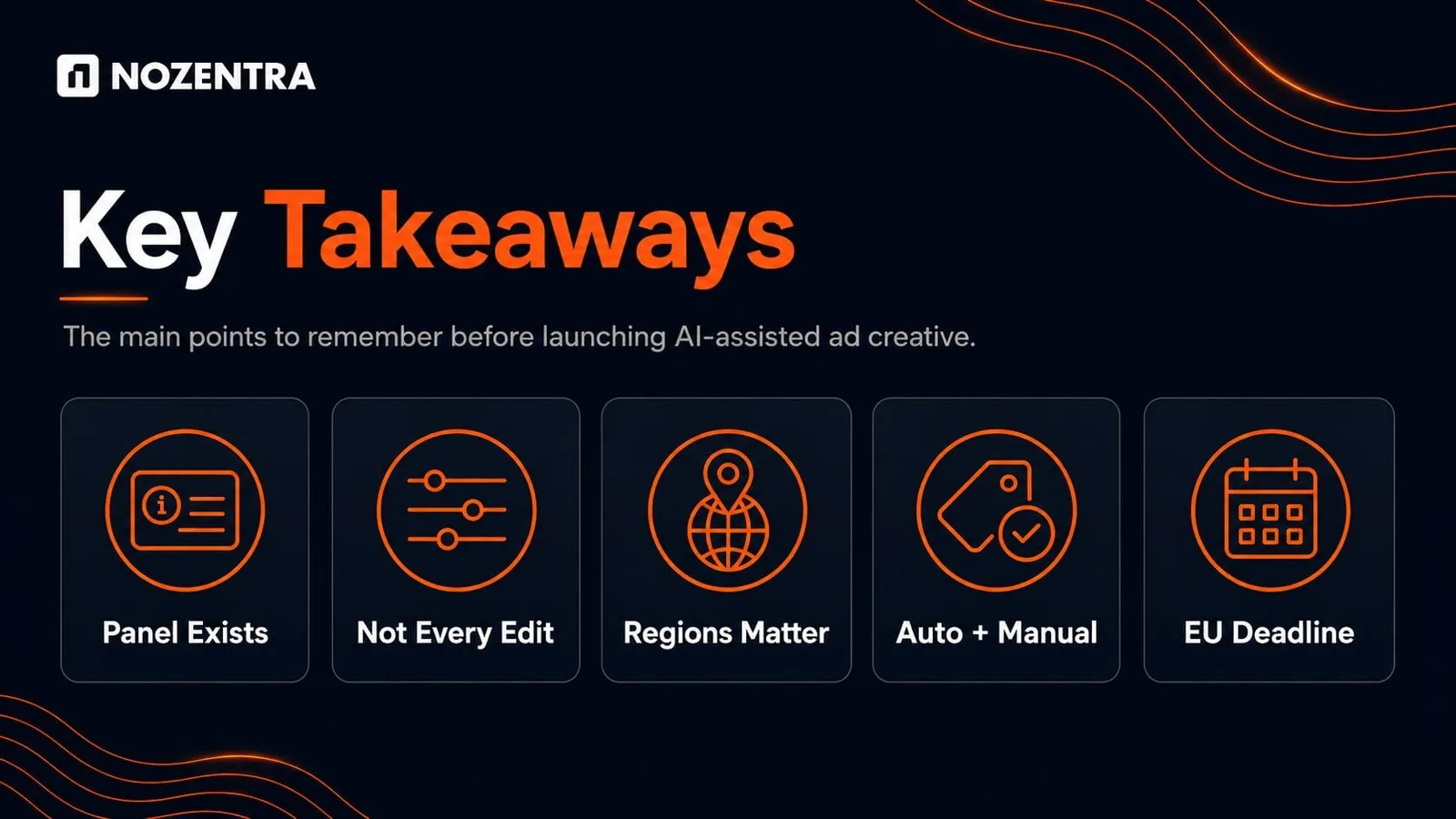
The panel is global. People open it from the three-dot menu or info icon on ads across Search, YouTube and Discover.
Minor edits usually do not count. Google's election ad policy explicitly exempts resizing, cropping, colour correction and defect fixes.
Region decides whether a label appears on the ad itself. Google names the EU, India and New York as examples of places with disclosure rules.
Google labels its own AI output automatically. For creative made elsewhere, you declare it through a "Review assets" prompt.
The EU rules now apply. Article 50 of the AI Act has applied since 2 August 2026.
What did Google actually launch?
Google announced the change in a post by Keerat Sharma, VP and General Manager of Ads Privacy and Safety. There are three parts:
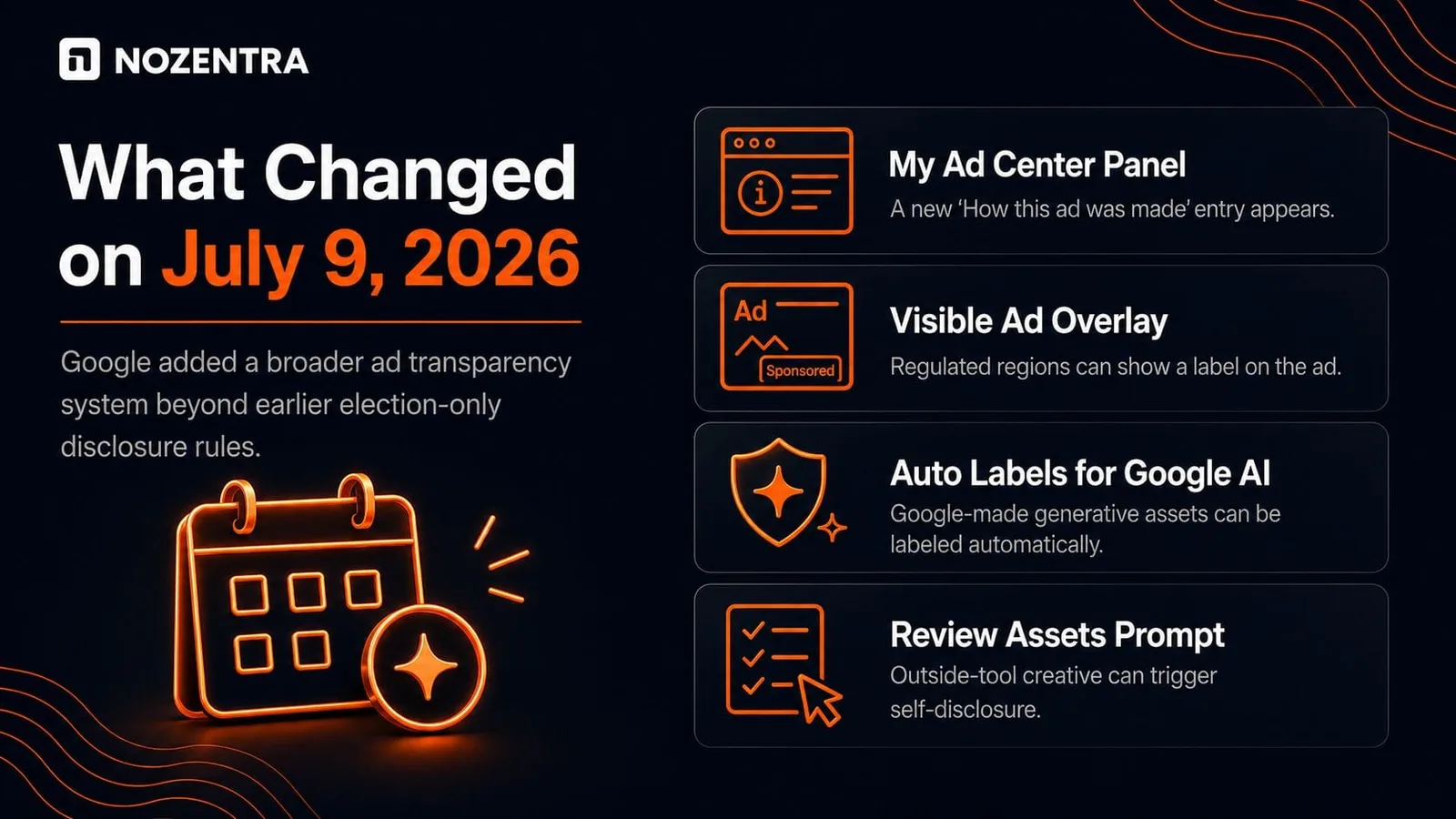
| Part | What it does | Who triggers it |
|---|---|---|
| "How this ad was made" panel | Shows whether AI was used to make or edit the ad | Available on ads everywhere |
| Label on the ad itself | A visible label directly on the ad | Local legal requirements |
| Automatic labels | Marks assets made with Google's generative AI tools | |
| "Review assets" prompt | Lets you declare creative made with other AI tools | You, during campaign setup |
Google also says it embeds imperceptible signals such as SynthID into output from its own generative tools.
Which edits need a label, and which do not?
Google has not published a detailed exemption list for ordinary commercial ads. Its election ad policy is the clearest guide to where it draws the line. That policy says disclosure is not needed for changes that are "inconsequential to the claims made in the ad":
| Usually no label | Likely needs a label |
|---|---|
| Resizing or cropping | A realistic person who does not exist |
| Colour or brightness correction | Someone appearing to say or do something they did not |
| Red-eye or defect removal | Generated or altered footage of a real event |
| Minor background clean-up | AI voice that sounds like a real person |
Treat that as a guide, not a guarantee. When an edit changes what the ad shows or claims, label it.
Here is the decision as a simple flow:
Did AI generate or substantively change this asset?
|
+-- No (cropping, resizing, colour fixes) --> no label needed
|
+-- Yes --> Was it made with Google's own generative AI tools?
            |
            +-- Yes --> Google labels it automatically
            |
            +-- No  --> Declare it in "Review assets"
                        and check the rules where the ad runs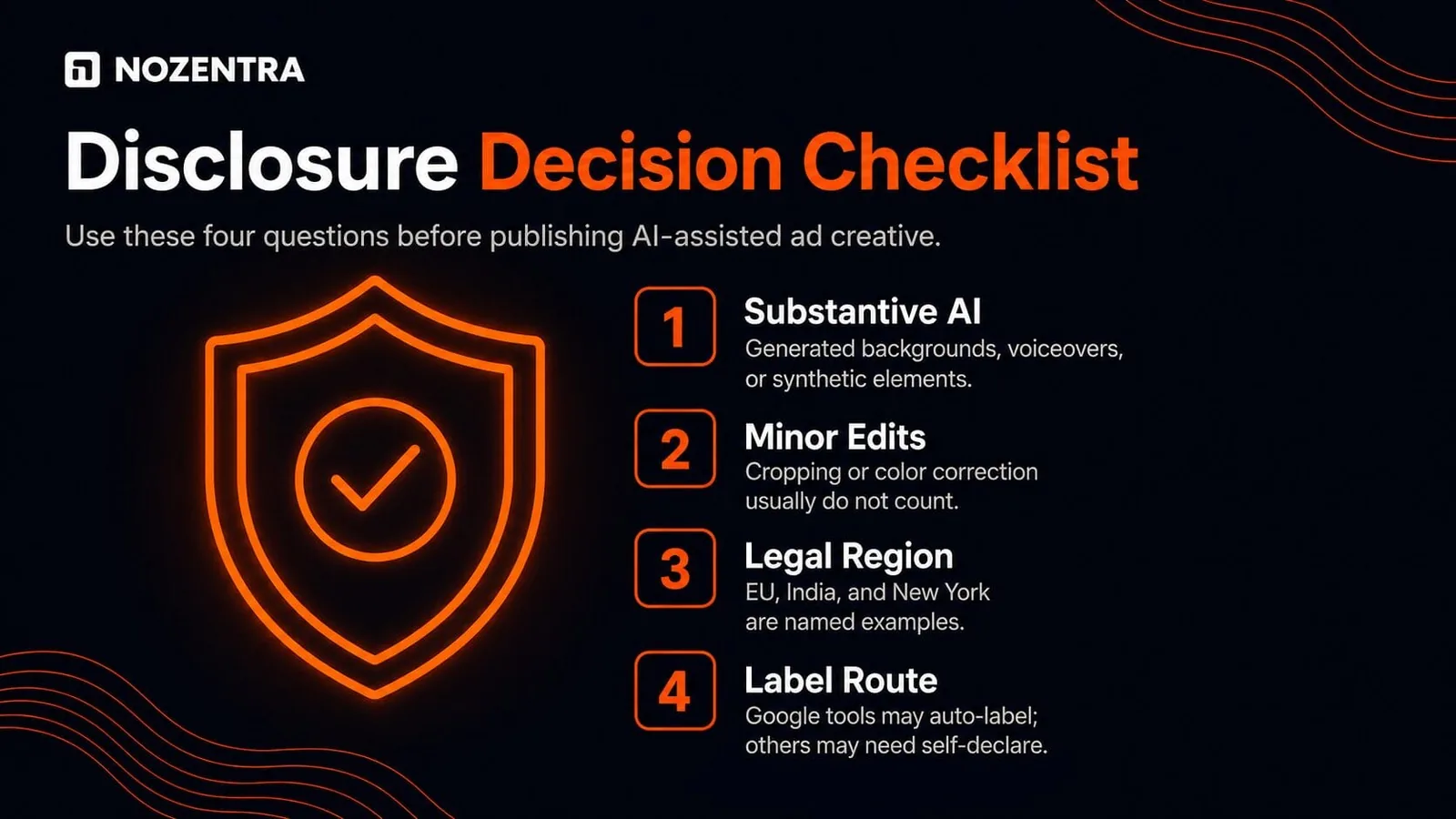
Where is a label legally required?
Google's My Ad Center help page names the EU, India and New York as examples of locations with disclosure requirements. It is a list of examples, not a complete one.
| Region | Rule | Applies from | Who it targets |
|---|---|---|---|
| India | IT Amendment Rules 2026 on synthetically generated information | 20 February 2026 | Large social media platforms must label synthetic content |
| New York | Synthetic performer disclosure law | 9 June 2026 | Anyone producing an ad with an AI-generated performer |
| European Union | AI Act, Article 50 | 2 August 2026 | Deployers must disclose deepfakes, providers must mark AI output |
Two details matter for EU campaigns:
According to the European Commission, deployers, which includes advertisers who publish AI content, must disclose deepfakes "to a natural person upon first exposure at the latest."
Generative AI systems already on the market have until 2 December 2026 to add machine-readable marking to their output.
New York's Governor described the law as the first of its kind in the US, requiring anyone who produces an ad to identify when it includes "AI-generated synthetic performers."
How do Google's automatic labels work?
If you build creative with Google's own generative tools, Google adds the disclosure for you. Its Google Ads help page also warns that these labels "cannot be overwritten."
For creative made outside Google, you get a "Review assets" prompt while creating or editing a campaign. For each asset you choose one of two options:
"Label this asset as created or edited with AI"
"Don't label this asset"
Self-declaring is not the only route. Google says it "may label your assets in some cases, such as in regions where Google itself is legally required to do so, or when we get signals to do so from other platforms."
Is Google the only platform doing this?
No. Meta announced AI labels for ads in February 2025. Its label appears in the three-dot menu, or next to "Sponsored" when an ad includes an AI-generated photorealistic person.
The pattern repeats across platforms: a transparency feature arrives first, and regional law makes it mandatory soon after.
Where do advertisers usually get this wrong?
In the Google Ads accounts we review, the gap is rarely that nobody knows the feature exists. It is treating "AI disclosure" as one task when it is two separate checks:
Does this asset cross the line from routine editing into substantive AI generation?
Does this campaign target a region that legally requires a visible label?
Build both checks into your pre-launch creative review, alongside Google's own prompt.
What should you do next?
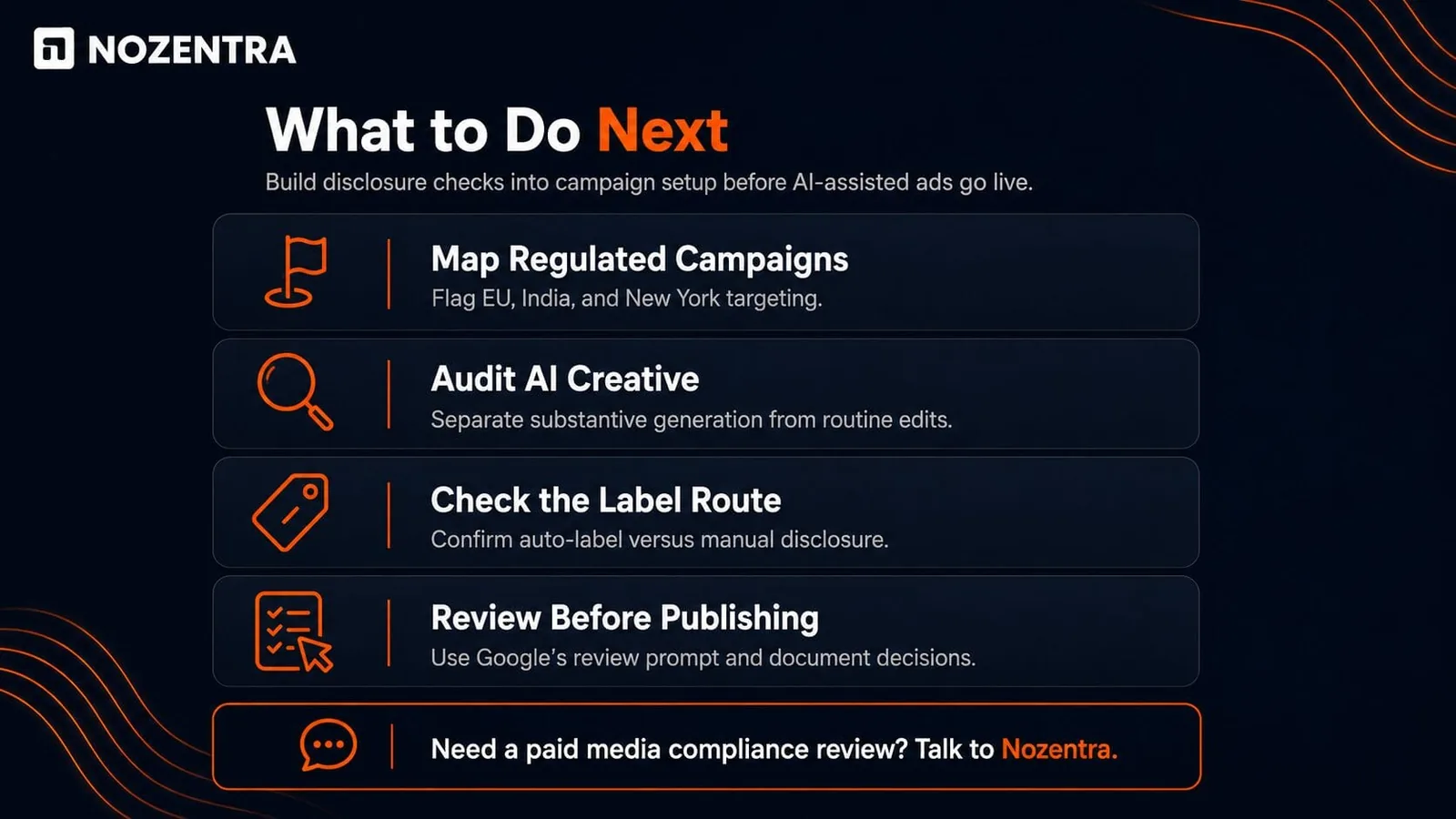
List campaigns that target the EU, India or New York. Remember these are Google's examples, not the full list.
Audit your creative and separate substantive AI generation from routine edits.
Split assets by origin: made with Google's tools (labelled automatically) or made elsewhere (declare in "Review assets").
Record your decisions so you can show why each asset was or was not labelled.
Recheck EU campaigns against Article 50, especially anything showing realistic people.
Not sure which campaigns are affected? Ask us for a review and we will check your account against current regional rules as part of a targeting and creative audit. The recent Google Ads terms of service update is worth checking at the same time.
Frequently asked questions
Do I have to label every ad that touched AI?
No. Google's scope is substantive generation or editing, not any AI involvement. Its election ad policy explicitly exempts routine edits, and its commercial guidance points the same way.
Can Google label my ad without me declaring it?
Yes. Google says it may label assets where it is legally required to, or when it receives signals from other platforms. Labels on ads made with Google's fully automated features cannot be overwritten.
Does the EU rule apply to every AI-assisted ad?
No. Article 50 covers specific cases, such as deepfakes that depict real-seeming people, places or events. Clearly artistic, creative or satirical work has lighter disclosure duties.
Sources
Google: Google introduces new AI labels for Ads (9 July 2026)
Google Ads Help: Use AI content label settings and disclosures
European Commission: Transparency obligations under Article 50 of the AI Act (updated 24 July 2026)
Governor of New York: Synthetic performer disclosure law in effect (9 June 2026)