Choose an AI agency by matching its delivery skills to a specific business problem, checking evidence of comparable work, and agreeing how you will test the result. Before you hire, get clear answers on data access, ongoing costs, human oversight and what you can take with you if the relationship ends.
An impressive demonstration can help you understand an idea. It cannot tell you who will maintain the integration, approve a sensitive action or fix a broken workflow after launch. Those details belong in the buying decision.
This guide gives you ten questions to ask an AI agency, the evidence to request, and a way to compare proposals without needing to become an AI engineer.
What does an AI agency do?
An AI agency helps a business design, build or improve products and processes using artificial intelligence. The term covers several kinds of provider, so ask what the agency actually delivers before comparing prices.
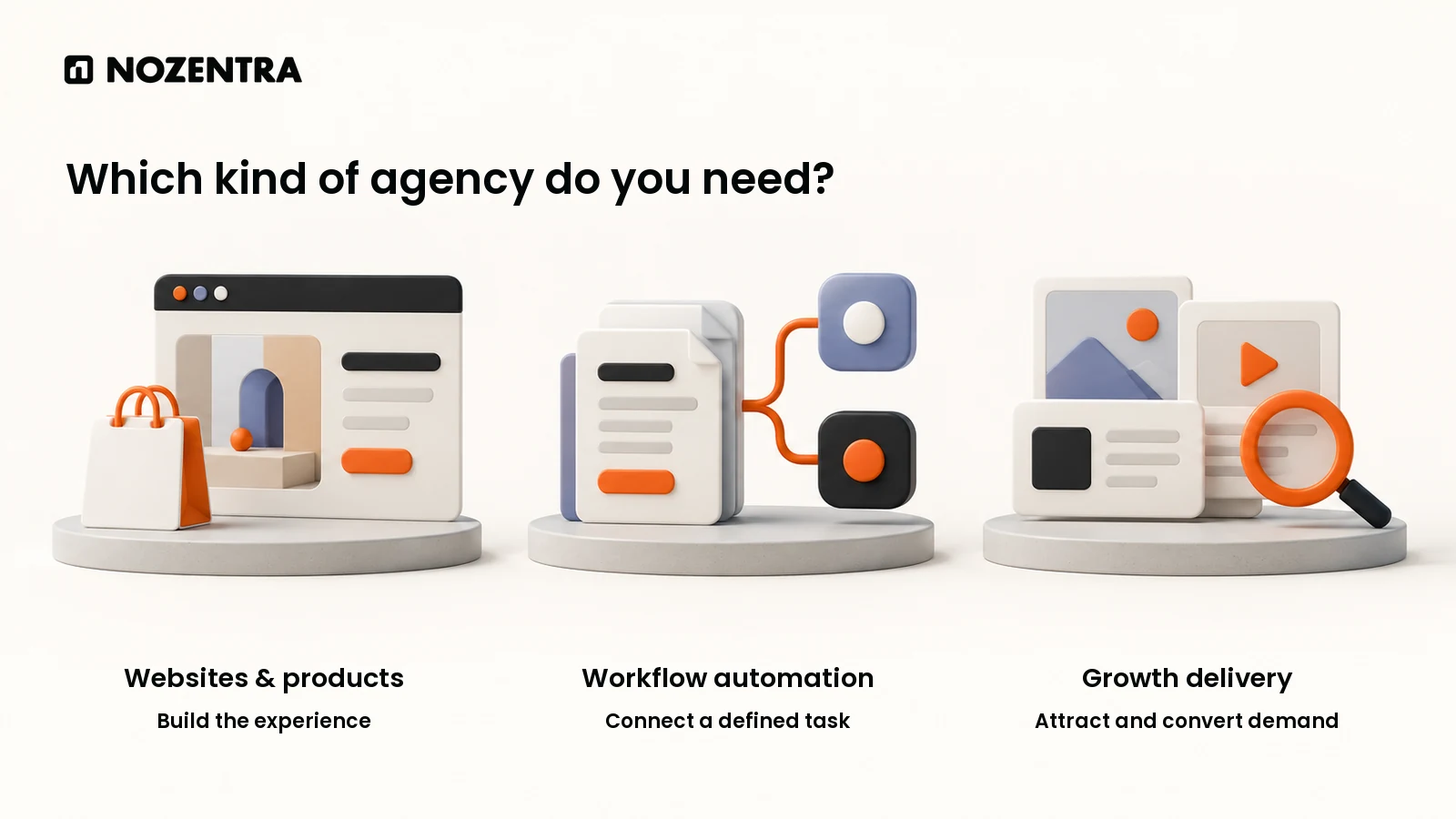
You will usually encounter three overlapping offers:
Websites and products: An AI web development agency may build websites, ecommerce experiences or applications, using AI within the product or during delivery. Ask which of those it means.
Workflow automation: An AI automation agency may connect business tools, classify documents, route enquiries or prepare responses, with defined rules for review and escalation.
Growth delivery: An agency may use AI to assist research, content, analysis or marketing operations while people own strategy, accuracy and publication decisions.
Some providers cover more than one category. Others advise on a roadmap and expect a different team to implement it. Neither arrangement is automatically better, but you need to know whether you are buying advice, a working system, an ongoing service or a combination.
When reading an agency's service descriptions, look for outputs you can recognise: a deployed application, an approved content programme, a connected workflow or an agreed measurement plan. A list of AI tools leaves that question unanswered.
What is the difference between an AI agency and a traditional digital agency?
The useful difference is the work the team can deliver and operate. An AI agency may specialise in AI-enabled products or automation, while a digital agency may focus on websites, brand, search and campaigns. In practice, their capabilities often overlap.
A digital agency can use AI extensively. An AI agency can still be weak at design, content or measurement. Treat each label as a starting point for questions, rather than evidence of quality.
| What to compare | AI-focused offer | Conventional digital offer |
|---|---|---|
| Main deliverable | May include an AI application, agent or connected workflow | May include a website, campaign, brand or content programme |
| Role of AI | May be part of the product, the delivery process, or both | May support research, production and analysis |
| Evidence to request | Working integrations, relevant evaluations and operating responsibilities | Relevant work, commercial measurement and quality checks |
| Ownership questions | Code, data, prompts, workflows, infrastructure and platform licences | Website, content, creative files, accounts and platform licences |
| Continuing work | Model or tool changes, output review, integration maintenance and support | Content updates, optimisation, campaigns and website support |
| Buying rule | Verify the capabilities your particular project requires | Verify the capabilities your particular project requires |
The table describes possible scopes, not a universal division. If you need a better website and a reliable enquiry workflow, ask who owns each part and how the two will be tested together.
How do I choose an AI agency for my business?
Start with a short brief, compare agencies against the same requirements, and use a bounded first engagement to resolve the uncertainties that matter most.
Write down the problem, the people affected, the systems involved and what a useful outcome would look like. Include constraints such as access to customer information, a fixed launch date or limited internal technical support.
For example, “We need AI” gives a provider little to work with. “Our team retypes enquiry details into the CRM, and we need to reduce that work without losing or duplicating leads” defines a process that can be investigated. The solution might require AI, ordinary automation, a form improvement or a combination.
Shortlist providers whose work matches that problem. Review documented projects and outcomes, then ask what the team contributed, what the starting conditions were and how the result was measured. Where public detail is restricted, a redacted walkthrough or a reference shared with permission may provide useful evidence. Confidentiality should be explained, rather than filled with unsupported numbers.
Give finalists the same brief. Differences in their assumptions, exclusions and questions can reveal more than differences in their headline prices.
What questions should I ask before hiring an AI agency?
Ask about the problem, the delivery team, evidence, data, testing, costs, ownership and support. Request something concrete behind each answer, such as a sample plan, a redacted project record or a written contract schedule.
1. What exactly will you deliver, and where does AI help?
A useful answer names the deliverables and explains which steps need AI. It also identifies work that should remain a straightforward rule or a human decision.
Ask the agency to walk from the initial input to the final output. For an enquiry workflow, that could mean receiving a form submission, checking required fields, suggesting a category and preparing a CRM record for review. Clarify what happens when information is missing and what is outside the scope.
Request a brief that lists deliverables, exclusions, dependencies and acceptance criteria. If the proposed solution changes during discovery, agree how you will approve the revised scope.
2. Who will do the work and make decisions with us?
You should know the delivery lead, the relevant specialists and the person accountable for resolving problems. A sales contact alone does not establish who will build or maintain the result.
Ask whether employees, contractors or delivery partners will handle each part. That structure can work well when responsibilities are clear. What matters is continuity, relevant skill and a practical communication process.
Request a responsibility list covering technical decisions, content approval, data access, testing and launch sign-off. Name an owner on your side too, so the agency has someone who can answer questions about the real process.
3. What comparable work can you show, and how was it assessed?
Relevant evidence should explain the problem, the agency's contribution and how the outcome was checked. A polished screenshot shows presentation; it does not establish reliability or business impact.
Ask about a project with similar systems, users or constraints. If a result is quoted, request the baseline, measurement period and definition of the metric. Separate the agency's work from changes in traffic, staffing or other campaigns that could affect the outcome.
For an AI application, ask to see how it handles an unsuccessful request as well as a successful one. For growth work, ask how reporting connects activity to qualified enquiries or another agreed business outcome.
4. Which systems and data will you need to access?
The agency should identify the information it needs, where that information travels and which people or services can access it. “It is secure” is too general to assess.
Request a simple data-flow explanation covering your systems, external model or software providers, stored outputs and logs. Ask about retention, deletion, access permissions and whether your information may be used for provider training under the proposed terms.
Give access appropriate to the current stage, then review it before expanding the work. A discovery exercise does not automatically require permission to change production records. Have your responsible privacy and security contacts review the proposed arrangement before sensitive information is shared.
5. How will you test quality before anything goes live?
A credible plan defines what must work, how failures will be identified and who decides whether the result is ready. It tests the complete task, including integrations and human handovers.
For an AI workflow, ask for representative cases, ambiguous requests, missing information and failures in connected tools. Agree which errors are unacceptable and what the system should do instead of guessing.
NIST's AI Risk Management Framework is a voluntary reference for considering trustworthiness across the design, development, use and evaluation of AI systems. Ask a provider how its actual checks address your risks, rather than accepting a framework name as proof that the work is safe.
For a website, the checks should also cover relevant user journeys, mobile behaviour, accessibility and technical operation. AI-assisted production does not remove those requirements.
6. Which actions require a person to approve them?
The answer should specify what the system may read, suggest or change, and where it must stop for approval. A general promise of “human oversight” leaves too much open.
Discuss actions with consequences, such as publishing content, contacting a customer, changing a price or issuing a refund. Agree the boundaries for your use case and who receives an escalation.
Ask for a demonstration of a request that crosses one of those boundaries. Check that the person taking over receives enough context to continue, and that the system records whether the action actually happened.
7. What will this cost to build and keep running?
Compare the total cost over an agreed period, including the work your own team must do. The initial project fee may exclude software, model usage, hosting, maintenance, content production or paid media.
Request a breakdown of one-off charges, recurring fees, usage-based charges and optional work. Ask what could change the estimate and who must approve an increase.
For a usage-based system, discuss normal demand, a busy period and a spending limit. Include time spent reviewing outputs and correcting errors. Zendesk's AI agent buyer guide similarly advises buyers to consider licensing, integration, maintenance, governance and training when evaluating total cost.
8. What will we own, and what will remain licensed?
Get a written inventory of what transfers to you, what you can export and which third-party rights continue to apply. “You own everything” can hide important exceptions.
Custom code, content and workflow configuration are different from a model provider's software or a licensed platform. A subscription can be a reasonable choice when its limits, recurring costs and exit conditions are understood.
Request the handover list: repository access where applicable, account ownership, documentation, prompts or configuration, evaluation cases, data export and administrator training. Confirm what another provider would need to maintain the work if you moved on.
9. Who notices and fixes problems after launch?
The support arrangement should name the responsible team, the issues it covers and how incidents are handled. Separate a defect warranty from ongoing monitoring and improvement.
Ask who reviews output quality, checks failed integrations and responds when a dependency changes. Agree support hours, escalation contacts, response commitments and the cost of work outside the contract.
For customer-facing systems, discuss a fallback that lets the business continue when the automated path is unavailable. For content or growth work, clarify who updates inaccurate material and reviews changing performance.
10. How will we measure progress and decide what happens next?
Agree a starting point, a measurement method and a review decision before delivery begins. Completing a list of tasks is different from improving the problem you hired the agency to address.
For automation, you might track completion quality, review effort and exceptions. For a website or growth project, you might track qualified enquiries and the relevant conversion journey. Use measures that fit the work, with clear definitions and access to the underlying evidence.
Be cautious about promises the agency cannot control. Google's guidance on hiring an SEO explicitly warns that nobody can guarantee a first-place Google ranking. Ask for realistic commitments to scope, quality and reporting, with a clear review point for continuing, changing or stopping the engagement.
Is it better to use one AI agency for building and growth, or separate agencies?
One team can suit work where product, website and growth decisions depend closely on each other. Separate agencies can suit a business that needs specialist depth or already has a strong team coordinating delivery. The better option depends on capability and ownership, rather than the number of suppliers.
| Decision | One team for building and growth | Separate specialist agencies |
|---|---|---|
| Coordination | A shared roadmap can reduce the number of handovers | Your team needs to coordinate dependencies and priorities |
| Depth | Verify the actual specialists assigned to each discipline | You can select expertise separately for each need |
| Measurement | Agree how the shared team will assess each part of the work | Agree common definitions so reports can be compared |
| Changes | Clarify how a build change affects growth work and budget | Define which supplier approves and implements each dependency |
| Continuity | Check capacity, documentation and exit arrangements | Check handovers, shared access and responsibility for gaps |
| Best fit | Connected work with a capable, accountable team | Distinct needs with enough internal coordination |
For example, new landing pages may depend on development, content, tracking and campaign decisions. A combined team can coordinate those dependencies, but a specialist arrangement can also work when someone owns the overall plan.
Nozentra describes its Build and Grow model as connected delivery through one accountable roadmap when product, visibility and conversion depend on one another. That is an operating approach to assess against your needs, not a reason to buy services you do not need.
What should I check when hiring across the UK, US, UAE and Pakistan?
Use the same quality criteria in every market, then make the working arrangements specific to your customers and your team. Location alone does not establish quality, price or suitability.
| Market in your brief | Details to agree with the agency |
|---|---|
| United Kingdom | GBP quote where appropriate, UK audience conventions, local examples and support overlap with your team |
| United States | USD quote where appropriate, the relevant US time zones, customer expectations and market-specific review |
| United Arab Emirates | AED quote where appropriate, English or Arabic requirements, right-to-left testing if needed and local customer journeys |
| Pakistan | PKR quote where appropriate, English or Urdu requirements, local payment or communication needs and support arrangements |
These are scoping prompts, not assumptions about every business in a country. Ask who will review regional language and examples. Agree the invoice currency, treatment of third-party charges, meeting times, incident coverage and the entity responsible for delivery.
If data or delivery crosses borders, ask your responsible privacy or security lead to review the actual data flow and contractual arrangement. Do not infer where information is processed from the agency's office address.
How should I test an agency before committing to a larger project?
Use a small, representative engagement with a clear decision at the end. It should answer whether the approach fits your work and whether the team can deliver, communicate and document it reliably.
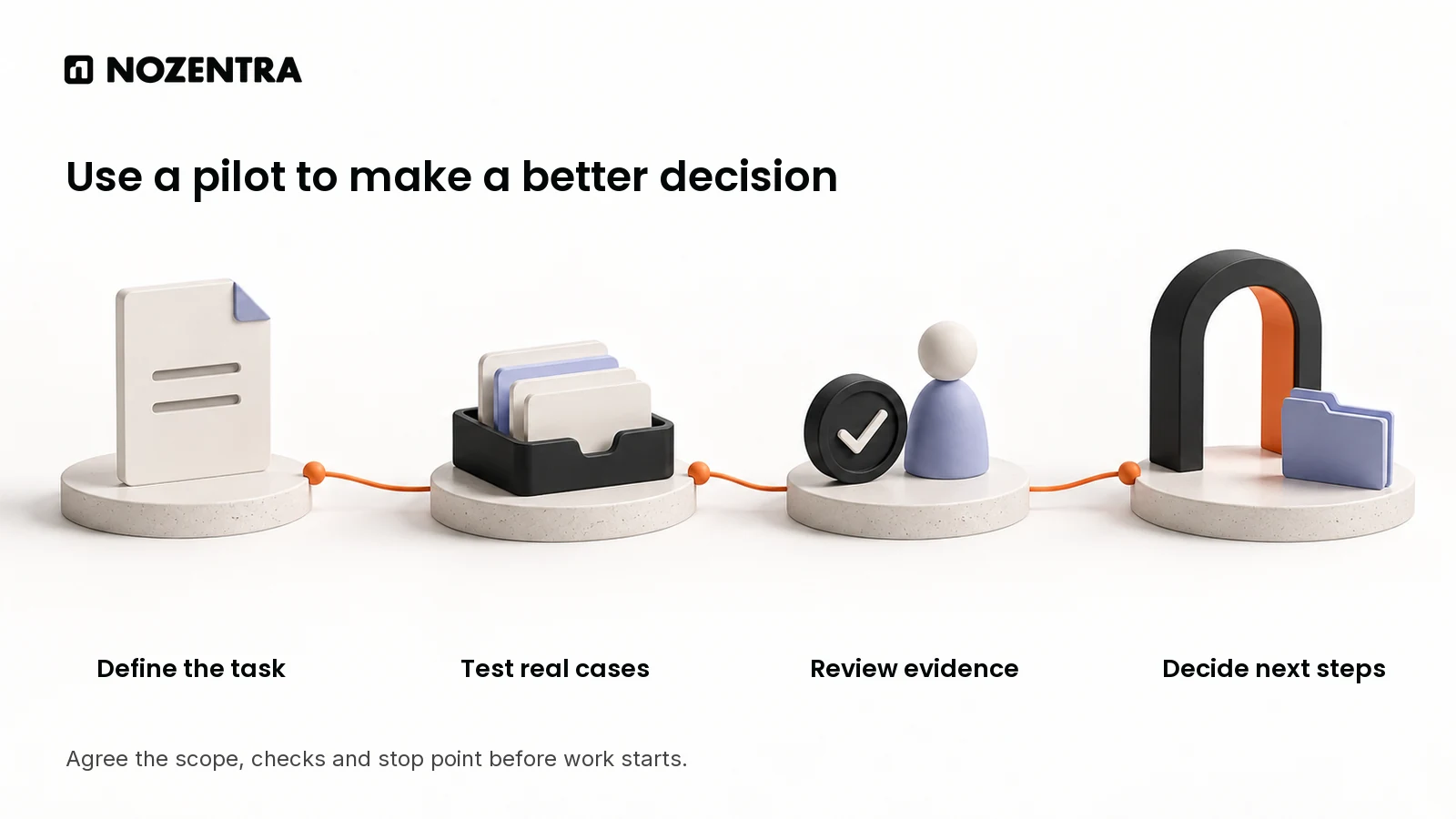
For an enquiry-routing pilot, you could agree to evaluate historical enquiries in a test environment before allowing any changes to the live CRM. Include straightforward enquiries, incomplete messages, duplicates and requests outside the agreed scope. This is a hypothetical evaluation plan, not a reported client test.
Write a short decision record before work starts:
Define the task: State the input, expected output, exclusions and who owns the decision.
Set the comparison: Record how the task works today and choose cases that reflect real conditions.
Agree the checks: Define acceptable results, required human review and conditions that stop the pilot.
Review the evidence: Inspect outputs, exceptions, review effort and operating costs together.
Choose the next step: Continue, revise the scope or stop, with a documented reason.
The pilot length should reflect how the process behaves. A rare exception may not appear during a brief demonstration. You are also assessing whether the agency explains uncertainty, responds to feedback and hands over usable records.
How do I make the final hiring decision?
Choose the provider whose evidence and proposal best fit the work you need, with the unresolved risks made visible. If an important answer is missing, resolve it before expanding the commitment.
Compare finalists against the same brief. Mark each important requirement as evidenced, partly evidenced or unresolved, and attach the relevant document or example. Do not let a strong presentation cancel out an unanswered ownership or data-access question.
Before signing, confirm the deliverables, named owners, testing approach, full costs, support and exit arrangements. If you are considering an engagement with us, our frequently asked questions provide a starting point for discussing those details against your own brief.
The useful outcome of choosing an AI agency is a relationship you can understand and assess: a defined problem, a team responsible for the work and evidence that helps you decide what to do next.