B2B teams are testing AI agents alongside their contact databases, and in some cases replacing parts of the list-building process. Instead of exporting a fixed list and hoping it is still accurate, an agent can research, refresh and rank prospects when you need them.
The shift is real. It is not a replacement for judgement, strategy or the relationship itself. Here is what the evidence supports, and how to test it without putting your domain or brand at risk.
Key takeaways
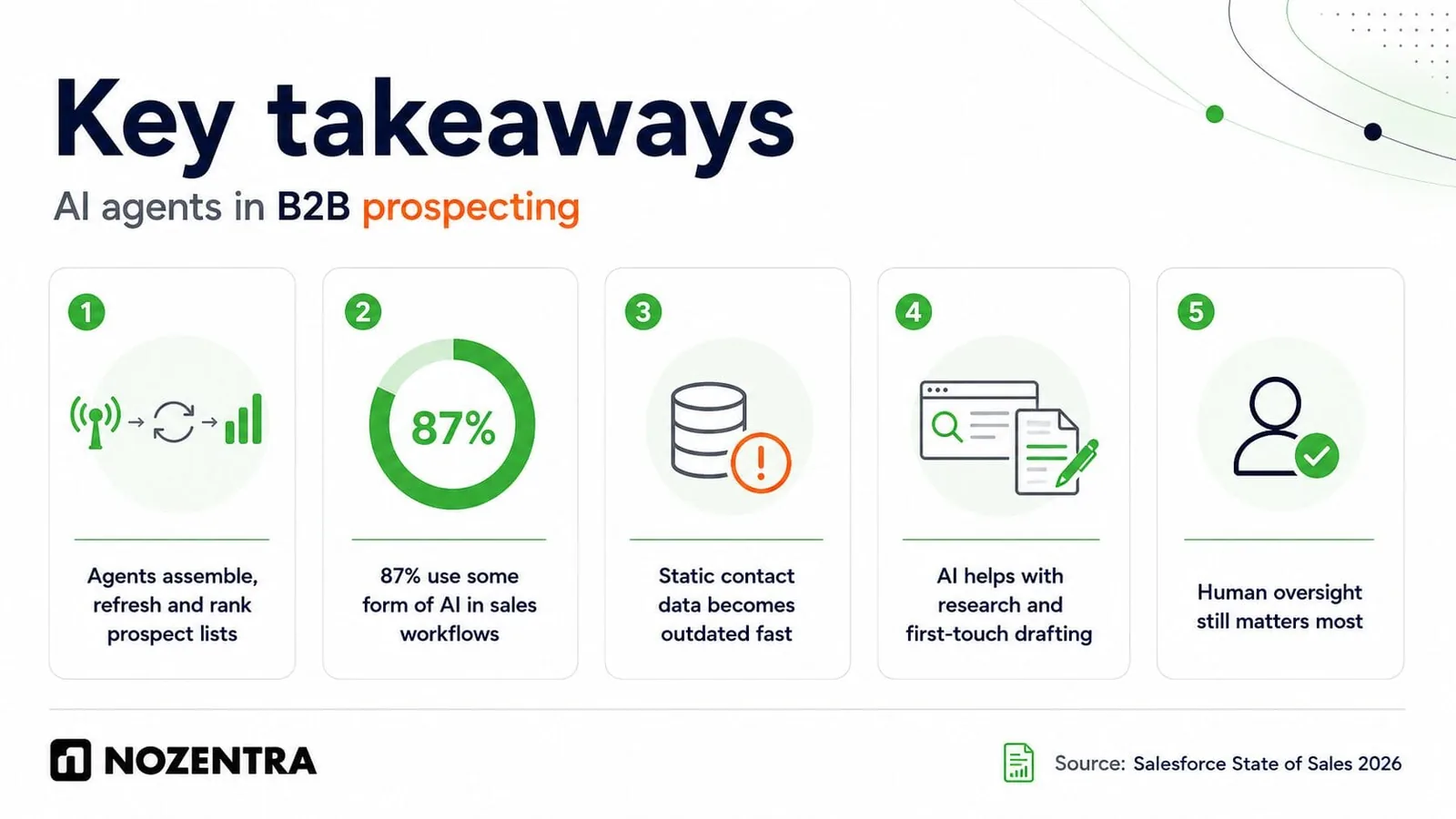
AI is already mainstream in sales. Salesforce found 87% of sales organisations use some form of AI, and 54% of sellers have used AI agents.
Top performers are 1.7 times more likely to use AI agents than struggling teams, according to the same survey.
Contact data still goes stale. People change jobs, and a record can stay in a database long after it stops being useful.
Agents are good at research and drafting, weaker at judgement. Forrester warns they cannot reliably infer buying intent.
Keep a human approval step before anything is sent to a prospect.
How is prospecting with an agent different?
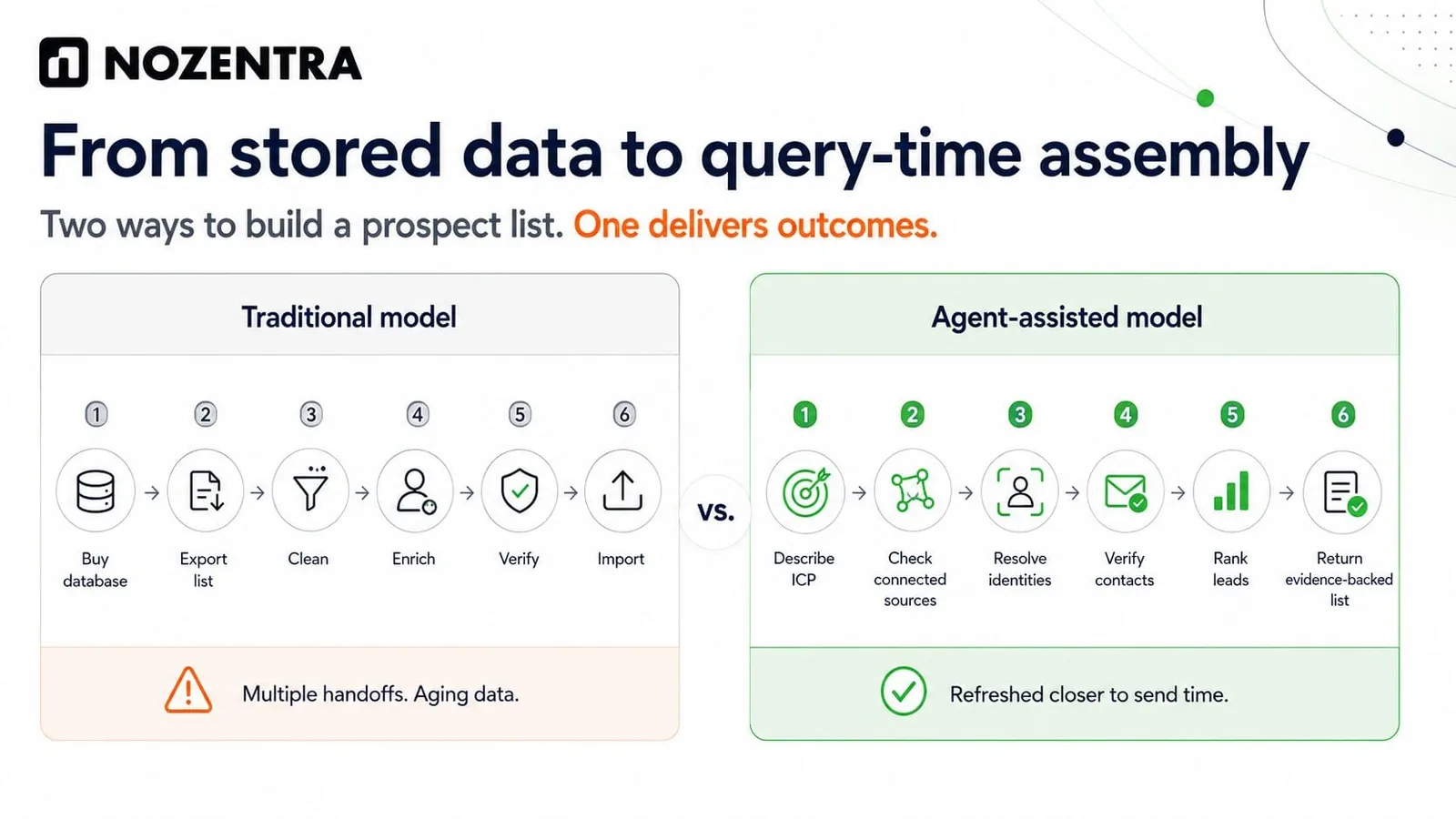
| Step | Traditional database model | Agent-assisted model |
|---|---|---|
| Start | Buy access to a contact database | Describe your ideal customer in plain language |
| Build | Filter and export a list | Agent checks connected sources for matches |
| Maintain | Clean, enrich and verify by hand | Agent verifies contacts when the list is requested |
| Output | A spreadsheet that starts ageing immediately | A ranked list with evidence for each match |
| Your team's job | Repairing data | Deciding who to pursue and what to say |
For example, you might ask for heads of revenue operations at US software companies with 100 to 500 employees that recently moved to usage-based pricing. The agent breaks that into conditions, checks your CRM, past emails, company websites, hiring pages and data providers, then returns matches with the evidence behind each one.
The benefit is not that stored data disappears or that everything gets cheaper. It is that information gets refreshed closer to the moment you use it.
Why do static prospect lists break down?
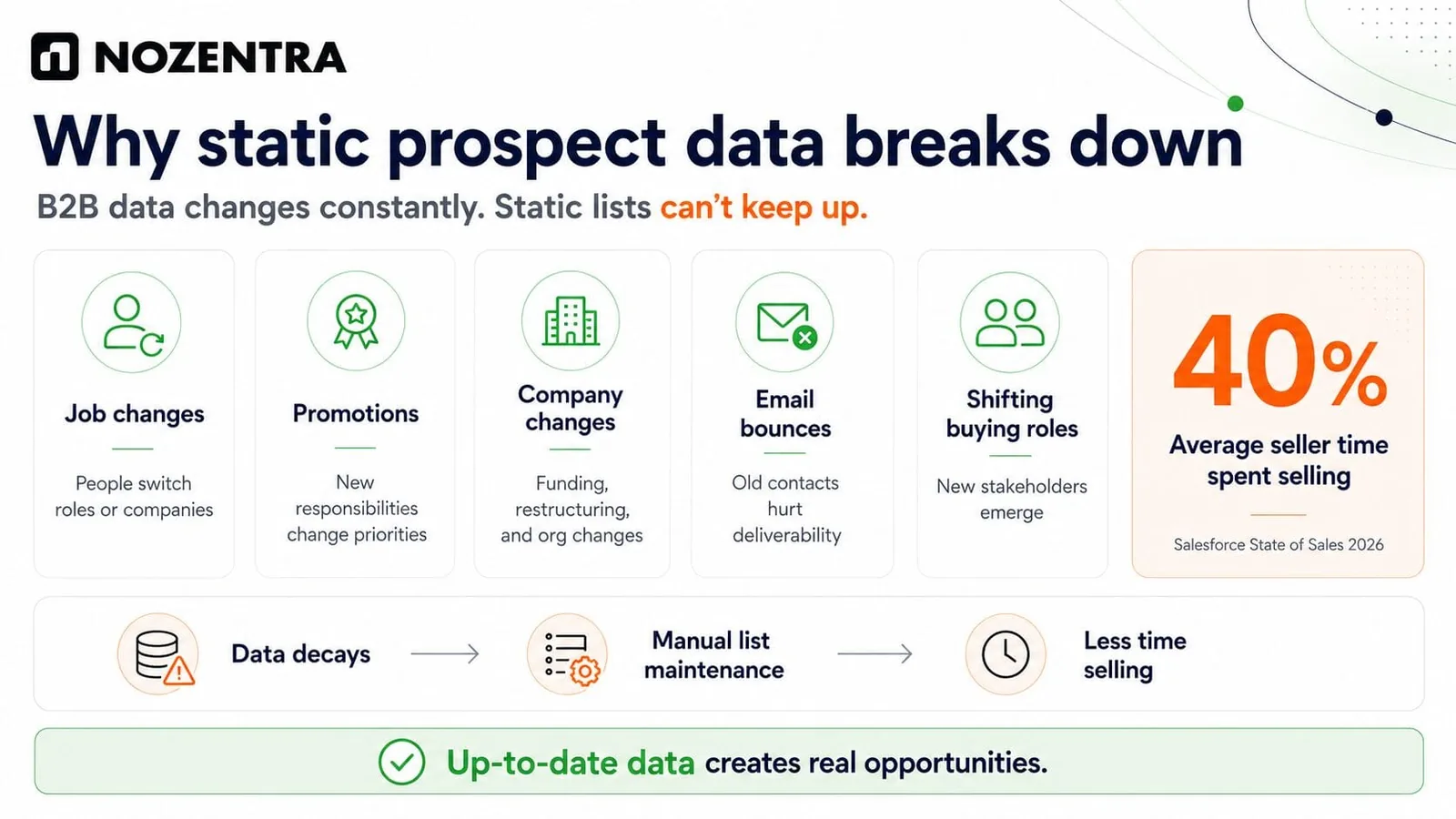
There is no single decay rate that applies to every B2B database. Accuracy depends on the market, the data type and how often the provider refreshes it. The problem underneath is simple: people change jobs, get promoted and move companies, and businesses restructure. Dun & Bradstreet's guide to managing fragile contact data explains why contact records need constant maintenance.
That maintenance eats selling time. Salesforce's 2026 State of Sales research found the average seller spends only 40% of their time actually selling. Gen Z reps spend just 35%.
What do the 2026 adoption numbers actually show?
Salesforce surveyed 4,050 sales professionals across 22 countries in August and September 2025:
- Sales orgs using some form of AI87%
- Sellers who have used AI agents54%
Source: Salesforce, State of Sales 2026, survey of 4,050 sales professionals
It also found that nearly 9 in 10 sellers plan to use agents by 2027, and that top performers are 1.7 times more likely to use AI agents than struggling teams.
Sellers expect agents, once fully implemented, to save time on the most repetitive work:
| Task | Expected time reduction |
|---|---|
| Prospect research | 34% |
| Email drafting | 36% |
Read these carefully. The 87% covers many kinds of AI use, including forecasting and lead scoring. It does not mean 87% of teams run autonomous prospecting agents. And the time savings are what sellers expect, not measured results.
Where do AI agents help, and where do they struggle?
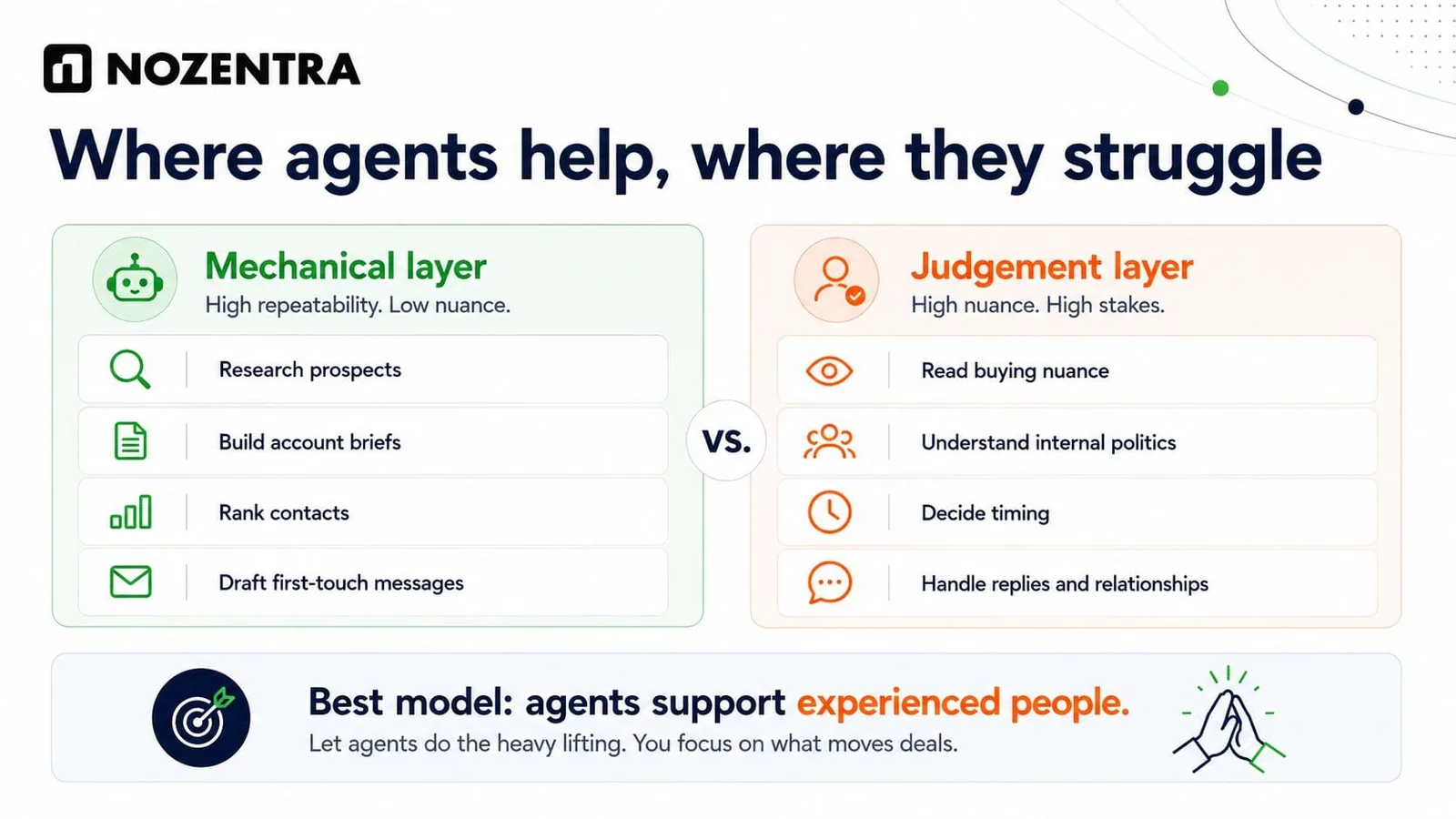
Agents are strong at the mechanical layer: researching an account, building a brief, ranking contacts against your ideal customer profile, drafting a first message and routing leads based on defined signals.
They are weaker at judgement. Anthony McPartlin, VP and Principal Analyst at Forrester, puts it plainly in Agentic Prospecting: Seven Reasons The Hype Falls Short:
AI can detect activity; it cannot infer intent with the certainty required to autonomously trigger customer-facing action at scale.
He points out that web visits, content downloads and hiring signals "may indicate interest, but they rarely indicate intent with confidence." Acting on weak signals at scale creates noisy outreach and missed opportunities at the same time.
How should you set approval rules for a prospecting agent?
Contacting customers is one of the actions we keep under human control in every AI workflow we build. Write down what the agent can do alone, what needs a person, and what must be recorded. An illustrative policy:
prospecting_agent:
  can_do_without_approval:
    - research target accounts
    - rank contacts against the ideal customer profile
    - draft first-touch emails
  needs_human_approval:
    - send any email or message
    - add a contact to a sequence
    - change targeting rules
  record_for_every_contact:
    - where the data came from
    - date the email was last verified
    - opt-out and suppression check result
Your business stays responsible for privacy, direct marketing rules and deliverability, even when software does the work.
How can you test this without overhauling your stack?
Run both approaches side by side before changing anything:
Pick difficult segments. Choose a few ideal customer profiles that currently need lots of research or cleaning.
Run both workflows on the same definitions.
Review the output before any outreach: company fit, job titles, email validity, evidence and message quality.
Measure quality, not volume:
| Metric | Why it matters |
|---|---|
| Valid contact rate and bounce rate | Protects your sending domain |
| Wrong-fit matches | Shows whether the agent understands your ideal customer |
| Positive reply rate and qualified meetings | Shows whether the list produces pipeline |
| Research time per accepted contact | Shows real time saved |
| Share of agent output needing correction | Shows how much review it still needs |
| Opt-outs and spam complaints | Early warning of damage to your reputation |
Decide at renewal. Keep the database where broad coverage matters. Use agents where fresh research and signal-based ranking add value. Or combine them.
Our guide to B2B lead generation uses the same principle: judge lead generation by quality and commercial outcome, not list size. Messages triggered by real behaviour, covered in email campaigns for start-ups, fit naturally with this approach.
What is our view?
AI agents are useful where they remove genuinely mechanical work. They are risky when used to fake a relationship that is not there.
B2B buyers remember irrelevant automated outreach. An agent that helps a rep show up faster with better research is a real advantage. An agent that sends without data checks, sending limits or human review can damage a list, a brand and a domain's reputation all at once.
If you want help designing a prospecting workflow with the right controls, see our AI agents and automation work or talk to us.
Frequently asked questions
Will AI agents replace SDRs entirely?
The evidence does not answer that yet. Current use focuses on research, prioritisation and drafting. Qualification, relationship-building and closing still need people.
Should I cancel my contact database subscription?
Not immediately for most teams. Test agents on difficult or signal-driven segments first, then decide using accuracy, pipeline quality, cost and time saved.
What is the biggest risk with AI agents in outreach?
Poor data combined with weak controls. An agent can scale wrong targeting, inaccurate personalisation and excessive sending far faster than a person can.