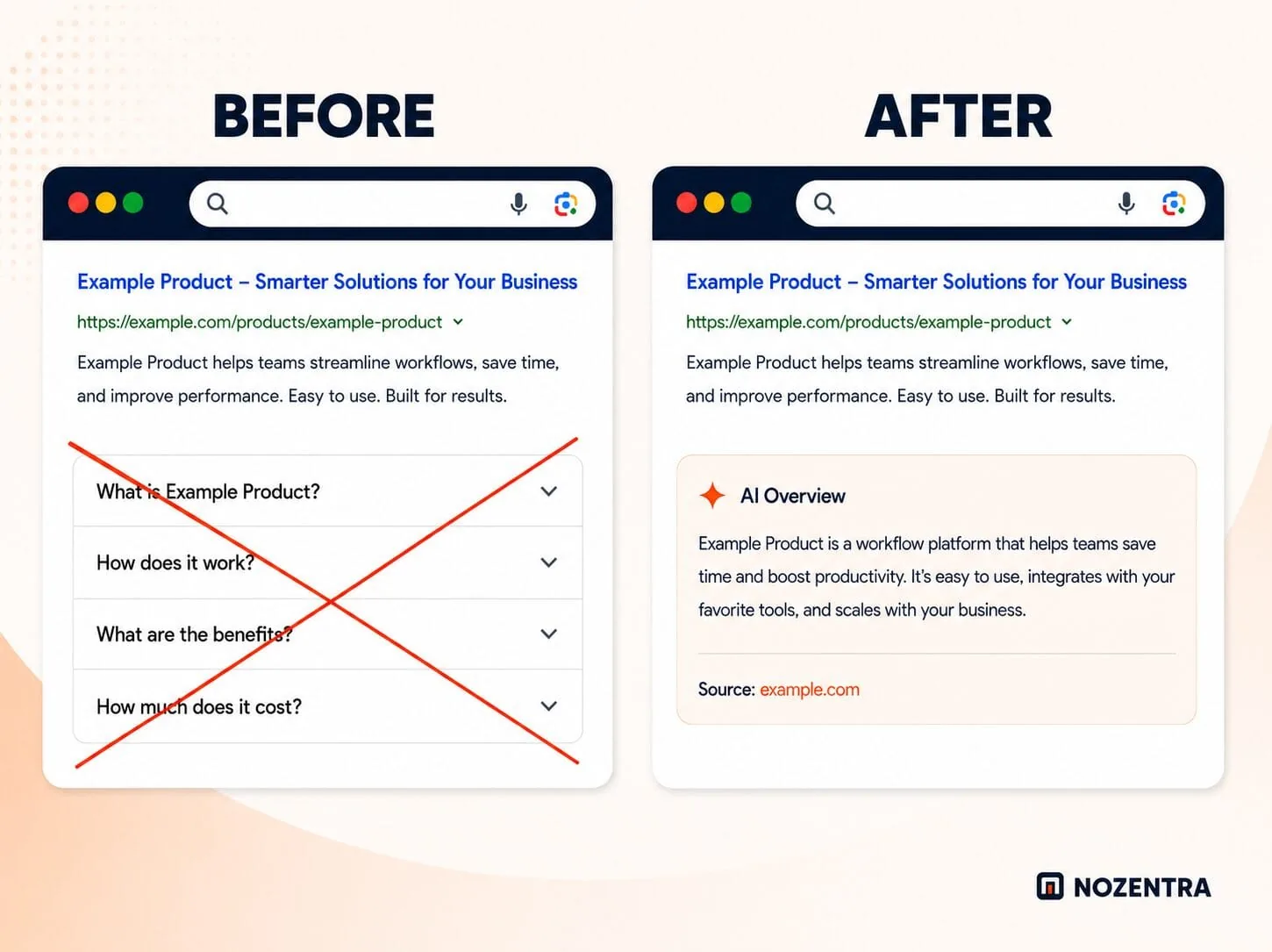
Google stopped showing FAQ rich results on 7 May 2026. Those expandable question-and-answer rows under a search listing are gone for every site. In June, Google removed the FAQ rich result documentation altogether.
If your answer engine optimisation (AEO) plan relied on that snippet to win clicks, the plan needs updating. Good questions answered clearly still matter. The visual reward for marking them up does not.
Key takeaways
FAQ rich results ended on 7 May 2026, after being limited to government and health sites since August 2023.
Google removed the FAQ rich result documentation on 15 June 2026.
Existing FAQ markup does no harm. Google has said unused structured data "does not cause problems for Search, but also has no visible effects."
Google's spam policies now explicitly cover AI answers. Trying to manipulate generative AI responses is spam.
Optimise for the answer, not the snippet shape. Real questions with clear, direct answers still serve readers and AI systems.
How did FAQ rich results disappear?
Gradually, then quietly. Google did not publish a blog post for the final step. The record is in its documentation changelog:
| Date | What Google changed |
|---|---|
| 8 August 2023 | FAQ rich results limited to "well-known, authoritative government and health websites" |
| 7 May 2026 | FAQ rich results stop appearing in Google Search |
| 8 May 2026 | Deprecation notice added to the FAQ documentation |
| 15 May 2026 | New guide on optimising for generative AI features, and spam policies clarified to cover AI responses |
| 15 June 2026 | FAQ rich result documentation removed |
The 2023 change was announced in Changes to HowTo and FAQ rich results. The 2026 removal came as changelog entries only.
Should you remove FAQ schema from your pages?
You do not need to. When Google first restricted FAQ rich results in 2023, it said:
While you can drop this structured data from your site, there's no need to proactively remove it. Structured data that's not being used does not cause problems for Search, but also has no visible effects in Google Search.
So existing markup is harmless. But do not add new FAQ markup expecting a visible benefit in Google, because there is no longer a feature for it to power. Also note that Google's AI features guide says you do not need special markup to appear in AI Overviews or AI Mode.
To find which of your pages still carry FAQ markup, this loops through your sitemap and lists them:
# Lists every URL in your sitemap whose HTML contains FAQPage structured data.
curl -s https://www.example.com/sitemap.xml \
  | grep -o '<loc>[^<]*' | sed 's/<loc>//' \
  | while read -r url; do
      curl -s "$url" | grep -q '"FAQPage"' && echo "$url"
    done
For large sites or sitemap indexes, a crawler such as Screaming Frog does the same job more reliably.
Does this change answer engine optimisation?
It removes one visible incentive, not the underlying work. AEO means preparing content so systems that generate direct answers, including AI Overviews and AI Mode, can find a precise, trustworthy response on your page. FAQ markup was only ever one small part of that.
And AI answers are common on exactly the kind of queries FAQ blocks targeted. Seer Interactive's 2026 study of 5.47 million queries found:
- Informational36%
- Commercial8%
- Transactional5%
Source: Seer Interactive, 'AIO Impact on Google CTR: 2026 Update', April 2026
Within informational searches, question-style queries showed an AI Overview 85.9% of the time. That is where clear, well-answered questions still earn their place.
What does Google now say about gaming AI answers?
Google clarified on 15 May 2026 that its spam policies apply to generative AI responses. Its spam policies now define spam to include "attempting to manipulate generative AI responses in Google Search."
Its AI features guide also lists "pursuing inauthentic mentions" among tactics you can ignore.
That is a useful filter when you evaluate AEO vendors. If a tactic tries to influence which sources get cited, rather than making your page answer the question better, it now carries real risk.
What should you do instead of chasing the old snippet?
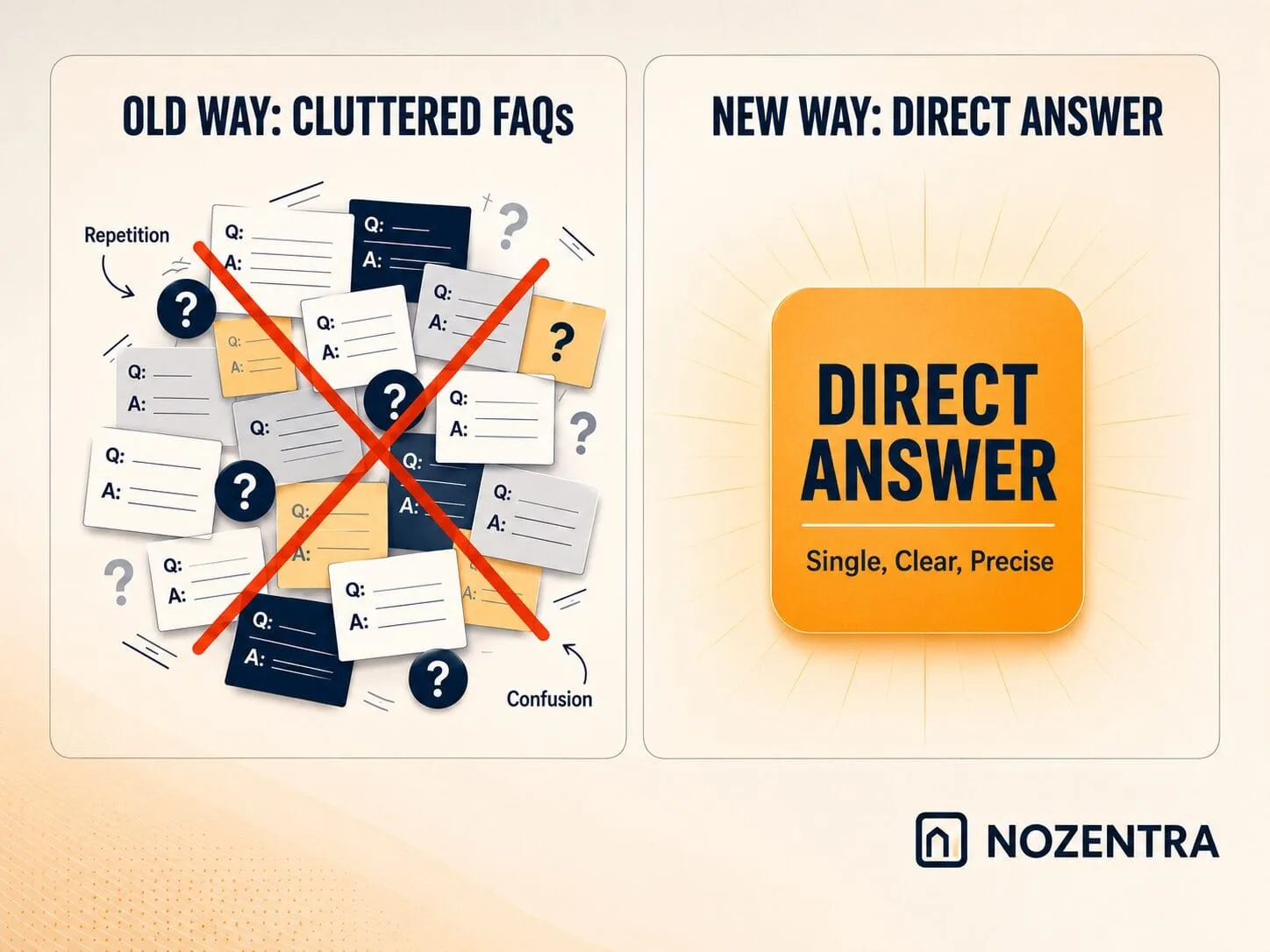
Move the effort from snippet design into the page itself.
| Before (built for the snippet) | After (built for the reader) |
|---|---|
| Ten FAQs added to fill the format | Three to five questions people genuinely ask |
| Answers repeating the body text | Answers adding something the page did not cover |
| FAQ block at the bottom only | A direct answer at the top of each relevant section |
| Schema added to every page by default | Markup only where it describes real content |
A thin FAQ versus a useful one, for the same page:
THIN
Q: What is website maintenance?
A: Website maintenance is maintaining your website.

USEFUL
Q: How often should a small business site be updated?
A: Apply security and plugin updates at least monthly, and review key pages
   every quarter so prices, services and contact details stay accurate.
How do you audit your existing FAQ sections?
Start with your highest-impression informational pages:
Does the page answer its main question near the top? If not, fix that before touching the FAQ.
Are the FAQs real? Check them against questions from customers, sales calls and Search Console queries.
Cut the filler. If six of ten FAQs repeat the page, remove them.
Check AI visibility. Compare these pages in Search Console's generative AI report, covered in how to track AI Overview visibility.
Leave existing markup alone unless it describes content that is no longer on the page.
This is incremental work, not a rebuild.
What is our view?
AEO often gets reduced to a checklist: add schema, add an FAQ block, done. Losing FAQ rich results is a healthy correction. Sites that used FAQs to answer real questions lose very little. Sites that built thin FAQ blocks for extra search real estate now have a clear reason to fix what was always a quality problem.
The pattern is familiar. Google limited HowTo rich results in the same 2023 change. When a markup type becomes a shortcut rather than a description, it tends not to last. The lesson is not "stop using structured data." It is "stop using it as a substitute for answering the question."
For the bigger picture, read how AEO is changing search by prioritising user intent and why AI-friendly formatting is not an SEO hack. For help auditing your pages, see our AI search visibility work or talk to us.
Frequently asked questions
Is FAQ schema pointless now?
In Google Search, it no longer powers any visible feature, and Google has removed its documentation. Existing markup does no harm. Other search engines and tools may still read it.
Will AI Overviews replace organic clicks?
They change them. AI Overviews appear most on informational queries, and Seer found pages cited in them earn more clicks than uncited pages. No format guarantees a citation.
Should I pay for "AI citation optimisation" that promises placement?
Be very careful. Google's spam policies now explicitly cover attempts to manipulate generative AI responses. Anyone guaranteeing placement through manipulation puts your site at risk.
Sources
Google Search Central: Latest documentation updates (entries for 8 May, 15 May and 15 June 2026)
Google Search Central Blog: Changes to HowTo and FAQ rich results (8 August 2023)
Seer Interactive: AIO Impact on Google CTR, 2026 Update (April 2026)