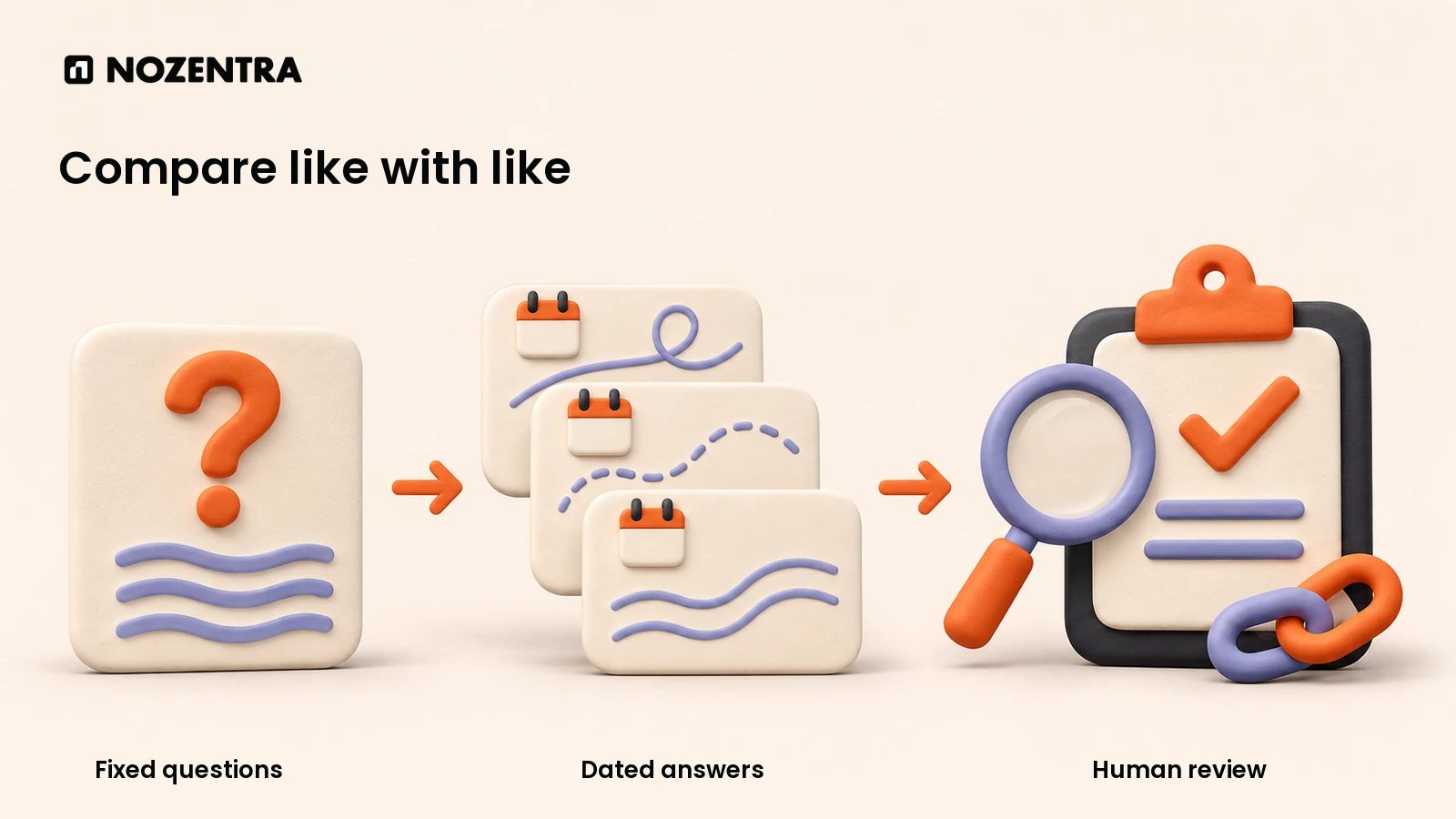
To track brand mentions in AI answers, repeat a fixed set of buyer questions on the same platforms each week, save the dated answers and record whether your brand is named, recommended or cited. Keep the wording, market and checking conditions consistent. Compare the results with earlier checks, then investigate material changes rather than treating one favourable answer as your overall visibility.
You can start with a spreadsheet and a small prompt set. This guide explains that manual method first, then shows where monitoring tools help. It also includes a public Google observation recorded for this article on 3 November 2026. It uses no company or client private queries, analytics or dashboard captures.
How can I check if ChatGPT mentions my brand?
Check both questions that name your brand and discovery questions that do not. The first reveals how ChatGPT describes a business it has been asked about. The second tests whether the business appears when someone is exploring a category without already knowing its name. Keep those two groups separate.
1. Which questions should I repeat?
Write down the buyer decisions you want to investigate and turn them into a fixed prompt list. Cover relevant needs, use cases and comparisons. These are illustrative templates, not observed Google suggestions or evidence of demand:
| Purpose | Example prompt | What to review |
|---|---|---|
| Unbranded discovery | Which inventory tools should a small retailer with two shops compare? | Whether a brand appears without being named in the question |
| Use-case discovery | Which inventory tools support a retailer selling online and in a physical shop? | Inclusion for a specific requirement |
| Branded accuracy | What does [brand] offer, and who is it suitable for? | Description and factual accuracy |
| Named comparison | How do [brand] and [competitor] differ for [use case]? | Comparative claims and supporting sources |
Choose realistic requirements rather than adding details solely to make your preferred brand appear. Keep the original text and give each prompt a stable identifier. If you change its wording later, record a new version instead of quietly replacing the old one.
2. How should I control the checking conditions?
Use a fresh conversation for each planned run and record the product, visible model or mode, language, market and personalisation conditions. A fresh chat reduces conversation carry-over, but it does not necessarily remove account memory or instructions.
OpenAI's current Temporary chat guidance distinguishes personalised and unpersonalised temporary chats. Where those controls are available, select the appropriate unpersonalised option before starting a baseline check. Do not assume that a Temporary label or private browser window proves that all personal context is absent.
If your study is specifically about search-enabled answers, use the supported search mode and record what the interface actually shows. Do not mix those observations with answers captured under different conditions without labelling the difference.
3. What should I save from each answer?
Save the exact prompt, full answer, timestamp and visible source links. Record whether the brand appears in the answer text, whether it is recommended for the stated need, which competitors appear and which factual statements need checking. Keep the raw answer beside your summary so another reviewer can verify your coding.
A name appearing only in a source card is a different observation from a name in the answer's recommendation list. Likewise, five repetitions of a brand inside one answer are still one answer containing that brand.
4. What should I do with an answer that looks wrong?
Flag it for review and preserve it before asking follow-up questions. A follow-up can change the conversation's context, so it should not overwrite the original baseline result. Open any visible citation and check whether it supports the specific claim.
OpenAI's search documentation explains how to review citations and Sources, and warns that search results and citations can still be incomplete or incorrect. An answer with a link is evidence to inspect, rather than automatic proof that the statement is true.
5. When should I repeat the checks?
Repeat the same core prompt set on an agreed weekly schedule. Use the same planned number of runs and review rules each time. Add extra checks for a significant factual error or product change, but label them as investigations so they do not distort the regular comparison.
How do I track my brand's visibility in AI answers?
Track each product and surface separately, using a shared recording method. ChatGPT, the Gemini app, Google AI Overviews and Google AI Mode can present different answers and source links. A result on one surface does not establish what someone sees on another.
For each observation, keep the following fields:
The prompt identifier, version, exact wording and whether it names the brand.
The platform and surface, visible model or mode, date and time zone.
The requested market, language and any location or personalisation conditions you can verify.
The run number, full answer and capture status.
Brand presence, recommendation context, factual concerns and named competitors.
Visible cited URLs and publishers, plus the reviewer and next action.
Use “not shown” or “unknown” where the interface does not expose a model or setting. A monitoring tool should not fill that gap with an assumption. Protect the answer archive, particularly if your own questions or account views contain confidential information.
| Surface | What to inspect | Important boundary |
|---|---|---|
| ChatGPT | Answer wording, recommendation context and visible citations or Sources | Record search and personalisation conditions |
| Gemini app | Answer text and available source links | Keep assistant conversations separate from Google's Search surfaces |
| Google AI Overviews | Whether an overview appears, its expanded answer and visible sources | A valid search can produce no AI Overview |
| Google AI Mode | The answer and its sources for the exact query or follow-up | Record follow-ups separately because they introduce context |
Google's Gemini sources guide explains where related links can appear and notes that not every response includes them. Record the visible evidence without claiming that it reveals every source that influenced the model.
For Google website visibility, add the appropriate first-party report. The Search Console generative AI report measures impressions of links to your site in supported Google AI features. It does not replace an answer-text log showing whether your business was named or recommended. Our guide to AI Overview visibility in Search Console explains that Google-specific view and its limits.
What does a fair sample of AI answers look like?
A fair sample follows a declared plan and keeps unfavourable, missing and uncertain results visible. It represents the prompts and conditions you selected, rather than every conversation on the platform.
Begin with a manageable set that covers the buyer needs you actually serve. Decide the markets, platforms, repetition count and schedule before collecting answers. For example, ten unbranded questions with three fresh runs create a workload of thirty answers per platform in one market. Those are planning numbers, not findings or a statistically validated minimum sample size.
Use these rules to make the comparison useful:
Keep a stable core. Track the same questions over time. Analyse newly added prompts separately until they have a comparable baseline.
Apply the same effort. Do not run a disappointing prompt repeatedly until it produces a favourable answer. Keep every planned run and label any diagnostic retries.
Separate markets. If you serve the UK, US, UAE and Pakistan, keep distinct country records. Record requested locale settings and actual conditions where known. Country wording alone does not prove a locally representative experience.
Separate branded prompts. A question containing your name measures a different task from unprompted discovery. Combining them can make inclusion look stronger than it is.
Classify missing results. Distinguish no AI Overview, a completed answer without the brand, an ambiguous name, a technical failure and an unfinished response.
Review the same competitor set. Changing comparison brands or counting rules changes the meaning of a share-of-voice figure.
Fresh conversations do not automatically make observations statistically independent. Accounts, models, prompts and sources may overlap. Repeated runs help reveal variation, but they do not justify claiming that a small panel measures the entire market. Increase coverage when the decision warrants it, and report uncertainty when it remains.
Why does ChatGPT give different answers about my brand each time?
The answer is generated for a particular request and context, so keeping the visible prompt identical does not fix every condition. Conversation history, personalisation, the selected model, available sources and location can affect what appears. Product and source changes can also make a later check different from an earlier one.
For search-enabled answers, OpenAI explains that ChatGPT may rewrite a request into targeted search queries. Relevant memories and approximate location can affect that process. This is a reason to record those conditions, not a way to infer exactly why a particular brand disappeared.
Keep account and source-preference differences in view when comparing Google results too. Our article on Google Preferred Sources explains a specific example of user choices affecting the source experience. A setting on one person's account is not a universal visibility gain for a publisher.
When an answer changes, first check whether the prompt, product, mode or conditions changed. Then compare the full answers and cited pages. A model update or a newly published article may be relevant context, but a coincidence in timing does not prove that it caused the change. Avoid presenting one missing mention as evidence of a penalty or a failed campaign.
What is AI brand monitoring?
AI brand monitoring is the repeated collection and review of how a brand appears in generated answers. It covers presence, recommendation context, factual accuracy, competitors and visible sources. It complements monitoring of public web pages, reviews and social discussions, which contain different evidence.
Define each measure before reporting it:
| Measure | A useful definition | What it does not establish |
|---|---|---|
| Mention frequency | Completed answers naming the brand divided by completed answers reviewed under the stated rules | The percentage of all users who saw the brand |
| Recommendation context | Whether the answer actually suggests the brand for the stated need | That every mention is positive or useful |
| Visible citations | Links and publishers exposed in the captured answer or source panel | A complete history of model training or source influence |
| AI Overview coverage | Valid search checks that produced an overview divided by all valid search checks | How often the brand appeared inside those overviews |
| Factual accuracy | Specific statements checked against current authoritative evidence | That an automated positive-sentiment label means the answer is correct |
| Website visits | Visits recorded by the site's measurement system under its attribution rules | Every person who read an AI answer or later searched for the brand |
State the numerator, denominator and excluded failures beside any rate. For Google, show searches without an AI Overview separately from answers that omit the brand. A technical timeout is not evidence of absence. Keep ambiguous names for manual review rather than automatically assigning them to your business.
Also read the wording. A brand can be named as unsuitable, compared unfavourably or described using outdated information. An ordered recommendation list can support a position field, but paragraph order is not a traditional search ranking. Automated tone labels should help a reviewer find the relevant passage, rather than replace that review.
What did our public Google check show?
It showed why an answer name and a visible citation need separate fields, and why a collapsed answer can hide useful evidence. On 3 November 2026, we checked the public Google query “track brand in AI Overviews” in English, with Pakistan requested as the search locale and no signed-in account.
The answer's tool list named Ahrefs and Semrush. Before expansion, the visible section did not display the Semrush source link; after we expanded the overview, that link appeared. The visible source cards also included an Adobe article. A source publisher appearing there is not the same observation as that publisher being recommended as a tracking tool.
For a monitoring log, the practical lesson is to mark an uninspected source section as not yet reviewed. Do not classify a citation as missing simply because it was absent from the initial collapsed view. Preserve the state you inspected, then record the completed source review.
This was one public observation with its query, date and conditions recorded. It was not a comparison of vendor quality, a study of how often buyers see those brands or a client result. It demonstrates the recording method without exposing private business data.
How should I compare brand monitoring tools?
Compare tools against your established manual method and the evidence you need to retain. Automation becomes useful when collecting the same questions across platforms and markets consumes too much time, or when several people need to review the records.
| Approach | Useful role | What to verify |
|---|---|---|
| Manual answer log | Establishing the method and inspecting important examples | Repeatable collection, full answers and consistent review |
| Custom prompt tracker | Repeating your agreed questions on a schedule | Exact surfaces, locations, raw answers, failed-run handling and export |
| Broad prompt database | Discovering topics and wider competitive patterns | How prompts are selected, updated and weighted |
| Web analytics and Search Console | Understanding measured website visibility and visits | Metric definitions, attribution limits and reporting period |
For example, Semrush documents custom Prompt Tracking with platform and location settings. That is a different measurement task from browsing a provider's wider prompt database. Check the current documentation for the specific product and plan you are considering, rather than assuming that an overview score describes your own fixed prompt panel.
Ask every provider whether it captures the consumer interface or an API, what context is used, whether the original response and sources are retained, and what a failed collection does to the score. API and consumer-product observations should not be labelled interchangeable without evidence. Review an export before committing to a reporting workflow.
No single tool covers every AI conversation. This guide does not rank vendors or claim that their scores are comparable. A useful tool should make its collection method and limitations easier to inspect.
What should I do if an AI tool gives wrong information about my company?
Preserve the answer, verify the specific statement and correct the authoritative information you control. Then use the appropriate platform feedback or reporting route and recheck the result under recorded conditions. Correcting one conversation does not demonstrate that other users will receive a corrected answer.
Use a simple issue record:
Capture the evidence. Save the exact statement, prompt, platform, date, context and visible citations in a restricted record. Avoid unnecessarily republishing the error.
Verify the fact. Compare it with a current official product, service, pricing or policy page. Open the cited page to see whether it supports the claim or concerns a different business with the same name.
Fix source inconsistencies. Update incorrect information on your own pages and identify outdated third-party listings for review by the appropriate owner. A factual correction request should be supported by evidence.
Choose the right feedback route. Use ordinary response feedback for an inaccurate answer and the relevant reporting process for applicable policy concerns. OpenAI explains its content reporting routes. A submitted report is not confirmation that a global correction has been made.
Assign ownership and recheck. Give the issue a responsible reviewer, severity and next review date. Mark it resolved only when the evidence supports that decision, and retain the earlier record.
For a material claim that could mislead customers, have the responsible team review any public response before it is posted. Keep private customer records and account screenshots out of public corrections unless their publication has been specifically authorised.
What belongs in a weekly AI visibility review?
Include the stable prompt set and its conditions, material changes in the answers, supporting captures, unresolved uncertainties and a short list of assigned actions. Explain whether a change concerns discovery, factual accuracy, recommendation context or source links, because each calls for a different response.
A useful review can say which question changed, what the answer now says, what source was checked and what needs attention next. It should also say when the sample is too small or the collection conditions have changed. More screenshots do not automatically create a better measurement.
Nozentra's AI brand monitoring service describes scoped question selection, dated answer records, reviewed brand comparisons and response review. Those deliverables provide a practical structure for ongoing work while keeping the limits of the evidence visible.