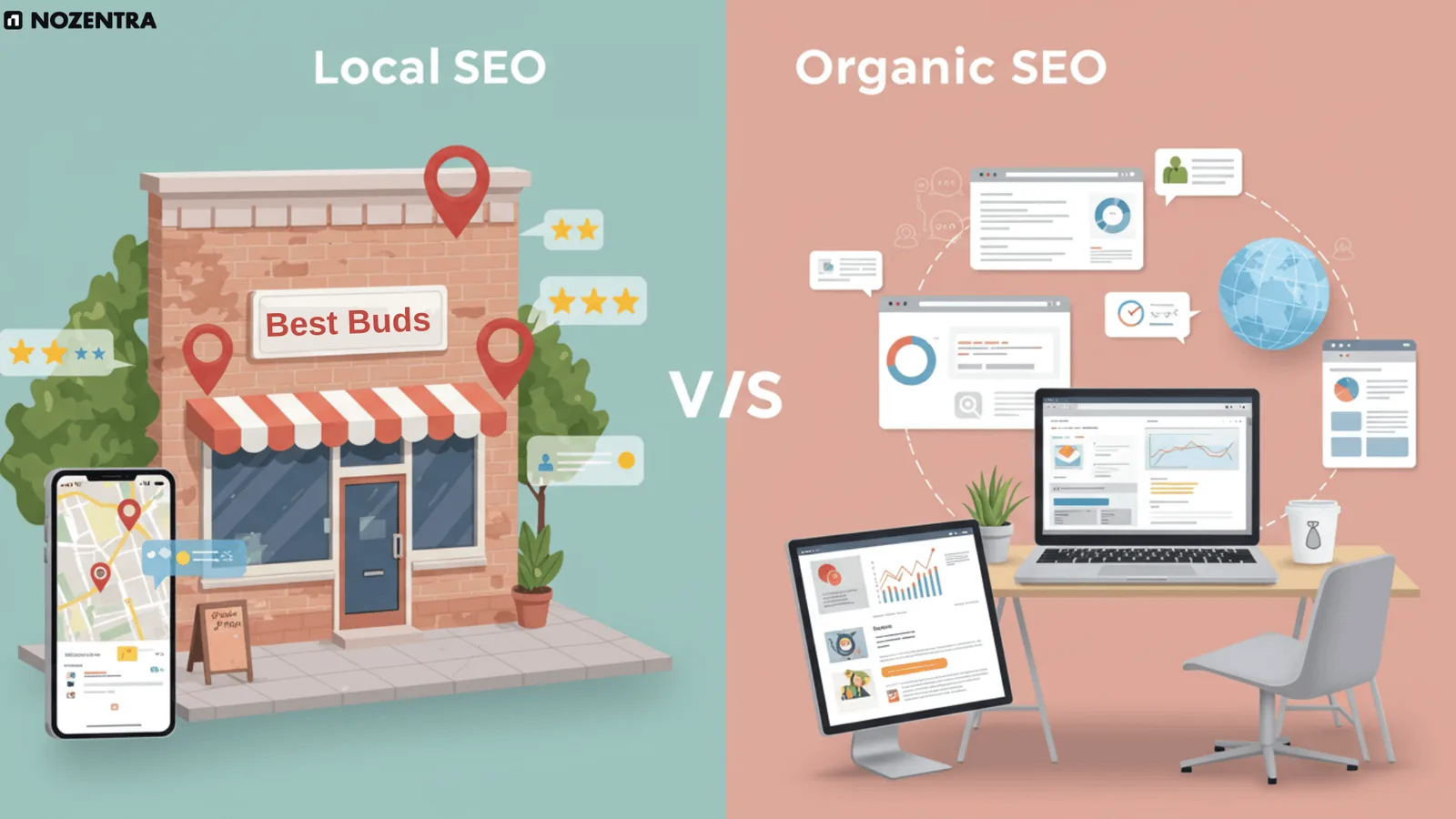
Local SEO helps your business appear in Google Maps and the map results for searches like "plumber near me". Organic SEO helps your web pages appear in the regular list of results below or around them.
They use different signals. Local results are built mainly from your Google Business Profile, your location and your reputation. Organic results are built from your website's pages, content and links. Most businesses that serve a local area need both, because the same search often shows both.
Key takeaways
Local SEO targets map results. Organic SEO targets web results. Many local searches show both on the same page.
Google ranks local results mainly on relevance, distance and prominence.
Links and reviews feed local rankings too. Google says prominence is based partly on how many websites link to your business and how many reviews you have.
You cannot pay for better local rankings. Google says so explicitly.
Your website supports both. In our work for a plumbing business, a new site with location pages plus Business Profile work lifted organic traffic by 500%.
How are local SEO and organic SEO different?
| Question | Local SEO | Organic SEO |
|---|---|---|
| Where you appear | Google Maps and the local map results in Search | The regular web results |
| What Google ranks | Your Google Business Profile | Individual pages on your website |
| Main signals | Relevance, distance and prominence, including reviews | Relevance to the search, content quality, links and page experience |
| Searcher's location | Central to what they see | Matters for some searches, irrelevant for others |
| Typical searches | "dentist near me", "electrician in Leeds" | "how to fix a leaking tap", "best CRM for small teams" |
| Competition | Businesses in the searcher's area | Any website that answers the search |
| Best suited to | Businesses serving customers in a place | Businesses whose customers can be anywhere, and any business publishing useful content |
How does Google rank local results?
Google's local ranking guidance is short and direct. Local results are "mainly based on relevance, distance, and popularity," described in three factors:
| Factor | Google's explanation | What you control |
|---|---|---|
| Relevance | How well a Business Profile matches what someone is searching for | Accurate categories, complete services, a clear description |
| Distance | How far each business is from the customer searching | An accurate address or service area |
| Prominence | How well known a business is, based partly on how many websites link to it and how many reviews it has | Reviews, replies to reviews, links and mentions from local sites |
Two statements from the same page are worth keeping in mind:
"There's no way to request or pay for a better local ranking on Google."
"More reviews and positive ratings can help your business's local ranking."
Google's Business Profile guidelines also matter. They ask businesses to represent themselves "as it's consistently represented and recognized in the real world," and to "choose the fewest number of categories it takes to describe your overall core business." Service-area businesses should have one profile for their central office with a designated service area.
How does Google rank organic results?
Organic ranking uses your website instead of your Business Profile. Google crawls, indexes and then serves pages, and its systems aim to show the most relevant, helpful and trustworthy results for each search.
The main levers:
Pages that match search intent, such as service pages for "hire" searches and guides for "how to" searches
Helpful content showing real experience and expertise
Links from relevant, credible sites
A technically healthy site that is fast, mobile-friendly and indexable
We break these parts down in what is the backbone of SEO, and which part should you fix first?
Which one does your business need?
| Your business | Priority | Why |
|---|---|---|
| Shop, restaurant, clinic or office customers visit | Local first, organic alongside | Map results drive visits and calls |
| Trade or home service covering an area | Local and organic equally | People search "near me" and search specific problems |
| Law, accounting or other professional firm | Both | Local for "near me" searches, organic for research-stage questions |
| Ecommerce store shipping nationally | Organic first | There is no local intent unless you also have a physical store |
| Software or online service | Organic | Customers can be anywhere |
| Multi-location business | Both, per location | Each location needs its own profile and page |
Why do most local businesses need both?
Because the same customer journey touches both. Someone might search "why is my hot water not working" (organic), then "hot water repair near me" (local), then check your reviews and website before calling.
Your website also strengthens your Business Profile. Google's own explanation of prominence includes how many websites link to your business, and a clear website helps both people and Google understand what you offer and where.
That is exactly how we approached VIP Plumbing in Australia:
| Work | Helps local | Helps organic |
|---|---|---|
| New WordPress website | Yes, as the destination from the Business Profile | Yes, as the foundation for ranking pages |
| Google Business Profile optimisation | Yes | Indirectly |
| Local citations in directories | Yes, prominence and consistency | Indirectly |
| Location-specific service pages | Yes, relevance for each area | Yes, ranking for area-based searches |
The result: organic traffic grew by 500%, ranked keywords grew from 95 to 156, and the business reached the top local position across multiple service areas.
What should a local SEO checklist include?
Claim and verify your Google Business Profile.
Choose accurate categories, using as few as describe your core business.
Add services, hours, photos and a clear description.
Set an accurate address, or a service area if you visit customers.
Keep your business name, address and phone number consistent on your website and major directories.
Ask every happy customer for a review, and reply to reviews, good and bad.
Build a page on your website for each main service and area, with genuinely local detail.
Earn links and mentions from local organisations, suppliers and press.
Structured data can help Google connect your website with your business details. A minimal example:
{
  "@context": "https://schema.org",
  "@type": "Plumber",
  "name": "Example Plumbing",
  "url": "https://www.example.com/",
  "telephone": "+61 2 5550 1234",
  "address": {
    "@type": "PostalAddress",
    "streetAddress": "12 Example Street",
    "addressLocality": "Parramatta",
    "addressRegion": "NSW",
    "postalCode": "2150",
    "addressCountry": "AU"
  },
  "areaServed": ["Parramatta", "Blacktown", "Penrith"]
}
Make sure every detail matches your Business Profile and what customers see on the page.
How do you measure each one?
| Measure | Local SEO | Organic SEO |
|---|---|---|
| Where to look | Google Business Profile performance | Google Search Console and GA4 |
| Visibility | Searches and views of your profile | Impressions and average position |
| Actions | Calls, direction requests, website clicks | Enquiries, sales and sign-ups from Organic Search |
| Reputation | Review count and average rating | Links and mentions earned |
For a step-by-step guide to appearing in both, read how do you get your website to show up on Google? If you want help with local or organic visibility, see our AI search visibility work or talk to us.
Frequently asked questions
Is local SEO easier than organic SEO?
It is often faster, because you compete only with nearby businesses. But it is not automatic: distance is outside your control, and prominence takes time to build through reviews and links.
Can I rank in local results without a website?
A Business Profile can appear in local results without a website. However, a website gives people more reasons to choose you, supports your prominence, and lets you rank in organic results too.
Does my address need to be visible to rank locally?
No. Service-area businesses that visit customers can hide their address and set a service area instead. Google's guidelines ask them to use one profile for their central location.
How long does local SEO take?
Improvements to your Business Profile can show within weeks, but reviews, links and location pages build results over months. Organic rankings for competitive searches usually take longer.