SEO (search engine optimisation) is the work that helps people find your business when they search. It matters because search is still where most people go when they have a need, and because the visibility it builds keeps working long after the work is done.
What has changed is how that visibility shows up. Rankings now sit alongside AI Overviews, AI Mode and assistants like ChatGPT. Good SEO today makes your business easy to find, easy to trust and easy to cite in all of them.
Key takeaways
Search still dominates traffic. In June 2025, Google Search sent 191 billion referrals to the top 1,000 websites, against 1.13 billion from all AI platforms combined.
Clicks are harder to earn. SparkToro found 68.01% of US Google searches ended without a click in early 2026.
Being cited in AI answers helps. Seer Interactive found pages cited in AI Overviews earn 120% more clicks per impression than uncited pages.
Google does not ban AI content. It rewards helpful, reliable content however it is produced.
SEO compounds. Our client results include 1,900% organic growth for a crane hire business and a fourfold increase in ranked keywords for an ecommerce brand.
Is search still worth investing in with AI answers everywhere?
Yes. AI platforms are growing fast, but from a much smaller base. Similarweb data reported by TechCrunch compared referrals to the top 1,000 websites in June 2025:
- Google Search191B
- All AI platforms combined1.13B
Source: Similarweb, via TechCrunch, 25 July 2025
AI assistants also draw on search indexes and well-structured web pages to build their answers. The work that makes a page rank well, such as clear answers, accurate facts and a site search engines can crawl, is largely the same work that makes it citable.
What has changed about SEO?
Fewer searches produce a click. SparkToro measured 68.01% of US Google searches ending without a click in the first four months of 2026, up from 60.45% in 2024.
When an AI Overview appears, being cited in it matters. Seer Interactive's 2026 study of 5.47 million queries found cited pages earn 120% more organic clicks per impression than uncited ones.
So the goal has shifted from "rank for keywords" to "be the most useful, trustworthy answer for the questions your customers ask." We explain how AI systems pick sources in how AI search engines decide which pages to use.
How does Google decide what to show?
Google's guide to how Search works describes three stages, and "not all pages make it through each stage":
| Stage | What happens | What stops pages getting through |
|---|---|---|
| Crawling | Google discovers pages and downloads their content | Blocked pages, broken links, pages with no internal links |
| Indexing | Google analyses the content and stores it | Thin or duplicate content, noindex tags, poor rendering |
| Serving | Google shows the most relevant results for a search | Content that does not match intent or lacks trust signals |
Google also states that it "doesn't accept payment to crawl a site more frequently, or rank it higher."
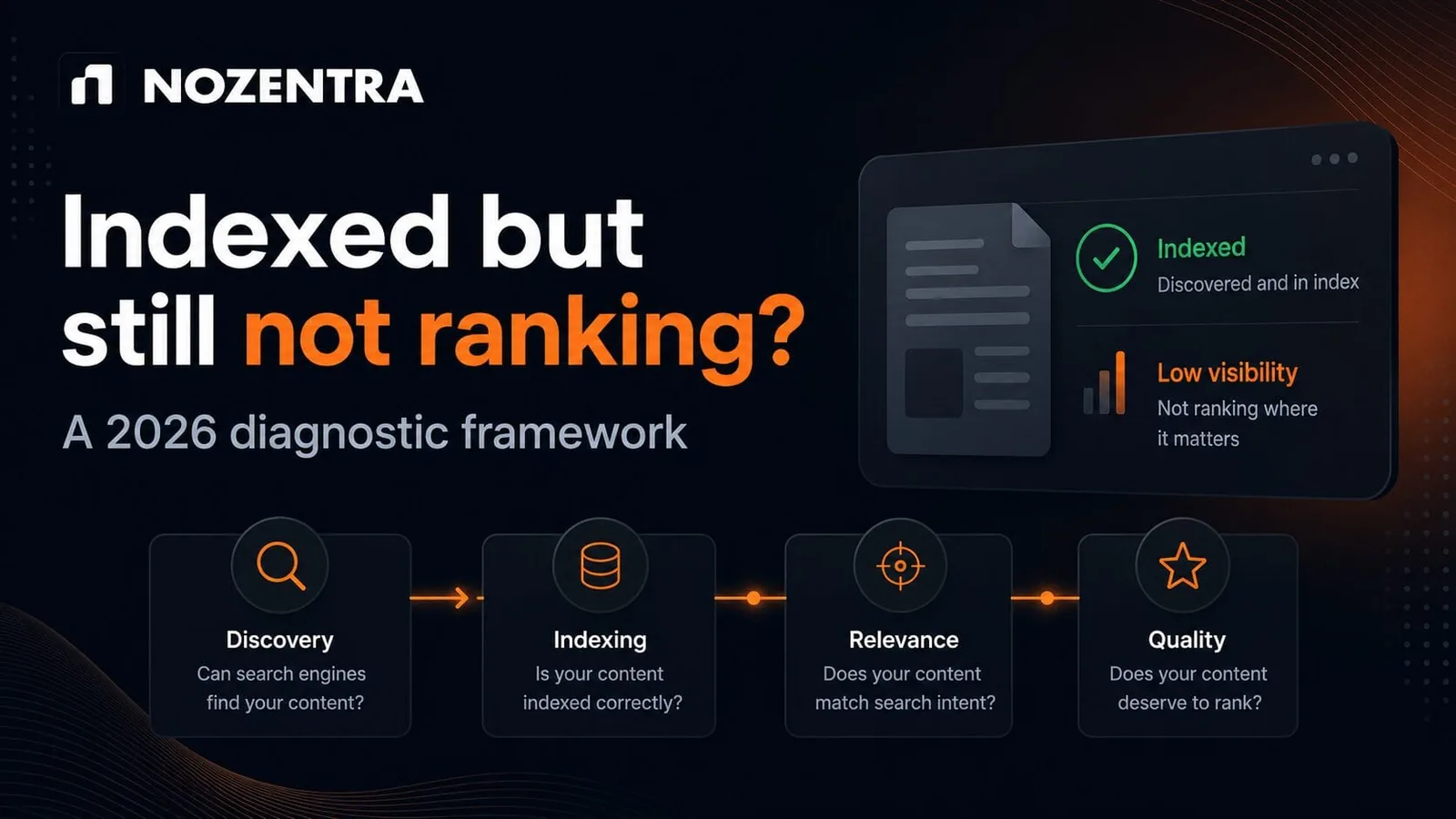
If your pages are indexed but still not appearing, read why indexed pages do not rank.
What does SEO actually involve?
| Area | What it covers | Why it matters to the business |
|---|---|---|
| Technical SEO | Crawlability, speed, Core Web Vitals, mobile experience, structured data | Pages that cannot be crawled or load slowly never get the chance to win |
| Keyword and intent research | What customers search for, and what they expect to find | Makes sure pages match real demand |
| On-page SEO | Titles, headings, internal links, clear answers | Helps search engines and AI systems understand each page |
| Content | Service pages, guides, comparisons, FAQs | Gives people reasons to trust, link to and choose you |
| Authority | Links, reviews, mentions and citations from credible sources | Signals that others vouch for you |
| Local SEO | Google Business Profile, location pages, consistent business details | Wins "near me" and area-based searches |
Does AI-written content hurt SEO?
Not by itself. Google's guidance on AI-generated content says: "Appropriate use of AI or automation is not against our guidelines." What breaks the rules is using it "to generate content primarily to manipulate search rankings."
Google's systems aim to reward content that shows E-E-A-T: experience, expertise, authoritativeness and trustworthiness. Its helpful content guidance suggests asking "Who, How, and Why" about every page: who created it, how it was made, and why it exists.
In practice, AI is useful for research, outlines and drafts. Real experience, accurate facts and a clear point of view still have to come from people who know the subject. We cover that balance in how to use AI in content with human ownership.
What do SEO results look like in practice?
Here are four results from our own client work, each with a different starting point:
| Client | Business | What we focused on | Result |
|---|---|---|---|
| Druids | UK ecommerce | Technical audit first, then keyword mapping, on-page work and links | Ranked keywords grew from 12,800 to 52,300 in 12 months; organic became the largest traffic channel |
| Knowles Cranes | Australian crane hire | Pages for each crane type and service area, matched to hire intent | 1,900% organic growth; ranked keywords grew from 101 to 240 |
| VIP Plumbing | Australian plumber | New WordPress site, Google Business Profile, citations and location pages | 500% organic growth; top local position across multiple areas |
| THACS | Heating and cooling | Expanded service and location coverage without repetitive pages | Keyword visibility up 4.3 times; organic traffic up 41% |
- Knowles Cranes1,900%
- VIP Plumbing500%
- THACS41%
Source: Nozentra case studies: Knowles Cranes, VIP Plumbing and THACS
None of these came from shortcuts. Each started by fixing what was stopping search engines understanding the site, then built pages around what customers were actually searching for. You can read the full stories for Druids, Knowles Cranes, VIP Plumbing and THACS.
How is SEO different from paid ads?
| Question | SEO | Paid search ads |
|---|---|---|
| Speed | Months to build | Traffic within hours |
| Cost per click | None | Every click is paid for |
| When you stop | Visibility declines slowly | Traffic stops immediately |
| Trust | Earned placement | Labelled as an ad |
| Best for | Long-term, compounding visibility | Immediate demand and testing |
Most businesses benefit from both. For a deeper comparison, read should you invest in SEO or broader digital marketing?
Where should a small business start?
Check that Google can crawl and index your key pages in Search Console.
Claim and complete your Google Business Profile if you serve a local area.
Build one clear page per service, and one per location where it makes sense.
Answer the questions customers ask on those pages, in plain language.
Ask happy customers for reviews and reply to them.
Earn mentions from real local and industry sources, never bought links.
Measure enquiries and sales from organic search, not just rankings.
For the difference between local and organic work, see what is the difference between local SEO and organic SEO? If you want a plan for your market, see our AI search visibility work or talk to us.
Frequently asked questions
How long does SEO take to show results?
Usually months. Technical fixes and local improvements can show early movement, while competitive rankings and authority take longer. Druids' keyword growth, for example, was measured over 12 months.
Is SEO worth it for a small local business?
Often more than for anyone. Local searches have clear intent, and a well-built Google Business Profile plus strong service and location pages can win enquiries from nearby customers without paying for every click.
Can I pay Google to rank higher?
No. Google says it does not accept payment to crawl a site more often or rank it higher. Paid ads can appear above organic results, but they are labelled as ads.
Is SEO being replaced by AI search?
No. AI answers change how visibility works, but they rely on content that is crawlable, clear and trustworthy. Search still sends vastly more traffic than AI platforms.
Sources
TechCrunch: AI referrals to top websites were up 357% year-over-year in June, reaching 1.13B (25 July 2025)
SparkToro: In 2026, less than one third of Google searches still send a click (8 June 2026)
Seer Interactive: AIO Impact on Google CTR, 2026 Update (April 2026)
Google Search Central: In-depth guide to how Google Search works
Google Search Central Blog: Google Search's guidance about AI-generated content (8 February 2023)
Google Search Central: Creating helpful, reliable, people-first content
Nozentra case studies: Druids, Knowles Cranes, VIP Plumbing, THACS